

Amniotic Fluid
ORIGIN OF AMNIOTIC FLUID:
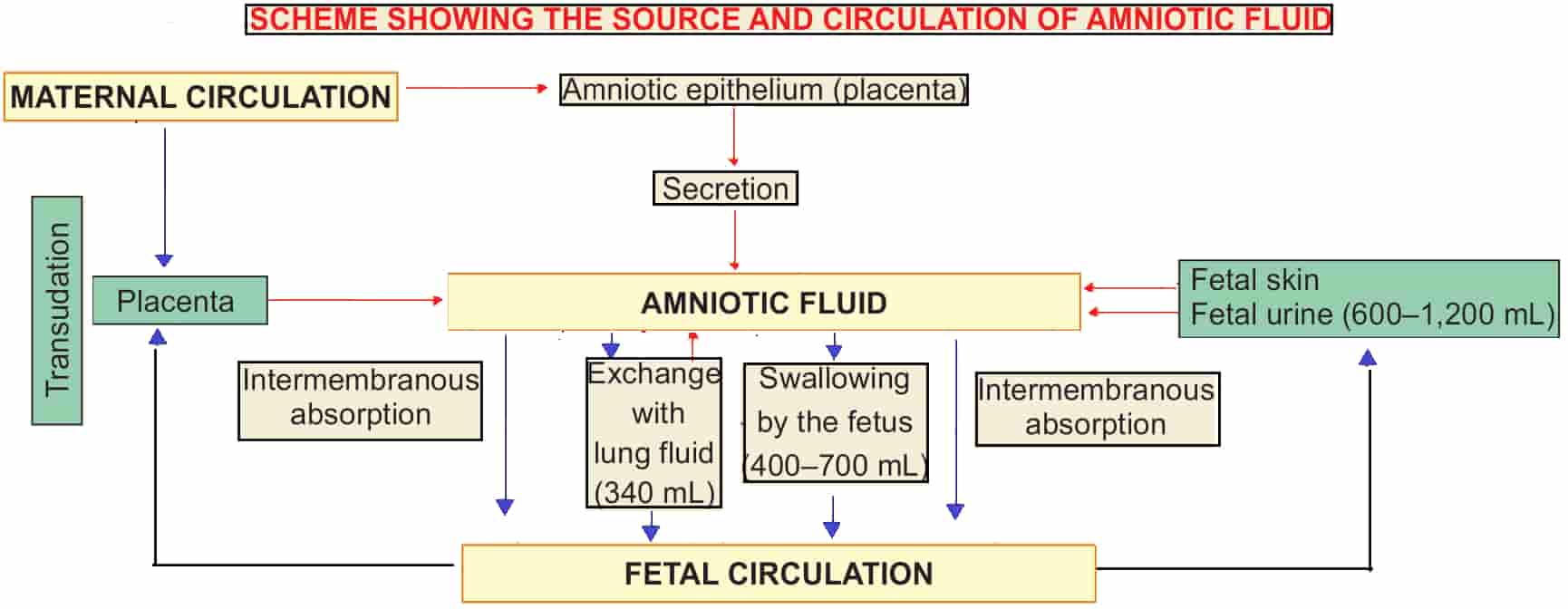
- The precise origin of the liquor amnii is mixed maternal and fetal origin.

CIRCULATION:
- The water in the amniotic fluid is completely changed and replaced in every 3 hours
- The presence of lanugo and epithelial scales in the meconium shows that the fluid is swallowed by the fetus and some of it passes from the gut into the fetal plasma
- The major contribution of the amniotic fluid after 20 weeks of gestation is Fetal urine
VOLUME:
| Gestational Age | Volume |
| 12 weeks | 50 mL |
| 20 weeks | 400 mL |
| 36–38 weeks | 1 liter |
| At term | 600–800 mL |
| Post term pregnancy(43 weeks) | 200 mL |
PHYSICAL FEATURES:
- Alkalinity:pH:7.0 – 7.5
- Specific gravity of 1.010
- Osmolarity of 250 mOsmol/L
- Color:
| COLOR | CAUSE |
| Pale straw | Exfoliated lanugo and epidermal cells from the fetal skin |
| Turbid | Vernix caseosa. |
| Meconium stained (green) |
Fetal distress in presentations other than the breech or transverse
Thick with presence of $akes suggests chronic fetal distress |
| Golden color | Rh incompatibility |
| Greenish yellow (safron) | Post maturity |
| Dark colored | Concealed accidental hemorrhage |
| Dark brown (tobacco juice) | IUD due to old HbA. |
COMPOSITION:
The composition includes:
- Water 98–99%
- Solid (1–2%)
The following are the solid constituents:
Organic:
| Constituents | Amount |
| Protein | 0.3 mg% |
| NPN | 30 mg% |
| Total lipids | 50 mg% |
| Glucose | 20 mg% |
| Uric acid | 4 mg% |
| Hormones (prolactin, insulin and renin) | – |
| Urea | 30 mg% |
| Creatinine | 2 mg% |
Inorganic constituents:
- Sodium, chloride :same as that found in maternal blood but declines As pregnancy advances due to dilution by hypotonic fetal urine
- Potassium is almost the same & remains unaltered
- Surfactant synthesis occurs in 24th week of gestation, it appear in amniotic fluid in 30-32th week of gestation
Suspended particles include:
- Lanugo
- Exfoliated squamous epithelial cells from the fetal skin
- Vernix caseosa
- Cast off amniotic cells
- Cells from the respiratory tract, urinary bladder and vagina of the fetus.
FUNCTIONS:
During pregnancy:
- Shock absorber
- Maintains even temperature
- Distends the amniotic sac and thereby allows for growth and free movement of fetus
- Water supply to the fetus
During labor:
- Hydrostatic wedge:Forms by amnion and chorion combination that Dilates wedge
- Prevents marked interference with the placental circulation
- Guards against umbilical cord compression
- Flushes the birth canal at the end of first stage of labor
- Aseptic and bactericidal action
CLINICAL IMPORTANCE:
- Provides Useful information about the well being and maturity of the fetus
- For lung maturity is Phosphtidyl glycerol estimation
- Presence of acetylcholinesterase (AChE) in the amniotic fluid is seen in cases of fetal open neural tube defects (NTD)
- The ratio of AChE to pseudocholinesterase (PChE):
- Ratio greater than 0.15 – open spna bifida
- Ratio less than 0.10 – ventral wall defect
- Skin maturity:Lipid containing cells in the amniotic fluid as detected by Nile Blue sulphate
- Amniocentesis is done during 16th week of pregnancy
- Intrauterine death:Increased alpha fetoprotein in amniotic fluid
- Lendrum’s stain is done for Amniotic fluid embolism
- Intra-amniotic instillation of chemicals is used as method of induction of abortion
- Excess or less volume of liquor amnii is assessed by amniotic fluid index (AFI) .
- It is measured to diagnose the clinical condition of polyhydramnios or oligohydramnios respectively
- It is calculated by adding the vertical depths of the largest pocket in each of four equal uterine quadrants
- Fluid restriction may lower the AFI
- Significant hydramnios is defined by an index greater than 24 cm
-
Peak AFI is seen at approximately 32 weeks followed by a steady decline until 42 weeks.
- Rupture of the membranes with drainage of liquor is a helpful method in induction of labor
Exam Important
- Best method for the diagnosis of lung maturity is Phosphtidyl glycerol estimation in amniotic fluid
- The presence of increased levels of Acetyl cholinesterase in amniotic fluid is an indicator of open neural tube defect in the fetus
- Nile blue sulphatase test in amniotic fluid is for Skin maturity
- Amniotic fluid contains acetyl cholinesterase enzyme can be a diagnosis of Open spina bifida
- Amniotic fluid is maximum at 38 weeks of pregnancy
- Amniotic fluid index (AFI) is calculated by adding the vertical depths of the largest pocket in each of four equal uterine quadrants
- Fluid restriction may lower the AFI
- Significant hydramnios is defined by an index greater than 24 cm
- Prenatal diagnosis at 16 weeks of pregnancy can be performed using Amniotic fluid
- The amount of amniotic fluid at 12 weeks of pregnancy is 50 ml
- Amniotic fluid at 38 weeks in normal pregnancy is 800 cc
- pH range of amniotic fluid is 7.0 – 7.5
- pH of amniotic fluid at later weeks of gestation is 7.2
- Golden colour amniotic fluid is seen in Rh incompatibility
- The amniotic fluid is completely replaced in every 3 hours
- The major contribution of the amniotic fluid after 20 weeks of gestation is Fetal urine
- At 15 weeks of gestation, increased alpha fetoprotein in amniotic fluid is seen in Intrauterine death
- Risk of amniotic fluid embolism is greatest During labour
- Amniotic fluid is mainly produced by Fetus
- Surfactant appears in amniotic fluid at the gestational age of 32 weeks
- The amniotic fluid is in balance by Excretion by fetal kidneys, Maternal hemostasis & Fetal intestinal absorption
- Antenatal screening is done using Cord blood, Amniotic fluid & Chorionic villi
- Lendrum’s stain is done for Amniotic fluid embolism
Don’t Forget to Solve all the previous Year Question asked on Amniotic Fluid
Click Here to Start Quiz
Click Here to Start Quiz

