

FRACTURE SHAFT OF FEMUR
FRACTURE SHAFT OF FEMUR
- One of the major long bone fractures.
- The narrowest portion of the shaft is known as isthmus.
- The bone is highly vascular.
- Surrounded all round by strong muscles of the thigh.
- Heavy blood loss up to 1.5 liters can occur.
- Patient may go in for hypovolemic shock.


Mechanism of Injury
- May occur in a road accident.
- The force causing the fracture may be:
- Indirect (twisting or bending force) or
- Direct (traffic accidents)
PATHOANATOMY
- The fracture may occur at any site.
- Common in the upper, middle and lower thirds of the shaft.
- Types of Fracture Femur
- Transverse fracture
- Oblique fracture
- Spiral fracture
- Comminuted fracture
- Segmental fracture
Clinical features:
- History of severe violence.
- Classic signs of fracture in the region of the thigh:
- Pain
- swelling
- Deformity
- abnormal mobility etc
- Diagnosis is not difficult.
Radiological examination:
- X-rays done for a femoral shaft fracture must include the whole femur.
- In addition, an X-ray of the pelvis should be done.
- X-rays help in identifying the type and level of fracture
- As well as the diameter of the medullary canal.
Investigations
- Hb%,
- PCV and
- blood grouping and cross-matching is a must
TREATMENT
Conservative methods:
1. Traction
- Treated by traction, with or without a splint.
- Usually a Thomas splint is used.
2. Hip spica
- This is a plaster cast incorporating part of the trunk and the limb.
- It may be a single spica or one-and-a-half.


Operative methods:
- Intra-medullary nailing is the preferred method.


- The fracture may be reduced by closed or open methods.
- Closed Interlock nailing
- Plating (fixing with a thick strip of metal)

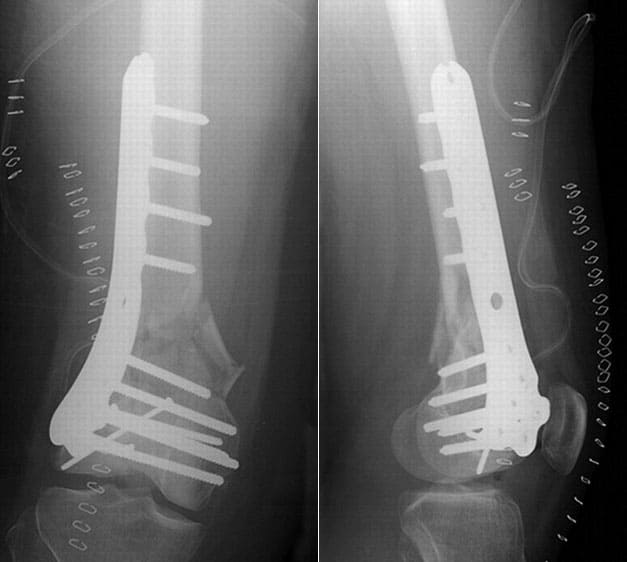
DECIDING TREATMENT PLAN
- In children, treatment is mostly by non-operative methods.
- The technique of traction varies in different age groups.
1. From birth to 2 years:
- Treated by Gallow’s traction.


2. From 2 years to 16 years:
- Conservative treatment.
- Different methods of traction are used (Russel traction).
- In older children (more than 10 yrs. of age), TENS (Titanium Elastic Nail System) nails are used.
COMPLICATIONS
EARLY COMPLICATIONS:
- Shock
- Fat embolism
- Injury to femoral artery
- Injury to sciatic nerve
- Infection
LATE COMPLICATIONS:
- Delayed union
- Non-union
- Malunion
- Knee stiffness
Exam Important
- Thomas splint is used for immobilizing fractures of Femur.
- Fracture shaft of femur in adult unites by 3 to 4 months.
- Fracture shaft of femur in children of less than 2 years old is treated by Gallow’s traction.
- Best way to treat a fracture neck of femur in a child is Hip Spica in abduction and internal rotation.
- Treatment of shaft femur fracture in a 3 years old boy by Russel traction.
- Best treatment of 3 weeks old, fracture shaft femur with nonunion is Bone graft with internal fixation.
- Treatment of Non-union of # shaft femur Bone grafting with internal fixation with K-Nail.
- Treatment of choice for old non-united fracture of shaft of femur is Compression plating with bone grafting.
- Intramedullary fixation is ideal in a case of fracture of shaft of femur when there is A transverse fracture.
- Fracture of femur at the level of isthmus is best treated by Intramedullary nail fixation.
Don’t Forget to Solve all the previous Year Question asked on FRACTURE SHAFT OF FEMUR
Click Here to Start Quiz
Click Here to Start Quiz

