

Question


| A. |
The movement of fewer sodium ions across the cell membrane |
| B. |
The calcium channels remaining open longer than the sodium channels |
| C. |
The increased membrane permeability to potassium ion |
| D. |
A decrease in the amount of calcium diffusing across the membrane |

|
Correct Answer � B Explanation |
 |

Ans: B.)The calcium channels remaining open longer than the sodium channels.
Action potential of cardiac muscles:

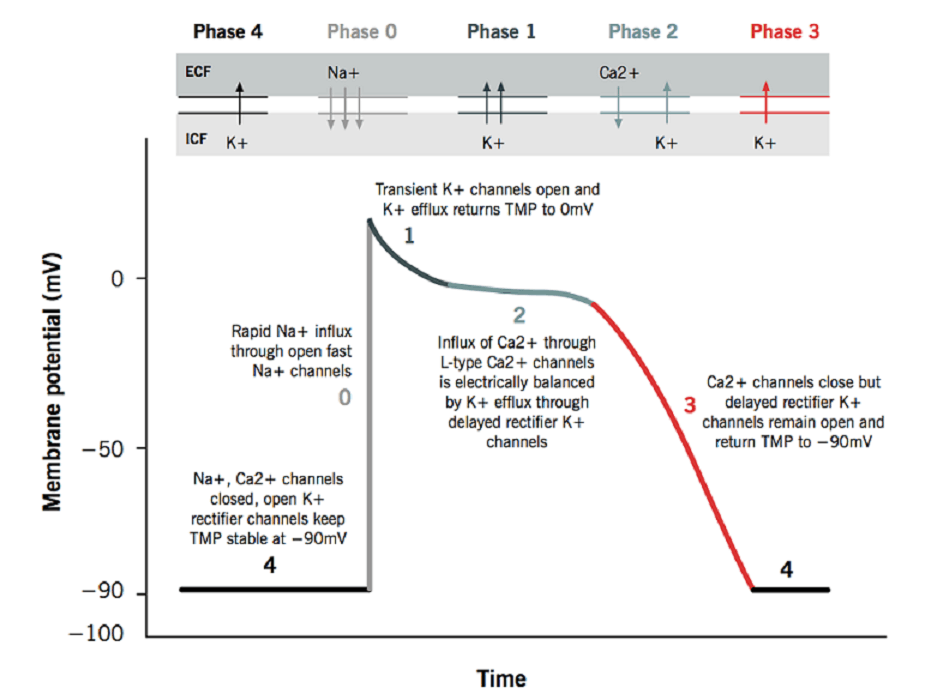
Phase 2 / “Plateau phase”:
* Calcium channels open and fast potassium channels close.
* A brief initial repolarization occurs.
* Action potential then plateaus as a result of,
– Increased calcium ion permeability
– Decreased potassium ion permeability.
Events during phase 2:
* The voltage-gated calcium ion channels open slowly during phases 1 and 0, and calcium enters the cell. Potassium channels then close, and the combination of decreased potassium ion efflux and increased calcium ion influx causes the action potential to plateau
Note on other phases:
1. Phase 0 / Depolarization:
* Fast sodium channels open.
* When the cardiac cell is stimulated and depolarizes, the membrane potential becomes more positive.
* Voltage-gated sodium channels (fast sodium channels) open and permit sodium to rapidly flow into the cell and depolarize it.
* The membrane potential reaches about +20 millivolts before the sodium channels close.
* Cellular repolarization starts, and potassium ions leave the cell through open potassium channels.
* Calcium channels close and slow potassium channels open.
* The closure of calcium ion channels and increased potassium ion permeability.
* This permits potassium ions to rapidly exit the cell, ends the plateau and returns the cell membrane potential to its resting level.
4. Phase 4 / “Resting membrane potential”:
* Averages about “−90 millivolts”