

Question
Identify this skin condition:
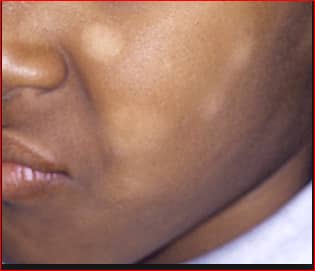

| A. |
Pityriasis Versicolor |
| B. |
Pityriasis Alba |
| C. |
Vitiligo |
| D. |
Tinea Facei |
Show Answer


|
Correct Answer � B Explanation |
 |

Ans:B.)Pityriasis Alba.
PITYRIASIS ALBA
- Pityriasis alba appears as poorly marginated, light patches on pigmented skin .
- Sometimes there is fine superficial scaling – hence the term pityriasis.
- Many patients are children with atopic dermatitis elsewhere.
- Other provokers of pityriasis alba are bites, sunburn (even among the dark-skinned), mechanical irritation from scrubbing, or other forms of eczematous dermatitis.
- Diagnosis:
- A workup, as follows, may be undertaken to exclude other causes of hypopigmentation:
- Wood’s light examination: May help in determining the presence of vitiligo, which will glow more brightly and have edges with sharper demarcation
- Potassium hydroxide (KOH) stain of a skin scraping: Will be positive if the patient has tinea versicolor (also called pityriasis versicolor), tinea faciei, or tinea corporis
- Skin biopsy: Not usually necessary or particularly helpful in establishing a diagnosis of pityriasis alba but may be indicated if a diagnosis of mycosis fungoides (cutaneous T-cell lymphoma) is a significant possibility.
- In vitiligo, the spots are much whiter, much more sharply marginated and always without scaling.
- Pityriasis versicolor is also more sharply marginated and is usually scaly. Sarcoidosis and leprosy should also be kept in mind.
- Treatment:
- No treatment is required and the patches in time will settle.The redness, scale and itch if present may be managed with simple emollients and sometimes hydrocortisone, a weak steroid, is also used.