

Question
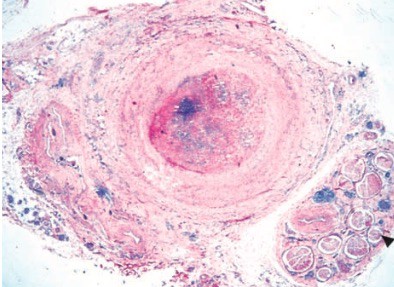
A 45-year-old man presents with pain in the legs upon exercise and destruction of the tips of his fingers. He has a history of smoking. Laboratory values include hemoglobin of 16g/dL, WBC of 8,500/μL, serum cholesterol of 220 mg/dL, fasting blood sugar of 90 mg/dL, and negative tests for antinuclear antibodies. The biopsy of the affected area is shown in the image. What is the appropriate diagnosis?

| A. |
Takayasu arteritis
|
| B. | Kawasaki disease |
| C. |
Polyarteritis nodosa |
| D. |
Buerger disease |
Show Answer


|
Correct Answer � D Explanation |
 |

Ans.D. Buerger disease
- The histopathological image shown in the question suggests Buerger’s disease.
- Buerger disease (Thromboangiitis obliterans) is an occlusive inflammatory disease of medium and small arteries of the distal arms and legs.
- The etiologic role of smoking has been emphasized by the observation that cessation of smoking can be followed by remission.
- The microscopic examination of affected vessels shows polymorphonuclear infiltrate extending to neighboring veins and nerves. Inflammation of the endothelium is associated with thrombosis and obliteration of the affected vessels.
- The other choices are not associated with smoking and do not exhibit these characteristic histologic findings.