

Question
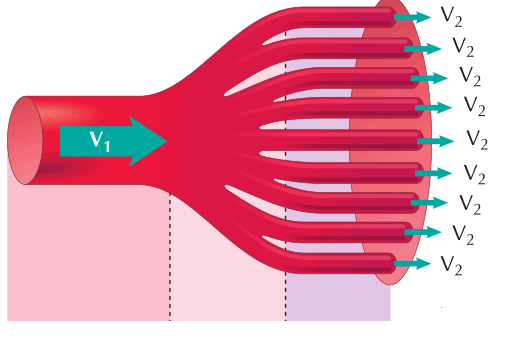
What is the relative velocity of fluid in the large tube (V 1 ) compared with the velocity of the fluid in one of the small tubes (V 2 ), assuming that each of the nine small tubes has a cross-sectional area equal to one-ninth the area of the large tube?

| A. |
V1 = V2 |
| B. |
V1 < V2 |
| C. |
V1 > V2 |
| D. |
V1:V2 = 0 |
Show Answer


|
Correct Answer � A Explanation |
 |

Ans. A. V1 = V2
- Velocity of flow in the large tube (V 1 ) is the same as velocity of flow in each of the small tubes (V 2 ).
- Q = vA
- or rearranging,
- v = Q / A
- where Q is flow, v is velocity, and A is cross-sectional area.
Note:
- The equation can only be used to compare velocities based on cross-sectional area when the flow rate (or relative flow rate) is known.
- In the cardiovascular system (B), velocity is greatest in the aorta and large arteries, where total cross-sectional area is smallest; velocity is lowest in the capillaries, where the total cross-sectional area is greatest.