

Question
| A. | Paralysis of the abductor pollicis brevis muscle |
| B. |
Osteoarthritis of the radiocarpal joint |
| C. |
Hypesthesia of the hypothenar eminence |
| D. |
Avascular necrosis of the lunate bone |


|
Correct Answer � B Explanation |
 |

Answer B) Osteoarthritis of the radiocarpal joint
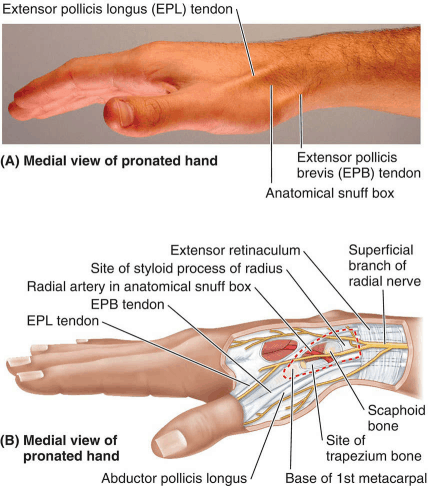
The region between the tendons of extensor pollicis longus and extensor pollicis brevis is called the anatomical snuff box.

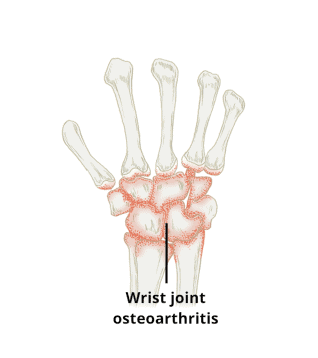
Osteoarthritis of the radiocarpal joint
Decreased grip strength with pain in the anatomical snuffbox suggests a scaphoid fracture, which is typically caused by falling onto an outstretched hand.
The scaphoid bone, which is one of the carpal bones that forms the radiocarpal joint, receives its blood supply from an end artery that runs in a distal to proximal direction.
A fracture of scaphoid can damage this artery and cause avascular necrosis of the proximal segment.
Avascular necrosis of the scaphoid increases the risk of osteoarthritis of the radiocarpal joint.
The initial x-ray in the case of scaphoid fracture can be normal. Therefore, patients with a normal x-ray should be followed up with a repeat x-ray after 2 weeks or an MRI if a scaphoid fracture is strongly suspected.


Paralysis of the abductor pollicis brevis muscle
Paralysis of the abductor pollicis brevis is a feature of median nerve palsy, which can occur following a fall on the hand due to compression of the median nerve within the carpal tunnel by a dislocated lunate.
However, lunate dislocation would cause swelling in the wrist with restriction of the range of motion, and the dislocated lunate would be clearly visible on x-ray.
This patient with pain in the anatomical snuffbox and a normal initial x-ray most likely has a different injury.
Avascular necrosis of the lunate bone
Avascular necrosis of the lunate is seen in Kienbock disease, a condition that is associated with repetitive impact to the hand (e.g., playing volleyball).
This patient with pain in the anatomic snuff box after acute trauma is most likely to develop avascular necrosis of the scaphoid, not the lunate.
Hypesthesia of the hypothenar eminence
Hypesthesia of the hypothenar eminence is a feature of ulnar nerve palsy, which can occur following a fall on the hand due to compression of the ulnar nerve by a fractured hook of hamate.
Hook of hamate fractures can cause decreased grip strength, and the initial wrist x-ray can be normal in anteroposterior and lateral views.
However, patients with a hook of hamate fracture would have tenderness on the palmar surface of the hand at the site of the hamate. This patient with pain in the anatomical snuffbox (dorsal surface of the hand) most likely has a different injury.