Question
| A. | Popliteal vein to small saphenous vein |
| B. |
Anterior tibial vein to popliteal vein |
| C. |
Great saphenous vein to femoral vein |
| D. |
Femoral vein to external iliac vein |


|
Correct Answer � A Explanation |
 |

Answer A) Popliteal vein to small saphenous vein
Explanation: Distended and tortuous veins in both legs, ankle edema, and skin changes on the medial ankle indicate chronic venous disease.
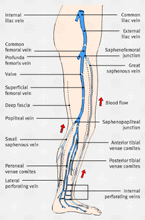
Popliteal vein to small saphenous vein
-
Venous blood flowing from the deep popliteal vein to the superficial small saphenous vein indicates retrograde blood flow and confirms the diagnosis of chronic venous disease.
-
Normally, the small saphenous vein would arise from the dorsal venous arch and drain into the popliteal vein at the saphenopopliteal junction.
-
In a patient with chronic venous disease, however, incompetence of the venous valves caused by elevated venous pressure (e.g., due to pregnancy, increased BMI, prior thrombosis) leads to blood reflux from deep into superficial veins.
-
This results in the formation of varicose veins, and ultimately edema and skin changes (e.g., stasis dermatitis), as seen in this patient. First-line treatment consists of conservative measures such as leg elevation, compression therapy, and application of topical dermatologic agents.