Question
| A. | Greater trochanter |
| B. |
Iliotibial band |
| C. |
Femoral head |
| D. |
Lateral femoral cutaneous nerve |


|
Correct Answer � A Explanation |
 |

Answer A) Greater trochanter
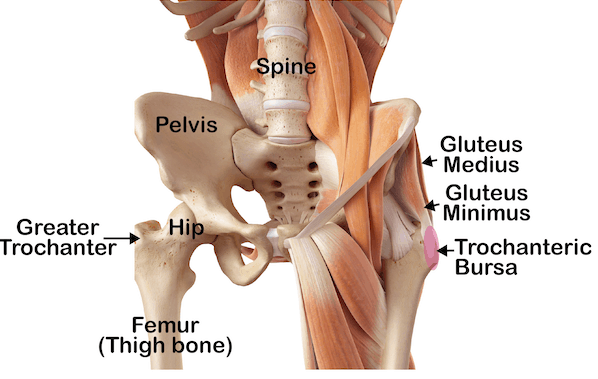
Lateral hip tenderness that is exacerbated by lying on the affected side and triggered by resisted adduction is consistent with tendinopathy involving the area where the gluteus muscles attach to the hip.
Greater trochanter
-
This patient likely presents with greater trochanteric pain syndrome, which results from tendinopathy at the attachment of the gluteus medius and/or minimus muscle.
-
It manifests with lateral thigh or hip pain near the great trochanter.
-
Typical findings include tenderness to palpation over the greater trochanter, exacerbation of pain when lying on the affected side, and triggering of pain by resisted adduction, all of which are present in this patient.
-
X-ray is usually normal and essentially rules out bone involvement.
-
Treatment measures of greater trochanteric pain syndrome include relative rest, heat pads, NSAIDs, and stretching and strengthening exercises.