

Question
| A. | Amygdala |
| B. |
Ventral posterolateral nucleus |
| C. |
Nucleus accumbens |
| D. |
Hippocampus |


|
Correct Answer � D Explanation |
 |

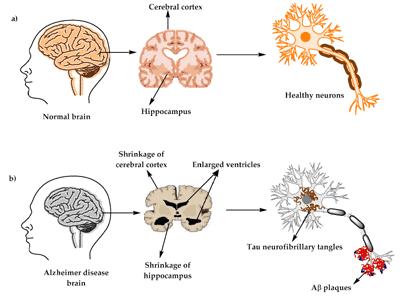
Answer D) HippocampusShort-term memory loss is often the earliest sign of Alzheimer disease, the most common cause of progressive dementia in the United States.
Hippocampus
-
The earliest sites of neurodegeneration in Alzheimer disease are structures in the medial temporal lobe such as the hippocampus and parahippocampal cortex, which are critical for memory formation.

Amygdala
-
The amygdala is a structure of the limbic system that plays a role in the processing of emotions.
-
Involvement of the amygdala in Alzheimer disease causes emotional lability, depression, and/or anhedonia.
-
Damage to a different structure would more likely explain the short-term memory loss in this patient with a normal affect.
-
Bilateral damage to the amygdala results in Klüver-Bucy syndrome, which is characterized by emotional lability, anxiety, hypersexuality, hyperorality, and hyperphagia.
Ventral posterolateral nucleus
-
The ventral posterolateral nucleus is a structure of the thalamus involved in relaying sensory input from the spinothalamic tract and dorsal column to the primary somatosensory cortex.
-
This nucleus does not play a role in memory formation and is not affected in early Alzheimer disease.
-
The medial dorsal nucleus of the thalamus and the anterior thalamic nucleus are involved in memory formation.
Nucleus accumbens
-
The nucleus accumbens is a basal forebrain structure that has a role in the reward pathway. This structure does not play a major role in semantic (factual) recall.
-
Degeneration of other basal forebrain structures such as the nucleus basalis of Meynert can cause memory loss and cognitive decline in Alzheimer disease.
-
Decreased GABA secretion by the nucleus accumbens is seen in Huntington disease and anxiety disorders.