

Question
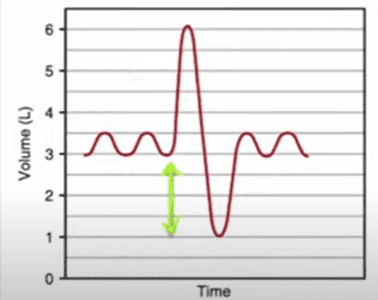
Spirometer recording was given in the following diagram. The part marked with the arrow, indicates-
| A. | Residual volume |
| B. |
FRC |
| C. |
ERV |
| D. |
Residual Volume |
Show Answer


|
Correct Answer � C Explanation |
 |


Correct Answer: C. Expiratory Reserve Volume (ERV)
Explanation of the Diagram:
In the spirometry image:
-
The arrow points downward from the end of a tidal breath to a lower volume, but not all the way to the base.
-
This arrow does not reach the Residual Volume (RV) line — it stops at the bottom of ERV.
ERV (Expiratory Reserve Volume):
-
It is the additional volume of air that can be forcibly exhaled after normal tidal expiration.
-
The area it covers is above Residual Volume.
| Parameter | Definition | Measured by Spirometry |
|---|---|---|
| Tidal Volume (TV) | Air in/out during quiet breathing | Yes |
| Inspiratory Reserve (IRV) | Extra inhalation after normal inspiration | Yes |
| Expiratory Reserve (ERV) | Extra exhalation after normal expiration | Yes |
| Residual Volume (RV) | Air remaining after maximal exhalation | No (requires helium dilution/body plethysmography) |
| Vital Capacity (VC) | TV + IRV + ERV | Yes |
| Functional Residual Capacity (FRC) | ERV + RV | No |
| Total Lung Capacity (TLC) | VC + RV | No |