

Question
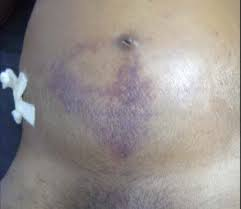
A 45-year-old man presents with severe abdominal pain and hypotension. On examination, the image shows bluish discoloration around the umbilicus. What is the most likely diagnosis?

| A. | Necrotizing fasciitis |
| B. |
Acute pancreatitis |
| C. |
Chronic pancreatitis |
| D. |
Traumatic fat necrosis |
Show Answer


|
Correct Answer » B Explanation |
 |

The image demonstrates:
- Bluish-purple ecchymosis around the umbilicus.
- This finding is known as Cullen’s sign.
- Cullen’s sign results from intraperitoneal or retroperitoneal hemorrhage, with blood tracking along the falciform ligament to the periumbilical subcutaneous tissue.
- It is a classical sign of hemorrhagic acute pancreatitis, although it may also rarely occur in ruptured ectopic pregnancy, ruptured abdominal aortic aneurysm, or abdominal trauma.

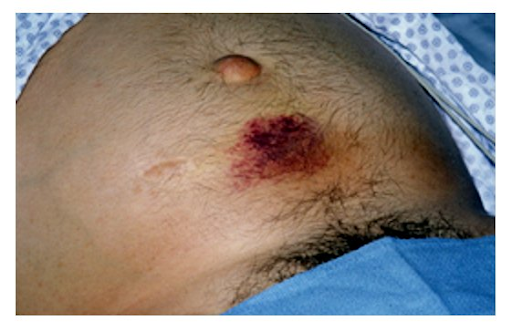
Acute pancreatitis is an acute inflammatory condition of the pancreas caused by premature activation of pancreatic enzymes, leading to autodigestion of pancreatic tissue.
The combination of:
- Severe epigastric abdominal pain
- Hypotension
- Cullen’s sign
strongly suggests severe hemorrhagic acute pancreatitis.
B. Acute pancreatitis
Supporting features include:
- Acute onset of severe abdominal pain
- Hypotension indicating severe disease
- Cullen’s sign indicating retroperitoneal hemorrhage
- Typical presentation of hemorrhagic pancreatitis
Why Other Options are Incorrect
A. Necrotizing fasciitis
- Presents with rapidly progressive soft tissue infection.
- Features include severe pain, erythema, edema, skin necrosis, crepitus, and systemic toxicity.
- Does not produce Cullen’s sign.
C. Chronic pancreatitis
- Characterized by recurrent abdominal pain, steatorrhea, diabetes mellitus, and pancreatic calcifications.
- Cullen’s sign is not a feature.
D. Traumatic fat necrosis
- Occurs following trauma to adipose tissue.
- Produces localized fat necrosis but not periumbilical ecchymosis.