

Question
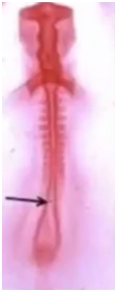
Identify the marked structure in the given image.
| A. |
Notochord |
| B. |
Primitive streak |
| C. |
Neural groove |
| D. |
Neural fold |
Show Answer


|
Correct Answer � B Explanation |
 |

The image depicts an embryonic structure. The arrow is pointing to a midline structure in the caudal region, consistent with the primitive streak. This is a transient structure observed during early embryogenesis.
The primitive streak is a linear structure formed during gastrulation in the epiblast of the bilaminar disc. It represents the site of cell migration to form the three germ layers (ectoderm, mesoderm, and endoderm). The image and location match the primitive streak’s characteristic appearance.
Key Features of the Primitive Streak:
- Function: Initiates gastrulation, allowing epiblast cells to ingress and form the mesoderm and endoderm.
- Location: Caudal midline of the epiblast layer.
- Significance: Establishes the body’s longitudinal axis and bilateral symmetry.
- Fate: Degenerates by the end of the 4th week of embryonic development.
Differentiating Features:
- Notochord: The notochord is a rod-like structure located along the midline in the mesoderm. It serves as the axial support and is the precursor to the vertebral column. Cranial to the primitive streak, later contributes to intervertebral discs (nucleus pulposus).
- Neural groove and folds: Found cranially during neural tube formation. The neural groove is a midline depression formed during the early stages of neural tube development. It is more localized cranially and does not extend caudally like the primitive streak. Neural folds are elevated edges on either side of the neural groove, which eventually fuse to form the neural tube.