

Question
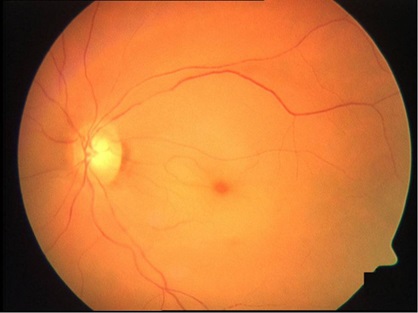
A 55-year-old male patient presents to the clinic with a complaint of sudden visual blurring that lasted for a short duration. He reports that during the episode, he completely lost vision in his left eye for a few minutes and then regained his vision. The patient denies any pain, headache, or other associated symptoms during the episode. Based on the clinical description and image given below what is the most likely diagnosis?

| A. |
Amaurosis fugax |
| B. |
Central retinal artery occlusion |
| C. |
Central retinal vein occlusion |
| D. |
Hypertensive retinopathy |


|
Correct Answer » A Explanation |
 |

Given the patient’s clinical presentation of sudden, transient loss of vision in one eye, without pain, and the subsequent restoration of vision, along with the description of a curtain-like visual disturbance, the most likely diagnosis is amaurosis fugax.
Image Analysis – The Fundus is normal in the image. There is a physiological foveal redness, NOT a cherry-red spot shown in the image
Amaurosis fugax is characterized by a temporary loss of vision in one eye due to a lack of blood flow to the retina. It is often described as a “curtain” coming down over the vision of one eye and can last from a few seconds to several minutes before vision returns to normal. This condition can serve as a warning sign for potential future stroke or other serious vascular disorders.
Reasons to rule out other options
Option B- Central retinal artery occlusion (CRAO) involves sudden, painless vision loss due to an obstruction of the central retinal artery, leading to ischemia of the retina. While the presentation is somewhat similar to amaurosis fugax, the key difference is that the vision loss in CRAO typically does not resolve spontaneously and can result in permanent damage.
Option C- Central retinal vein occlusion (CRVO) also leads to sudden vision loss, but it is usually associated with retinal hemorrhages and other signs that can be observed upon fundoscopic examination. Patients may also report pain in some cases.
Option D- Hypertensive retinopathy is related to chronic uncontrolled high blood pressure leading to changes in the retinal vasculature. Symptoms of hypertensive retinopathy develop gradually rather than suddenly and are not characterized by brief episodes of total vision loss as described