

Question
Which of the following conditions is characterized by the absence of P waves?
| A. |
Ventricular tachycardia |
| B. |
Focal atrial tachycardia |
| C. |
Ventricular fibrillation |
| D. | Atrial fibrillation |


|
Correct Answer » D Explanation |
 |

Atrial Fibrillation (AF):
AF is the most common pathologic tachyarrhythmia.
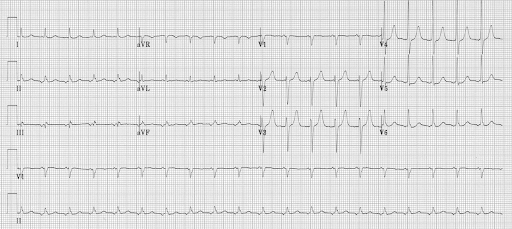
The hallmark of AF is the absence of P waves on the ECG.
Instead of P waves, the baseline may show either fibrillatory waves (f-waves) or minute oscillations.
The ventricular rhythm is irregularly irregular.
AF is strongly associated with age and other risk factors like hypertension, heart disease, and obesity.


Reasons to rule out other options
Ventricular Tachycardia (VT):
VT is a rapid heart rhythm originating from the ventricles.
On an electrocardiogram (ECG), VT typically shows wide QRS complexes without visible P waves.
However, P waves may still be present in VT, especially if it is a slow VT.
Therefore, VT does not consistently exhibit the absence of P waves.
Ruling out VT: While VT can have wide QRS complexes, it does not consistently lack P waves 1.

Focal Atrial Tachycardia (FAT):
FAT is an atrial tachycardia originating from a specific focus within the atria.
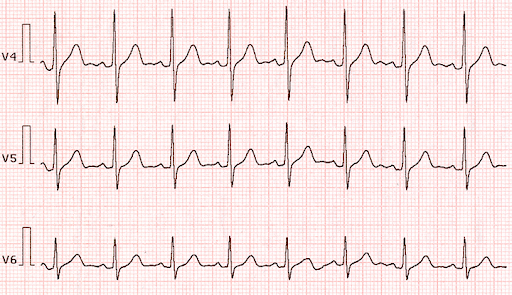
On ECG, FAT usually shows narrow QRS complexes with visible P waves.
P waves are typically present in FAT.
Ruling out FAT: FAT does not match the absence of P waves 1.

Ventricular Fibrillation (VF):
VF is a chaotic, disorganized rhythm originating from the ventricles.
On ECG, VF shows irregular, rapid, and erratic QRS complexes.
There are no discernible P waves in VF.
Ruling out VF: VF indeed lacks P waves 1.

