

Question
A hepatitis B positive person came to your opd on routine urine massive proteinuria (> 3.5 g/day), Further renal biopsy was performed to identify the disease?
| A. |
Focal segmental glomerulosclerosis |
| B. | Membranous glomerulonephritis |
| C. | Membranoproliferative glomerulonephritis |
| D. |
Minimal change disease |


|
Correct Answer � B Explanation |
 |

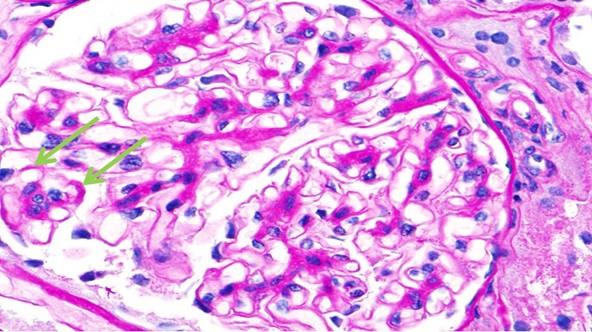
Membranous glomerulonephritis (MGN) is the most common form of glomerular disease associated with hepatitis B infection. This kidney disorder involves the thickening of the capillary walls of the glomerulus due to immune complex deposition.
In hepatitis B patients, the formation of these immune complexes is often related to the viral antigens circulating in the blood. The hallmark of MGN is significant proteinuria, which in this case is described as massive (greater than 3.5 g/day).
The diagnosis is confirmed through a renal biopsy which shows thickening of the glomerular basement membrane without significant proliferation of glomerular cells.
The diffuse capillary and GBM thickening is characteristic finding
Reasons for ruling out other options are-
A: Focal segmental glomerulosclerosis (FSGS) – While FSGS also presents with proteinuria, it is characterized by scarring in scattered regions of some glomeruli. It is not typically associated with hepatitis B and lacks the immune complex deposition seen in membranous glomerulonephritis.
C: Membranoproliferative glomerulonephritis (MPGN) – MPGN involves both thickening of the capillary walls and increased cellular proliferation in the glomeruli. It can be associated with hepatitis B; however, the typical histological findings lean more towards mixed nephritic and nephrotic features rather than predominantly nephrotic as in MGN.
D: Minimal change disease (MCD) – MCD is characterized by minimal changes seen under light microscopy, with the main changes visible only under electron microscopy showing effacement of the foot processes of podocytes. It is primarily associated with massive proteinuria but is more commonly seen in children and not linked with hepatitis B infection.