

MUSCLES OF FACIAL EXPRESSION
| A | Temporalis muscle | |
| B |
Occipitofrontalis |
|
| C |
Masseter muscle |
|
| D |
Medial pterygoid muscle |
All of the following muscles are derived from Pharyngeal Arches, Except:
| A |
Tensor Tympani |
|
| B |
Levator Palpebrae superioris |
|
| C |
Palatine Tensor |
|
| D |
Orbicularis oculi |
All the following muscle are innervated by the facial nerve except:
| A |
Occipito-frontalis |
|
| B |
Anterior belly of digastric |
|
| C |
Risorius |
|
| D |
Procerus |
Which part of orbicularis oculi is known as Horner’s muscle:
| A |
Orbital |
|
| B |
Lacrimal |
|
| C |
Temporal |
|
| D |
Muller’s muscle |
Muscle which dilates the palpebral aperture:
| A |
Orbicularis oculi |
|
| B |
Orbicularis oris |
|
| C |
Levator palpebrae superioris |
|
| D |
Levator labii superioris |
False about facial muscles:
| A |
Dilate and constrict facial orifices |
|
| B |
Supplied by facial nerve |
|
| C |
Develops from 3rd pharyngeal arch |
|
| D |
They develop from mesoderm |
Identify the Muscle as marked No 5 in the Diagram


| A |
Buccinator |
|
| B |
Platysma |
|
| C |
Risorius |
|
| D |
None of the above |
Muscle of fascial expression, which is not supplied by facial nerve ‑
| A |
Orbicularis oris |
|
| B |
Orbicularis oculi |
|
| C |
Frontalis |
|
| D |
Levator palpebrae superioris |
The muscles acting upon the temporomandibular joint for various actions are given below, EXCEPT?
| A |
Temporalis muscle |
|
| B |
Occipitofrontalis |
|
| C |
Masseter muscle |
|
| D |
Medial pterygoid muscle |
- Temporalis muscle: The temporalis muscle elevates the mandible.
- Masseter muscle: It elevates the mandible. It works functionally with the temporalis and pterygoid muscles to move the mandible at the TMJ, it is a muscle of mastication.
- Lateral pterygoid muscle: Contraction causes the mandibular condyle and the articular disc to move anteriorly, resulting in both protraction and depression of the mandible. It works synergistically with the medial pterygoid muscle to move the mandible from side to side.
- Medial pterygoid muscle: It elevates the mandible and moves it from side to side.
All of the following muscles are derived from Pharyngeal Arches, Except:
| A |
Tensor Tympani |
|
| B |
Levator Palpebrae superioris |
|
| C |
Palatine Tensor |
|
| D |
Orbicularis oculi |
B i.e. Lavator palpebral superioris
All the following muscle are innervated by the facial nerve except:
| A |
Occipito-frontalis |
|
| B |
Anterior belly of digastric |
|
| C |
Risorius |
|
| D |
Procerus |
Facial Nerve Supplies
Facial muscles except levator palpebrae Superioris (Which is supplied by 3rd nerve).
- Posterior belly of Digastric
- Stapedius
- Auricular muscles
- Occipto Frontalis
- Platysma
- Stylohyoid
| A | Orbital | |
| B |
Lacrimal |
|
| C |
Temporal |
|
| D |
Muller’s muscle |
Ans. Lacrimal
Muscle which dilates the palpebral aperture:
| A |
Orbicularis oculi |
|
| B |
Orbicularis oris |
|
| C |
Levator palpebrae superioris |
|
| D |
Levator labii superioris |
The levator palpebrae superioris muscle elevates and retracts the upper eyelid.
Orbicularis oculi is a sphincter muscle for the eye.
Orbicularis Oris is a sphincter muscle for oral opening.
Levator labii superioris elevates the upper lip
False about facial muscles:
| A |
Dilate and constrict facial orifices |
|
| B |
Supplied by facial nerve |
|
| C |
Develops from 3rd pharyngeal arch |
|
| D |
They develop from mesoderm |
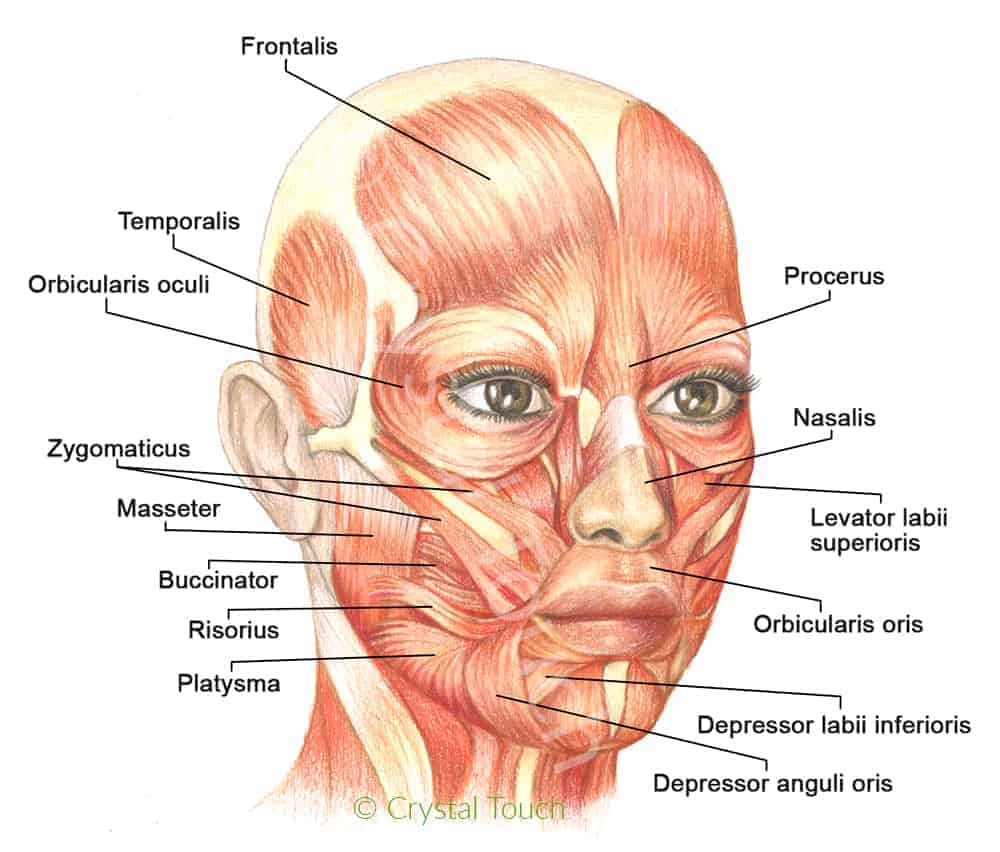
The muscles of the face are embedded in the superficial fascia, and most arise from the bones of the skull and are inserted into the skin.
- The orifices of the face, namely, the orbit, nose, and mouth, are guarded by the eyelids, nostrils, and lips, respectively.
- It is the function of the facial muscles to serve as sphincters or dilators of these structures.
- A secondary function of the facial muscles is to modify the expression of the face.
- All the muscles of the face are developed from the second pharyngeal arch and are supplied by the facial nerve.
| A |
Buccinator |
|
| B |
Platysma |
|
| C |
Risorius |
|
| D |
None of the above |
- Most buccinator fibers insert anteriorly into the buccal mucosa and around the buccal muscle node (Modiolus).
- Opposite the upper second molar the buccinator muscle is pierced by the parotid duct.
- Numerous buccal glands of varying size are interspersed among the muscle fibers, and a few appear on the outer surface of the muscle.
- The buccal nerve pierces the buccinator muscle but does not innervate it.

Muscle of fascial expression, which is not supplied by facial nerve ‑
| A |
Orbicularis oris |
|
| B |
Orbicularis oculi |
|
| C |
Frontalis |
|
| D |
Levator palpebrae superioris |
Ans. is ‘d’ i.e., Levator palpebrae superioris
Nerve supply of face
- Each half of the face is supplied by fourteen nerves, one is motor and the rest are sensory.
- Motor supply is derived from facial (7″) nerve which supplies all facial muscles except levator palpeprae sperioris, which is supplied by sympathetic fibers and 3rd cranial nerve.
- Eleven sensosry nerves are derived from branches of trigeminal (5th) nerve and only two sensory are derived from great auricular nerve and transverse (anterior) cutaneous nerve of neck.