

PAPILLOEDEMA
PAPILLOEDEMA (CHOKED DISC)



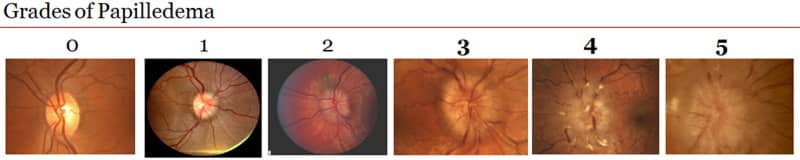
- Non-inflammatory edema of optic disc.
- Caused by increased intracranial tension (ICT).

CLINICAL FEATURES
- Initial symptoms due to increased ICT e.g:
- Headache
- Nausea
- Projectile vomiting
- Vision is normal initially.
- Visual symptoms occur only in advanced severe papilloedema
- Recurring brief episodes (transient) of visual obscurations (Amourosis fugax).
- Usually affect both eye.
- Central vision is affected late in the disease.
- Enlargement of blind spot
- Progressive contraction of the visual field
- Gradually progressive painless loss of vision.
OPHTHALMOSCOPIC FINDINGS
- Blurring or obscuratiom of disc margin (first sign).
- Blurring starts at upper & lower nasal margins.
- Venous engorgement & venous congestion
- Loss of venous pulsation
- There is filling of physiological cup with gradua obliteration of physiological cup.
- Hyperemia of disc.
- Disc becomes gradually elevated (mushroom/dome shaped) so that vessels bend sharply over ots margin.
- Cotton wool spots (soft exudates).
- Hard exudates may radiate from the centre of fovea in the form of macular fan or macular star
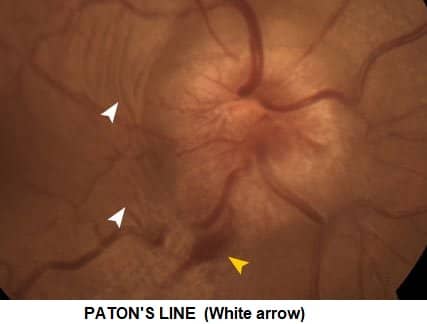
- Paton’s lines: Radial retinal lines cascading from the optic disc.
- Late findings in long standing (vintage) papilloedema are:
- Marked elevated disc with champagne cork appearance
- Postneuritic optic atrophy (pale disc with blurred margin)
- Thickening of theperivascular sheats lead to contraction of arteries
- Generalised retinal pigmentation
- corpora amylacea (drusen like crystalline deposits on disc margin)


Foster- Kennedy syndrome:
- The frontal lobe, pituitary & middle-ear tumor such as meningiomata of the olfactory groove .
- Associated with ipsilateral pressure atrophy of the optic nerve & contralateral pailloedema.
Pseudo-Foster-kennedy syndrome:
- Characterized by occurrence of unilateral papilloedema
- Associated with raised ICT (due to any cause) & a pre-existing optic atrophy.


Exam Important
- Earliest sign of papilloedema is Blurring of disc margin.
- Ipsilateral optic atrophy with contralateral papilloedema is a feature of Foster kennedy syndrome.
- Acute Papilloedema present with Severe loss of vision.
- Most severe papilloedema is caused by Posterior cranial fossa tumor.
Don’t Forget to Solve all the previous Year Question asked on PAPILLOEDEMA
Click Here to Start Quiz
Click Here to Start Quiz

