

Question
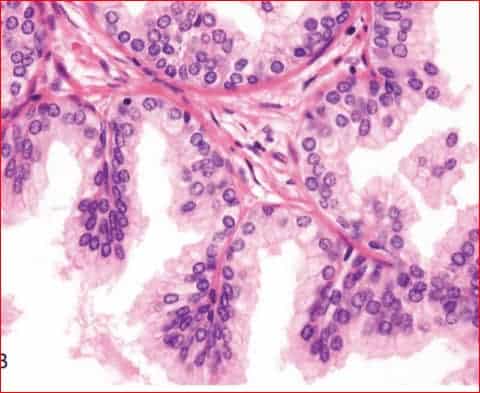
A patient presented with hesitancy, urgency, nocturia, and poor urinary stream.Prostate shows the following features.Regarding this pathology,which zone of prostate is affected?




| A. |
Central Zone |
| B. |
Periurethral Zone |
| C. |
Peripheral Zone |
| D. |
Transitional Zone |
Show Answer


|
Correct Answer » B Explanation |
 |

Ans:B.)Periurethral Zone.
Image shows:
- First:Nodular prostatic hyperplasia. Well-defined nodules compress the urethra into a slitlike lumen.
- Second:Low-power photomicrograph demonstrates a well-demarcated nodule at the right of the field, with a portion of urethra seen to the left. In other cases of nodular hyperplasia, the nodularity is caused predominantly by stromal, rather than glandular, proliferation.
- Third: Higher-power photomicrograph demonstrates the morphology of the hyperplastic glands, which are large, with papillary infolding
Benign Prostatic Hyperplasia(Nodular Hyperplasia)
• BPH is characterized by proliferation of benign stromal and glandular elements. DHT, an androgen derived from testosterone, is the major hormonal stimulus for proliferation.
• BPH most commonly affects the inner periuretheral zone of the prostate, producing nodules that compress the prostatic urethra.
- On microscopic examination, the nodules exhibit variable proportions of stroma and glands.
- Hyperplastic glands are lined by two cell layers: an inner columnar layer and an outer layer composed of flattened basal cells.
• Clinical symptoms and signs are reported by 10% of affected patients and include hesitancy, urgency, nocturia, and poor urinary stream. Chronic obstruction predisposes to recurrent urinary tract infections.Acute urinary obstruction may occur.