

TUBERCULOSIS OF HIP
TUBERCULOSIS OF THE HIP
- After spine, the hip is affected, most commonly.
CLINICAL FEATURES
Presenting complaints:
- Insidious in onset and runs a chronic course.
- First symptoms is stiffness of the hip and it produces a limp.
- Initially, stiffness may occur only after rest.
- Pain may be absent in early stages.
- The child may complain of ‘night cries’.
- The so called ‘starting pain’.
- Caused by the rubbing of the two diseased surfaces, when movement occurs as a result of the muscle relaxation during sleep.
- Later, there may be cold abscesses around the hip.
- These may burst resulting in discharging sinuses.
EXAMINATION
- Gait- ‘stiff-hip gait’ and ‘painful or antalgic gait’.
- Muscle wasting
- Swelling
- Discharging sinuses
- Deformity: Flexion, adduction and internal rotation deformity of the hip.
- Shortening: true shortening in TB of the hip, except in Stage I.
- Movements: Both, active and passive movements are limited in all directions.
- Abnormal position of the head: In a dislocated hip, the head can be felt in the gluteal region.
- Telescopy: This test assesses the instability of the head if it is out of the acetabulum.
STAGES OF TB OF THE HIP
- Stage I (stage of synovitis)- position of flexion, abduction and external rotation.
- Stage II (stage of the arthritis)
- Stage III (stage of erosion)
Radiological examination
- Haziness: Haziness of the bones around the hip is the earliest sign.
- Lytic lesion: There may be lytic lesions
- Reduction of joint space: This occurs because of destruction of the cartilage.
- Irregular outline: The outline of the articular ends of the bone becomes irregular because of destruction by the disease process.
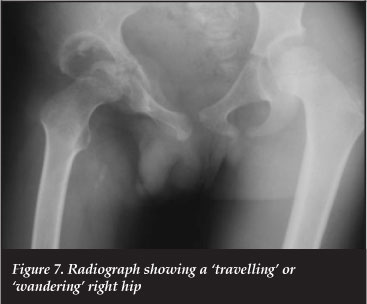
- Acetabular changes: The head may be lying out of the acetabulum in a ‘pseudo’ acetabulum on the ilium – the wandering acetabulum.
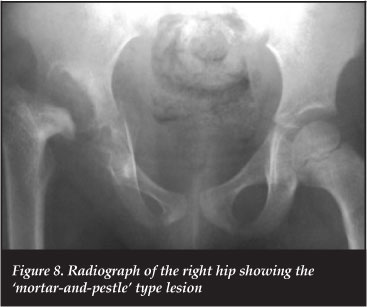
- The acetabulum simply gets enlarged and deepened with the deformed head shifted medially, giving the appearance of the ‘pestle and mortar’.
- Signs of healing: If the disease starts healing, there may be sclerosis around the hip.


DIFFERENTIAL DIAGNOSIS
- Other causes of monoarthritis of the hip
- Inguinal lymphadenopathy or psoas abscess
- Congenital dislocation of the hip
- Congenital coxa vara
- Perthes’ disease
- Osteoarthritis
TREATMENT
Conservative treatment: It consists of:
- Antitubercular chemotherapy and
- Care of the hip
Operative treatment:
- Joint debridement
- Girdlestone arthroplasty
- Arthrodesis
- Corrective osteotomy
- Total hip replacement
Exam Important
- Deformity of hip in stage of tubercular synovitis stage is flexion, abduction and external rotation.
- Deformity in transient synovitis of Hip is Abduction, Flexion & External rotation.
- During hip replacement, loss of joint and ligament receptors leads to No loss of sensation.
Radiological examination
- Haziness: Haziness of the bones around the hip is the earliest sign.
- Lytic lesion: There may be lytic lesions
- Reduction of joint space: This occurs because of destruction of the cartilage.
- Irregular outline: The outline of the articular ends of the bone becomes irregular because of destruction by the disease process.
- Acetabular changes: The head may be lying out of the acetabulum in a ‘pseudo’ acetabulum on the ilium – the wandering acetabulum.
- The acetabulum simply gets enlarged and deepened with the deformed head shifted medially, giving the appearance of the ‘pestle and mortar’.
- Signs of healing: If the disease starts healing, there may be sclerosis around the hip.
Don’t Forget to Solve all the previous Year Question asked on TUBERCULOSIS OF HIP
Click Here to Start Quiz

