

TUBERCULOSIS OF SPINE (Pott’s disease)
TUBERCULOSIS OF THE SPINE (Pott’s disease)
-
The spine is the commonest site of bone and joint tuberculosis.
-
Dorso-lumbar region affected most frequently.
Types of vertebral tuberculosis:
1. Paradiscal: commonest type
2. Central:
- Single vertebra is affected.
- This leads to early collapse of the weakened vertebra.
- The nearby disc may be normal.
- The collapse may be a ‘wedging’ or ‘concertina’ collapse
3. Anterior:
-
infection is localised to the anterior part of the vertebral body.
4. Posterior:
-
the posterior complex of the vertebra i.e., the pedicle, lamina, spinous process and transverse process are affected.
CLINICAL FEATURES
- Pain (back pain)
- Stiffness
- Cold abscess
- Paraplegia
- Deformity: increasing prominence of the spine – gibbus.
- Constitutional symptoms: Symptoms like fever, weight loss etc.
RADIOLOGICAL INVESTIGATIONS
X-ray examination:
• Reduction of disc space: earliest sign


• Destruction of the vertebral body


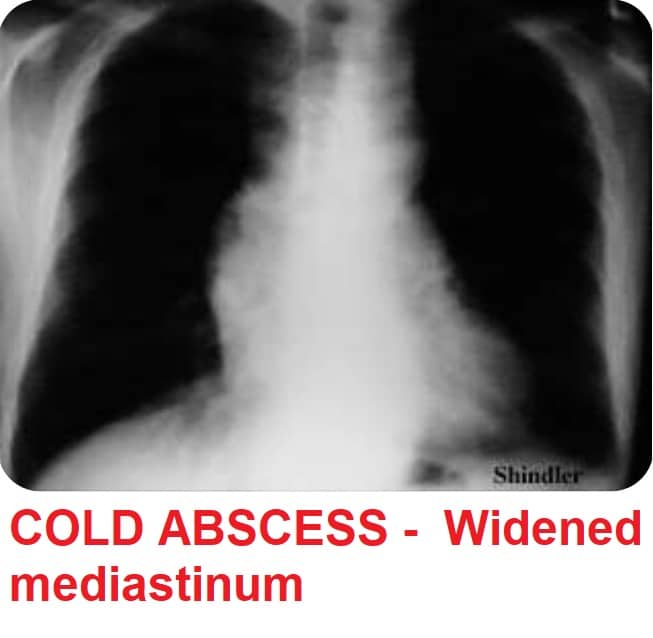
• Evidence of cold abscess:
1). Para-vertebral abscess-
- fusiform para-vertebral abscess (bird nest abscess – an abscess whose length is greater than its width (Fig-23.7a);
- globular or tense abscess – an abscess whose width is greater than the length
2). Widened mediastinum-
3). Retro-pharyngeal abscess
4). Psoas abscess



• Rarefaction: diffuse rarefaction of the vertebrae above and below the lesion.
• Unusual signs: erosion of the posterior elements of pedicle, lamina etc.
• Signs of healing
CT scan:
-
very useful investigation in cases presenting as ‘spinal tumour syndrome’.
MRI:
-
Investigation of choice to evaluate the type and extent of compression of the cord.
Other investigations:
-
ESR, Mantoux test, ELISA test for detecting anti- tubercular antibodies, chest X-ray, etc.,
COMPLICATIONS
1. Cold abscess: commonest complication of TB of the spine.
2. Neurological compression: At times the patient presents as a case of spinal tumour syndrome.
-
First clinical symptom being a neurological deficit.
- The following measures are adopted in the treatment of Pott’s paraplegia : ?
1) Conservative treatment
n Chemotherapy (ATTs) is the mainstay of conservative treatment.
n Immobilization by traction (in cervical spine) or brace (in dorsal region).
n Physiotherapy of paralysed limb.
2) Surgical treatment
n Following are the main indications for surgery.
i) Failed conservative treatment :- Paraplegia does not show improvement by conservative treatment even after 3-6 months.
ii) Patient develops paraplegia while on conservative treatment.
iii) Paraplegia getting worse despite adequate conservative treatment.
iv) In doubtful diagnosis.
v) Rapid onset paraplegia
vi) Recurrence of paraplegia after improvement initialy.
Operative procedure for Pott’s paraplegia
- There are various procedures, the most commonly used procedure is anterior decompression by surgical debridement (removal dead, necrotic & caseous material) followed by autogenous strut grafting.
- The logic is well understood; the compression is from anterior side most of the time because tuberculosis occurs in vertebral body which lies anterior to the spinal cord. So, anterior decompression is the best procedure.
- Anterior decompression can be caused by : ?
i) Anterior approach : – Called anterior decompression. It is the most preferred procedure.
ii) Anterolateral approach : – Called anterolateral decompression.
- Other surgical procedures (other than anterior decompression) are : ?
i) Costo-transversectomy
ii) Posterior fusion and instrumentation to correct kyphotic deformity.
iii) Laminectomy
Exam Important
- Tuberculosis in Pott’s disease involves Spine.
- Pott’s spine is commonest at Thoracolumbar spine.
- Tuberculosis of spine is common at Thoracolumbar.
- Most common cause of cold abscess of chest wall is Pott’s spine.
- Commonest presenting symptom of Pott’s spine is Back pain.
- The paradiscal type is M/C type of vertebral tuberculosis.
- Wedging or Concertina collapse: in central type.
- Pott’s disease: M/C cause for kyphosis & cold abscess.
- Earliest radiological sign of spine tuberculosis is reduction of intervertebral disc space.
- M/C complication of spine tuberculosis cold abscess.
- Investigation of choice- MRI.
- M/c performed surgery- Antero lateral decompression.
- TB of spine à bony ankylosis, other bones & joints a fibrous ankylosis.
Click Here to Start Quiz

