

Dapsone
Dapsone is used in the treatment and therapeutic diagnosis of:
| A | Leprosy | |
| B |
Dermatitis herpetiformis |
|
| C | Acne vulgaris | |
| D |
Lupus vulgaris |
Drug effective against dermatitis herpetiformis:
| A | Dapsone | |
| B | Corticosteroids | |
| C | Chloroquine | |
| D | Antihistaminics |
| A | Clofazimine/ethambutol | |
| B | Dapsone | |
| C | Rifampicin | |
| D | Pyrazinamide |
| A | Systemic steroids | |
| B |
Dapsone |
|
| C |
Both Dapsone & Systemic steroids |
|
| D |
Methotrexate |
A HIV infected patient develops multibacillary leprosy. What is the recommended treatment?
| A |
No anti leprosy drug should be given |
|
| B |
Rifampicin, dapsone and clofazimine |
|
| C |
Rifampicin and dapsone |
|
| D |
Rifampicin only |
In India all drugs are given under supervised regimen except –
| A |
Dapsone |
|
| B |
Clofazimine |
|
| C |
Pyrazinamide |
|
| D |
Rifampicin |
Dapsone is used in –
| A |
Dermatitis herpetiformis |
|
| B |
Pityriasis rosacea |
|
| C |
Contact dermatitis |
|
| D |
Oculocutaneous albinism |
Commonest side effect of Dapsone –
| A |
Hemolytic anemia |
|
| B |
Thrombocytopenia |
|
| C |
Cyanosis |
|
| D |
Bone marrow depression |
Dose of Dapsone is –
| A |
1-2 mg/kg |
|
| B |
5 mg/ kg |
|
| C |
10 mg/kg |
|
| D |
20 mg/kg |
WHO regime for paucibacillary leprosy:
| A |
100 mg Dapsone daily + Rifampcin monthly (600 mg) |
|
| B |
Dapsone daily + Rifampcin daily |
|
| C |
Dapsone + Rifampcin + Clofazemine daily |
|
| D |
Rifampcin + Clofazamine daily |
For treatment of paucibacillary leprosy drugs used are –
| A |
Rifampicin & dapsone |
|
| B |
Rifampicin, dapsone, steroids |
|
| C |
Rifampicin, clofazimine, dapsone |
|
| D |
None |
Dapsone is NOT used in:
March 2013
| A |
Alopecia areata |
|
| B |
Leprosy |
|
| C |
Dermatitis herpetiformis |
|
| D |
Malarial prophylaxis |
Drug of choice for dermatitis herpetiformis:
March 2010, September 2012, March 2013
| A |
Rifampicin |
|
| B |
Thalidomide |
|
| C |
Dapsone |
|
| D |
Clofazimine |
Which is not a side effect of dapsone ‑
| A |
Hemolytic anemia |
|
| B |
Myopathy |
|
| C |
Hepatitis |
|
| D |
Infectious mononucleosis type syndrome |
This patient developed following type of skin lesions after taking certain medications. Which of the following drug will give rise to these skin lesions in this patient?

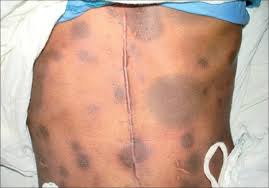
| A |
Phenolphthalein |
|
| B |
Aspirin |
|
| C |
Dapsone |
|
| D |
All of the above |
Drugs to be avoided in G6PD deficiency is ‑
| A |
Dapsone |
|
| B |
Metformin |
|
| C |
Pregabalin |
|
| D |
Rituximab |
Dapsone is used in the treatment and therapeutic diagnosis of:
| A | Leprosy | |
| B |
Dermatitis herpetiformis |
|
| C | Acne vulgaris | |
| D |
Lupus vulgaris |
Dermatitis herpetiformis REF: Journal of Investigative Dermatology Symposium Proceedings (2004) 9, 47-51 (http:// http://www.nature.com/jidsp/journal/v9/n1/full/5640132a.html) Therapy of Skin Diseases, By Yoshiki Miyachi, page 433
The responsiveness of DH to dapsone:
Responsiveness to dapsone was once considered a diagnostic criterion for DH. A number of other dermatoses clearly respond to dapsone, however and the list of dapsone-responsive dermatoses includes all of those listed in table given below. One would think that dapsone’s mechanism of action would be specifically related to IgA antibody and possibly related to neutrophil chemotaxis, but the exact mechanism by which dapsone is effective in these dermatoses has not been established. It is known that dapsone has no effect on antibody or complement deposition.
Drug effective against dermatitis herpetiformis:
| A | Dapsone | |
| B | Corticosteroids | |
| C | Chloroquine | |
| D | Antihistaminics |
| A | Clofazimine/ethambutol | |
| B | Dapsone | |
| C | Rifampicin | |
| D | Pyrazinamide |
Which of the following drugs is used in generalised lichen planus?
| A |
Systemic steroids |
|
| B |
Dapsone |
|
| C |
Both Dapsone & Systemic steroids |
|
| D |
Methotrexate |
A combination therapy with steroids and Dapsone gives a better result than 1 drug used alone.
A HIV infected patient develops multibacillary leprosy. What is the recommended treatment?
| A |
No anti leprosy drug should be given |
|
| B |
Rifampicin, dapsone and clofazimine |
|
| C |
Rifampicin and dapsone |
|
| D |
Rifampicin only |
Multi drug therapy for leprosy is not contraindicated in HIV infection. WHO recommends the following drugs for treatment of multibacillary leprosy
- Rifampicin: 600 mg once monthly
- Dapsone: 100 mg daily
- Clofazimine: 300 mg once monthly supervised; and 50 mg daily, self administered.
| A |
Dapsone |
|
| B |
Clofazimine |
|
| C |
Pyrazinamide |
|
| D |
Rifampicin |
Ans. is ‘a’ i.e., Dapsone
Dapsone is used in –
| A |
Dermatitis herpetiformis |
|
| B |
Pityriasis rosacea |
|
| C |
Contact dermatitis |
|
| D |
Oculocutaneous albinism |
Ans. is ‘a’ i.e., Dermatitis herpetiformis
Dapsone is first line anti-leprotic drug.
Dapsone is also used in dermatitis herpatiformis (drug of choice), P. jiroveci infection in AIDS, actinomycetoma, rhinosporidiosis, toxoplasmosis and leishmaniasis.
MOA :
- Dapsone is an analog of para-aminobenzoic acid (PABA) and hence competitively inhibits dihydropteroate synthase (DHPS) required for folic acid synthesis.
| A | Hemolytic anemia | |
| B |
Thrombocytopenia |
|
| C |
Cyanosis |
|
| D |
Bone marrow depression |
Ans. is ‘a’ i.e., Hemolytic anaemia
The most common adverse effect of dapsone is hemolytic anaemia (Patients with G-6-PP deficiency are more susceptible).
| A |
1-2 mg/kg |
|
| B |
5 mg/ kg |
|
| C |
10 mg/kg |
|
| D |
20 mg/kg |
A. i.e. 1-2 mg/kg
WHO regime for paucibacillary leprosy:
| A |
100 mg Dapsone daily + Rifampcin monthly (600 mg) |
|
| B |
Dapsone daily + Rifampcin daily |
|
| C |
Dapsone + Rifampcin + Clofazemine daily |
|
| D |
Rifampcin + Clofazamine daily |
A i.e. 100 mg Dapsone daily + Rifampcin 600 mg monthly
For treatment of paucibacillary leprosy drugs used are –
| A |
Rifampicin & dapsone |
|
| B |
Rifampicin, dapsone, steroids |
|
| C |
Rifampicin, clofazimine, dapsone |
|
| D |
None |
Ans. is ‘a’ i.e., Rifampicin & dapsone
Dapsone is NOT used in:
March 2013
| A |
Alopecia areata |
|
| B |
Leprosy |
|
| C |
Dermatitis herpetiformis |
|
| D |
Malarial prophylaxis |
Ans. A i.e. Alopecia areata
Alopecia areata (AA)
- Non-cicatricial/ non scaring alopecia
- Exclamation mark sign is characteristic
- Clinical presentation: Single or multiple circumscribed smooth patchy hair loss, most obviously on scalp but frequently involving any hair bearing skin like beard, eyebrows, eyelashes, with pathognomic “exclamation marks” and “going gray overnight” phenomenon
- AA is treated by: Minoxidil
Drug of choice for dermatitis herpetiformis:
March 2010, September 2012, March 2013
| A | Rifampicin | |
| B |
Thalidomide |
|
| C |
Dapsone |
|
| D |
Clofazimine |
Ans. C: Dapsone
Dermatitis herpetiformis:
- Epidemiology: Rare, male to female ratio is 2:1, onset at 20 to 40 years of age, but also in children, whites, rare in blacks or Asians
- Features: Grouped (herpetiform) excoriations or vesicles symmetrically located on extensor remission; watch for signs surfaces of elbows, knees, sacrum, buttocks, and shoulders with intense pruritus and burning sensation
- Diagnosis:
– Light microscopy: neutrophilic abscesses in dermal papillae, dermal infiltrates of neutrophils and eosinophils with subepidermal vesicles.
– Direct Immunoflorescence: granular IgA deposits in the tips of the dermal papillae
- Management: Gluten-free diet; sulfones.
Patients will experience prompt relief of lesions within one to two days of initializing treatment with dapsone or sulfapyridine.
It is important to remember to always check glucose-6-phosphate dehydrogenase (G6PD) and baseline complete blood count levels before starting dapsone, followed by complete blood cell counts every month to monitor for signs of hemolytic anemia.
Watch for signs of other autoimmune disorders; may coexist with gluten-sensitive enteropathv
| A | Hemolytic anemia | |
| B |
Myopathy |
|
| C |
Hepatitis |
|
| D |
Infectious mononucleosis type syndrome |
Ans. is ‘b i.e., Myopathy
Adverse effects of dapsone
- The most common adverse effect of dapsone is hemolytic anaemia (Patients with G-6-PP deficiency are more susceptible).
- Second most common adverse effect is methemoglobinemia.
- Other side effects are – Nausea, anorexia, headache, paresthesia, drug fever, mental symptoms, rashes, fixed drug eruption, hypermelanosis (Pigmentation), phototoxicity, exfoliative dermatitis, hepatitis, agranulocytosis, lepra reaction and sulfone syndrome, infectious mononucleosis like syndrome.
| A | Phenolphthalein | |
| B |
Aspirin |
|
| C |
Dapsone |
|
| D |
All of the above |
- Tetracyclines (tetracycline, minocycline)
- Sulfonamides, other sulfa drugs
- Metronidazole, nystatin, salicylates, NSAIDs, phenylbutazone, phenacetin
- Barbiturates
- Oral contraceptives
- Quinine (including quinine in tonic water), quinidine
- Phenolphthalein
- Food coloring (yellow): in food or medications
Drugs to be avoided in G6PD deficiency is ‑
| A |
Dapsone |
|
| B |
Metformin |
|
| C |
Pregabalin |
|
| D |
Rituximab |
Ans. is ‘a’ i.e., Dapsone
|
Drugs causing hemolytic Anaemia in C-6-PD Aminosalicylic acid Antimalarials – Primaquine, Quinine Analgesics – Aspirin, Acetanilid Chloramphenicol Cotrimoxazole Dapsone |
deficiency Nalidixic acid o Nitrofurantoin Phenacetin Probenecid Procainamide Quinidine |
Sulfonamides (Sulfamethoxazole) Vitamin C Vitamin K (water soluble form) Methylene blue Niridazole – Phenazopyridine Doxorubicin |