Question
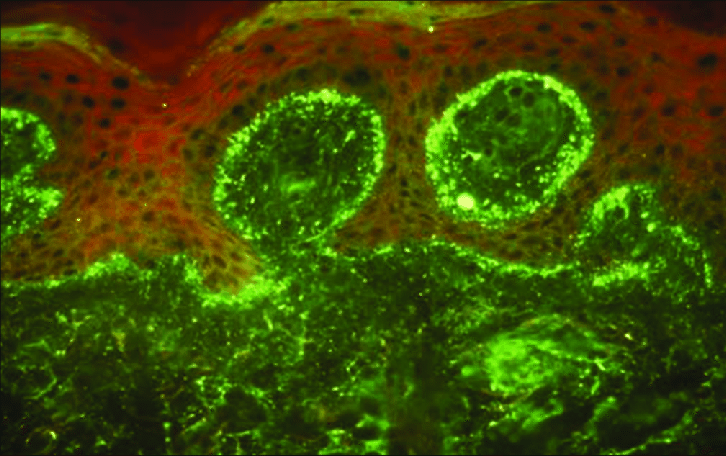
A patient presents with intensely itchy vesicular skin lesions on extensor surfaces. History of gluten sensitivity is given. Skin biopsy with immunofluorescence is shown. What is the most likely diagnosis?
| A. |
Bullous pemphigoid
|
| B. |
Pemphigus vulgaris
|
| C. |
Dermatitis herpetiformis
|
| D. |
Psoriasis
|
Show Answer
|
Correct Answer � C
Explanation
|
|
– Dermatitis herpetiformis (DH) is a chronic, itchy blistering skin disorder.
– Strongly associated with celiac disease (gluten-sensitive enteropathy).
– Affects extensor surfaces: elbows, knees, buttocks, scapula.
– Common in young to middle-aged adults.
Histopathology & Immunofluorescence:
– Biopsy (H&E): subepidermal blisters & neutrophilic microabscesses.
– Immunofluorescence: granular IgA deposits in dermal papillae → pathognomonic for DH.
Key diagnostic clues:
– Pruritic vesicles on extensor surfaces,
– Gluten sensitivity,
– Granular IgA deposits on direct immunofluorescence.
– Responds well to a gluten-free diet & dapsone for relief.
Incorrect Options:
A. Bullous pemphigoid – Affects elderly with tense bullae; DIF: linear IgG & C3.
B. Pemphigus vulgaris – Flaccid bullae, mucosal involvement; DIF: intercellular IgG.
D. Psoriasis – Scaly plaques, no vesicles or IgA deposition. Not linked to gluten sensitivity.