

LEARNING
| A | Modeling | |
| B |
Social learning |
|
| C |
Classical conditioning |
|
| D |
Operant conditioning |
Pavlov’s experiment is an example of which of the following learning theory?
| A |
Modeling |
|
| B |
Classical conditioning |
|
| C |
Operant conditioning |
|
| D |
Learned helplessness |
| A |
Habituation |
|
| B |
Sensitisation |
|
| C |
Potentiation |
|
| D |
None of the above |
‘Reinforcement’ is used in :
| A |
Psychoanalysis |
|
| B |
Hypnoanalysic |
|
| C |
Abreaction |
|
| D |
Conditioned learning |
Many of our bad habits of day to day life can be removed by:
| A |
Positive conditioning |
|
| B |
Negative conditioning |
|
| C |
Bio feed back |
|
| D |
Generalization |
Operant conditioning where paradigm pain stimulus are given to a child for decreasing a certain undesired behaviour can be classified as:
| A |
Positive Reinforcement |
|
| B |
Negative reinforcement |
|
| C |
Punishment |
|
| D |
Negotiation |
All of the following are done in behavior therapy to increase a behavior except:
| A |
Punishment |
|
| B |
Operant conditioning |
|
| C |
Negative reinforcement |
|
| D |
Reward |
The mechanism of learning and memory, include all except:
| A |
Changes in level of neurotransmitter at synapse |
|
| B |
Increasing protein synthesis |
|
| C |
Recruitment by multiplication of neurons |
|
| D |
Spatial Reorganization of synapse |
Salivation by dog seen when food is given along with ringing of bell is :
| A |
Conditioned reflex |
|
| B |
Reinforcement |
|
| C |
Habituation |
|
| D |
Innate reflex |
Which is not true about learning ‑
| A |
Conscious |
|
| B |
Temporary change in behaviour |
|
| C |
Acquiring new fears |
|
| D |
Formation of habits |
Child not eating vegetables. His mother starts giving a chocolate each time he finishes vegetables in the diet. The condition is
| A |
Operant conditioning |
|
| B |
Classical conditioning |
|
| C |
Social training |
|
| D |
Negative reinforcement |
Pavlov’s experiment is an example of ‑
| A |
Operant conditioning |
|
| B |
Classical conditioning |
|
| C |
Learned helplessness |
|
| D |
Modeling |
Behaviour therapy to change maladaptive behaviours using response as reinforcer uses the principles of which type of learning?
| A |
Modeling |
|
| B |
Social learning |
|
| C |
Classical conditioning |
|
| D |
Operant conditioning |
Ans:D-Operant Conditioning
- Operant conditioning is a form of learning in which responses are controlled by their consequences.
- The term operant conditioning for this type of learning was coined by B.F Skinner.
- The three basic operant conditioning techniques are reinforcement, negative reinforcement and punishment.
- Positive reinforcement increases the probability of a behavior with a positive condition such as giving reward.
- Negative reinforcement increases the probability of a behavior by associating the behavior with the removal of a negative condition.
- Punishment decreases the probability of a behavior by associating the behavior with a negative condition.
| A |
Modeling |
|
| B |
Classical conditioning |
|
| C |
Operant conditioning |
|
| D |
Learned helplessness |
Ans:B-Classical conditioning
Pavlov’s experiment is an example of Classical conditioning.
Classical conditioning is a process of learning, by which a previously neutral stimulus elicit an identical or similar response to one originally elicited by another stimulus as a result of pairing of the two stimuli.
| A |
Habituation |
|
| B |
Sensitisation |
|
| C |
Potentiation |
|
| D |
None of the above |
Habituation is a simple form of learning in which a neutral stimulus is repeated many times.
Ref: Ganong’s Review of Medical Physiology 23rd edition, Chapter 19.
‘Reinforcement’ is used in :
| A |
Psychoanalysis |
|
| B |
Hypnoanalysic |
|
| C |
Abreaction |
|
| D |
Conditioned learning |
D i.e. Conditioned learning
Many of our bad habits of day to day life can be removed by:
| A |
Positive conditioning |
|
| B |
Negative conditioning |
|
| C |
Bio feed back |
|
| D |
Generalization |
Ans:B i.e. Negative conditioning
- Negative reinforcement is a term described by B. F. Skinner in his theory of operant conditioning.
- In negative reinforcement, a response or behavior is strengthened by stopping, removing, or avoiding a negative outcome or aversive stimulus
- Negative reinforcement can be an effective way to strengthen the desired behavior.Hence it will be more useful to remove many of the bad habits that are practised daily.
- However, it is most effective when reinforcers are presented immediately following a behavior. When a long period elapses between the behavior and the reinforcer, the response is likely to be weaker.
- In some cases, behaviors that occur in the intervening time between the initial action and the reinforcer are may also be inadvertently strengthened as well.
| A |
Positive Reinforcement |
|
| B |
Negative reinforcement |
|
| C |
Punishment |
|
| D |
Negotiation |
Ans:C i.e. Punishment
Operant conditioning (learning) procedures of behaviour therapy to change maladaptive behaviour use response as reinforcer.
In punishment (operant conditioned-behaviour therapy) aversive (pain) response/stimulus is given for decreasing undesired behaviour whereas, in positive reinforcement desirable behaviour is followed by reward (eg material, praise or token economy) and in negative reinforcement punishment is avoided on performance of desirable act to strengthen it Many of bad day to day habbits can be removed by negative conditioning (contingency managment)
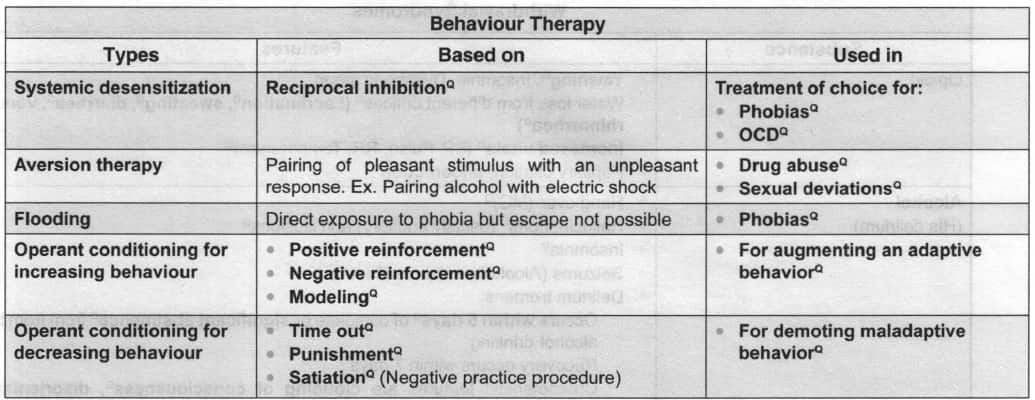
Operant Conditioning procedures used in Behaviour Therapy:
| For increasing adaptive behaviour | For decreasing maladaptive behaviour |
|
• Positive Reinforcement
(Reward): – Desirable (good/adaptive) behaviour is followed by reward (material or symbolic) e.g.: token economy – E.g.: If a child is reward (by anything he likes) for completing his homework. This will increase the likelihood that the desired response (of completing homework) will increase in frequency |
• Time-out/Frustrative
Non reward (Taking away positive stimulus) – Positive reinforcement (reward) is withdrawn for some time on undesired bad response – If an expected reward is taken away after bad behaviour (such as abusing) this will decrease the likelihood that the response will happen again. |
|
• Punishment (Aversion therapy)/ Adding negative stimulus
– Aversive (noxious) stimuli or punishment is presented immediately after an undesired (bad) behaviour. In other words, pairing of pleasant stimuli (e.g. alcohol) with an unpleasant response e.g. electric shock, drugs (disulfiram or apomorphine) or fantasy (when it is called covert sensitization) – Negative reinforcement (thereby suppress behaviour – Used for drug (e.g. alcohol) abuse, sexual deviations (transvestism, ego dystonic homosexuality), paraphilias, impulsive or compulsive behaviours – Is controversial as it can be sometimes be positively reinforcing and may cause ethical problems – If a child is scolded (or beaten) for failing to look after their younger sibling while studying by a parent who does not value homework then the child has been punished and will be less likely to do the homework another night. |
|
|
• Negative Reinforcements
(Removal of unpleasant stimulus) – Desirable behaviour is followed by avoidance of punishment – E.g. If a child expecting or carrying out an unpleasant task (such as cleaning out their room) is offered relaxation (such as parents offer to do cleaning for him) if he does his homework. |
|
|
• (Participant) Modelling
– Patient learns new behaviour primarily by observation, without having to perform until they feel ready (followed by imitation) – It is based on concept that just at irrational fears are acquired by learning, they can be unlearned by observing a fearless model confront the feared object. Eg: phobic children placed with normal children of same age approaching feared object or situation – Therapist accompanying adult patient into feared situation eg: agoraphobia, describing it in calm manner or acting out the process of mastering the feared activity – Behaviour rehearsal is acting out real life problems under therapist’s observation or direction |
|
|
• Satiation
The undesired response is positively reinforced so that tiring occurs. (Negative practice procedure) |
| A |
Punishment |
|
| B |
Operant conditioning |
|
| C |
Negative reinforcement |
|
| D |
Reward |
A i.e. Punishment
Punishment & frustrative-non reward lead to decrease in resultant behavior, whereas both positive & negative reinforcements increases (reinforces) the frequency of a particular response.
Operant conditioning describes how consequences of a behavior lead to an increase or decrease in that behavior. Behavior is increased when it is followed by reward (Positive reinforcement) or removal of unpleasant stimulus (negative reinforcement) and reduced by taking away a positive stimulus (frustrative-non reward) or adding a negative stimulus (punishment).
| A | Changes in level of neurotransmitter at synapse | |
| B |
Increasing protein synthesis |
|
| C |
Recruitment by multiplication of neurons |
|
| D |
Spatial Reorganization of synapse |
C i.e. Recruitment by multiplication of neurons
Salivation by dog seen when food is given along with ringing of bell is :
| A |
Conditioned reflex |
|
| B |
Reinforcement |
|
| C |
Habituation |
|
| D |
Innate reflex |
A > Conditioned Reflex
Which is not true about learning ‑
| A |
Conscious |
|
| B |
Temporary change in behaviour |
|
| C |
Acquiring new fears |
|
| D |
Formation of habits |
Ans. is ‘b’ i.e., Temporary change in behaviour
Learning
- Learing is any relative permanent change in behaviour that occurs as a result of practice of experience.
- It means acquiring something new- new knowledge, new techniques, new skills, new fears and new experiences.
- Learing is necessary for man’s survival and for human progress.
- It includes not only acquiring knowledge but also skills and formation of habits, and development of perception.
- Learing depends largely upon intelligence.
- Learing also depends upon motivation, and motivation depends on the need sutdents feel to learn.
- Learing is a continuous process. It is both conscious and unconscious.
Child not eating vegetables. His mother starts giving a chocolate each time he finishes vegetables in the diet. The condition is
| A | Operant conditioning | |
| B |
Classical conditioning |
|
| C | Social training | |
| D |
Negative reinforcement |
Ans. a. Operant conditioning

Pavlov’s experiment is an example of ‑
| A |
Operant conditioning |
|
| B |
Classical conditioning |
|
| C |
Learned helplessness |
|
| D |
Modeling |
Ans. is ‘b’ i.e., Classical conditioning
Classical conditioning
- In classical conditioning, the conditioned stimulus (which usually does not produce the response), when paired with unconditioned stimulus (stimulus which usually produces a response), directly produces a response.
- The typical example of classical conditioning is pavlov’s experiment. Normally food produces salivation in dog, Therefore salivation in response to food is called unconditioned response and the stimulus, i.e., food is called unconditioned stimulus. Under normal circumstances, a dog does not salivate at the sound of a bell. However, if the sound of bell is paired consistently with presentation of food, the dog begans to salivate to the sound of bell even if the food is not presented. This learned response, i.e., salivation to a sound of bell without food, is called conditioned response and the stimulus (sound of a bell) is called conditioned stimulus.
- There is a reverse side to classical conditioning, called counter conditioning. This amounts to reducing the intensity of conditioned response (e.g., anxiety) by establishing an incompatible response (e.g., relaxation) to a conditioned stimulus (i.e., snake). So anxiety symptoms can be reduced when the stimuli to anxiety are presented in graded order and systemically paired with a relaxation response. This process of reciprocal inhibition is called systemic desensitization.
- Other behavioral therapies based on classical conditioning principle (counter conditioning) are exposure with response prevention and aversion therapy.