

Question
| A. | Medial meniscus |
| B. |
Posterior cruciate ligament |
| C. |
Anterior cruciate ligament |
| D. |
Lateral meniscus |


|
Correct Answer � B Explanation |
 |

Answer B) Posterior cruciate ligament
Flexion of the quadriceps of the right thigh would translate the tibia forward; this is called a positive quadriceps active test and it is another sign of the patient’s condition.

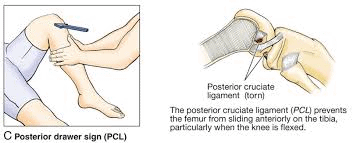
Posterior cruciate ligament
Posterior cruciate ligament (PCL) injury can occur when the flexed knee is subjected to excessive posterior force, as in the case of this patient.
He has a positive posterior drawer sign on the affected side, which is highly suggestive of PCL injury.
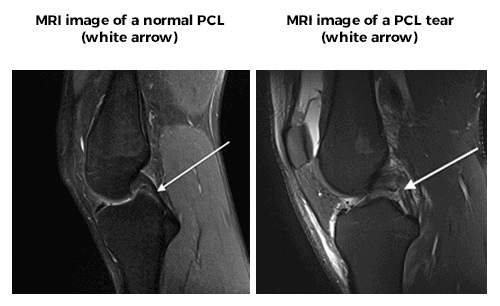
PCL injury is confirmed by MRI and can be treated conservatively (in the case of isolated injury) or surgically (in the case of multi-ligament injury or chronic symptoms).

Medial meniscus
Medial meniscus injury is a common cause of knee pain but would not explain this patient’s positive posterior drawer test.
Instead, McMurray test would be positive.
Anterior cruciate ligament
Anterior cruciate ligament injury causes knee pain but would not explain this patient’s posterior drawer sign.
Instead, ACL injury would present with a positive anterior drawer sign and a positive Lachman
Lateral meniscus
Lateral meniscus injury causes knee pain but would not explain this patient’s positive posterior drawer test.
Instead, McMurray test would be positive.