|
Correct Answer � A
Explanation
|
|
Answer A) A
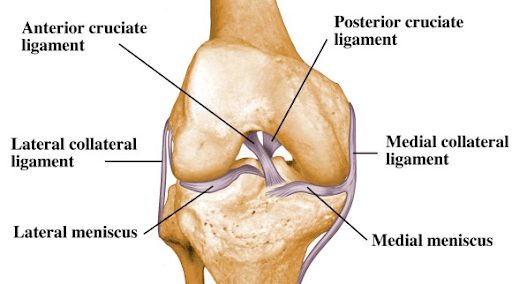
A refers to the anterior cruciate ligament (ACL)
B refers to the lateral meniscus
C refers to the medial meniscus
D refers to the posterior cruciate ligament (PCL)
The test performed here is the Lachman test. In this case, it is positive, demonstrating laxity.
Anterior cruciate ligament (ACL)
Anterior cruciate ligament (ACL), the most commonly injured knee ligament.
The mechanism of this patient’s injury is typical for damage to the ACL: Sudden deceleration and twisting to change direction as occurs during pivoting movements (e.g., “cutting inwards”).
This results in an audible pop followed by knee swelling (i.e., hemarthrosis) and joint instability. Clinical tests for injury to the ACL (e.g., the Lachman test, anterior drawer test, and pivot shift test) assess for laxity of the injured ligament compared to the contralateral side.
Posterior cruciate ligament (PCL)
Posterior cruciate ligament (PCL), which is most commonly injured when a flexed knee receives a sudden posterior-directed force (e.g., the dashboard injury).
It can also be injured in sports during a fall onto a flexed knee with a plantarflexed foot, which is not the scenario described in this case.
The clinical sign of injury to the PCL is posterior movement with traction (i.e., a positive posterior drawer test). However, the Lachman test described here indicates injury of another structure.
Medial meniscus
Medial meniscus, which can be injured when sudden directional change is applied to a flexed knee with the foot firmly planted, similar to the pivoting movement described by this patient.
Examination of a patient with a tear of the medial meniscus would show a positive McMurray test and a positive Apley grinding test on external rotation of the leg. However, the positive Lachman test described here indicates injury of another structure.
Lateral meniscus
Lateral meniscus, which can be injured when sudden directional change is applied to a flexed knee with the foot firmly planted, similar to the pivoting movement described by this patient.
Examination of a patient with a tear of the lateral meniscus would show a positive McMurray test and a positive
Apley grinding test on internal rotation of the leg. However, the positive Lachman test described here indicates injury of another structure.