

Measles
Introduction


- Measles is an infection of the respiratory system.
- Maximum incidence in 6m-3 year age group
- Also sometimes known as English Measle
- An alternative name for measles in English-speaking countries is rubeola
- Confused with rubella (German measles); the diseases are unrelated
Virus

- A paramyxovirus
- Genus Morbillivirus.
- Only one strain causes infection
- Enveloped, single-stranded, negative-sense RNA viruses.
- Nucleocapsid proteins
- Protect the genome RNA from nuclease digestion
- Recognize the location in the cell membrane for budding
Immunity
- The receptor for measles virus is CD46 (membrane cofactor protein), a regulator of complement activation.
- T and B lymphocytes are infected by measles virus.
Transmission
- Spread through respiration
- Contact with fluids from an infected person’s nose and mouth
- Either directly or through aerosol transmission
- Highly contagious
- 90% of people without immunity sharing living space with an infected person will catch it.
SAR
- Approximately 80%.
- Formula to Calculate SAR
- No. of exposed persons developing the disease within the range of incubation period/Total number of exposed/”susceptible” contacts*100
Incubation period
- An asymptomatic incubation period occurs nine to fourteen days from initial exposure
Infectivity
- Infectivity lasts from two to four days prior
- Until two to five days following the onset of the rash (i.e. four to nine days infectivity in total).
Isolation
- After the appearance of rash, prophylactic isolation of measles case is necessary for a minimum of 5 days
Clinical Manifestations
Prodromal/Pre-eruptive stage
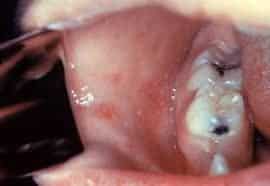
- Koplik’s spot

- A day or two before the appearance of rash
- Bluish white with erythematous halo
- Appear on the buccal mucosa opposite the first and second upper molars.
- Pathognomonic enanthem of measles.
- Disappears after the onset of rash
- Cough coryza conjunctivitis and increasing fever.
Eruptive Stage

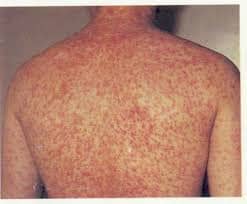
- Rash appears on the 4th day from fever.
- It begins at hairline and behind the ear,and spreads downward rapidly.
- Characteristically it is erythematous, non-pruritic and. maculopapular.
- Fever usually resolves by 4th day after the onset
Post measles stage
Complications
- Complications relatively common
- Mild and less serious
- Pneumonia is the most common life-threatening complication
- Mortality in developing countries may be as high as 10 to 15%
- Diarrhea
- Otitis media
- Most common complication
- Acute encephalitis (and rarely subacute sclerosing panencephalitis)
- The mortality rate in encephalitis associated with measles is about 10-20 %
- Rare complication
- Most serious complication
- Corneal ulceration leading to corneal scarring.
- Complications are usually more severe in adults who catch the virus.
Diagnosis
Microscopy
Warthin–Finkeldey cell :

- Giant multinucleate cell found in hyperplastic lymph nodes
- Seen early in the course of measels
- Under the light microscope, these cells consist of a large, grape-like cluster of nuclei.
- Rapid diagnosis is possible by immunofluorescence or PCR.
Exam Important
Introduction
- Maximum incidence in 6m-3 year age group
Virus
- A paramyxovirus
- Only one strain causes infection
- Nucleocapsid proteins
- Protect the genome RNA from nuclease digestion
- Recognize the location in the cell membrane for budding
Transmission
- Spread through respiration
- Contact with fluids from an infected person’s nose and mouth
- Either directly or through aerosol transmission
- Highly contagious
SAR
- Approximately 80%.
- Formula to Calculate SAR
- No. of exposed persons developing the disease within the range of incubation period/Total number of exposed”susceptible” contacts*100
Incubation period
- An asymptomatic incubation period occurs nine to fourteen days from initial exposure
Infectivity
- Infectivity lasts from two to four days prior
- Until two to five days following the onset of the rash (i.e. four to nine days infectivity in total).
Isolation
- After the appearance of rash, prophylactic isolation of measles case is necessary for a minimum of 5 days
Clinical Manifestations
Prodromal/Pre-eruptive stage
- Koplik’s spot
- A day or two before the appearance of rash
- Appear on the buccal mucosa opposite the first and second upper molars.
- Pathognomonic enanthem of measles.
Eruptive Stage
- Rash appears on the 4th day from fever.
- It begins at hairline and behind the ear,and spreads downward rapidly.
- Fever usually resolves by 4th day after the onset
Post measles stage
Complications
- Pneumonia is the most common life-threatening complication
- Mortality in developing countries may be as high as 10 to 15%
- Otitis media
- Most common complication
- Acute encephalitis (and rarely subacute sclerosing panencephalitis)
- The mortality rate in encephalitis associated with measles is about 10-20 %
- Rarest complication
Warthin–Finkeldey cell :
- Giant multinucleate cell found in hyperplastic lymph nodes
- Seen early in the course of measels
- Under the light microscope, these cells consist of a large, grape-like cluster of nuclei
Don’t Forget to Solve all the previous Year Question asked on Measles
Click Here to Start Quiz
Click Here to Start Quiz

