
Measles
| A | Hp bodies | |
| B |
Inclusion containing polykaryon |
|
| C |
Koplik cells |
|
| D |
Warthin-Finkeldey cells |
Giant cells seen in Measles are called?
| A |
Hp bodies |
|
| B |
Inclusion containing polykaryon |
|
| C |
Koplik cells |
|
| D |
Warthin-Finkeldey cells |
Lymphoid organs typically have marked follicular hyperplasia, large germinal centers and randomly distributed multinucleated giant cells called Warthin-Finkeldey cells, which have eosinophilic nuclear and cytoplasmic inclusion bodies.
Found in the paracortical region of hyperplastic lymph nodes in some patients of measles and AIDS. It consists of fused lymphocytes and can be seen in a lymph node biopsy after a measles vaccination.
Ref: Robbins Pathology, 7th Ed, page 363
| A |
Allow the virion to assemble in the icosahedral shell |
|
| B |
Protect the DNA from nuclear digestion |
|
| C |
Give the virion particle a geometric symmetry |
|
| D |
Protect the genome RNA from nuclease digestion and recognize the location in the cell membrane for budding |
Measles virus is an RNA-containing human virus that is membrane-bound. The nucleocapsid proteins are arranged in a helical symmetry inside the viral membrane. Therefore the first and second options are not correct. The last option becomes the best answer since the third option does not provide a function for the nucleocapsid protein.
- Measles virus is an enveloped negative-sense, single-stranded RNA virus which has hemagglutinin and fusion glycoproteins.
- The receptor for the measles virus is CD46 (membrane cofactor protein), a regulator of complement activation.
- T and B lymphocytes are infected by the measles virus.
- The incubation period is 7 to 18 days.
- Koplik’s spots appear on mucous membranes.
- Rash spreads from head to trunk and extremities.
- Rapid diagnosis is possible by immunofluorescence or PCR.
- Live, attenuated measles vaccine is available and is highly immunogenic. It is most commonly administered as MMRV.
| A |
5% |
|
| B |
10% |
|
| C |
20% |
|
| D |
21.5% |
Secondary attack rate (SAR) is defined as “the number of exposed person developing the disease within the range of incubation period, following exposure to the primary case”. The denominator consists of all persons who are exposed to the case.
|
No. of exposed persons developing the disease within the range of incubation period |
In the given question
No of exposed developing the disease is =14
No of susceptible children: (total no of children – no of immunized children)=100-28=72 -2=70
Two children develops measles (primary case) so 72-2=70
SAR = 14/70*100=20% thus 20% is the secondary attack rate
Ref: Park’s Textbook of Preventive and Social Medicine By K. Park, 19th Edition, Pages 56, 94.
| A |
Koplik cells |
|
| B |
HP bodies |
|
| C |
Warthin Finkeldey cells |
|
| D |
Weinberger bodies |
Measles virus is –
| A |
Paramyxovirus |
|
| B |
Orthomyxovirus |
|
| C |
Poxvirus |
|
| D |
Picornavirus |
Ans. is ‘a’ i.e., Paramyxo virus
All of the following statement regarding measles are true except –
| A |
Rash appears first on leg |
|
| B |
Koplik spot are seen on retina |
|
| C |
Long term complication may be seen in form of SSPE |
|
| D |
a and b |
Ans. is ‘a’ i.e., Rash appears first on leg; ‘b’ i.e., Koplik spot are seen on retina
Measles
o Measles is caused by a RNA virus of paramyxovirus family.
o Measles in also known as rubeola.
- The only source of infection is a case of measles, carriers are not known to occur.
o Infective period 4 days before and 5 days after the appearance of rash.
- Infective material Secretions of nose, throat and respiratory tract
o Age group –> 6 month to 3 years.
o Immunity One attack of measles generally confer life long immunity.
o Transmission 1) Droplet infection through respiratory tract 2) Infection through conjuctiva.
o Incubation period 10 days from exposure to onset of fever.
14 days from exposure to appearance of rash. 7 days for live vaccine of measles.
o Clinical manifestations
1) Prodromal stage
- Begins 10 days after the infection and lasts until day 14.
Characterized by fever, coryza with sneezing and nasal discharge, redness of the eyes, lacrimation and photophobia.
A day or two before the appearance of rash, Koplik’s spots appear on buccal mucosa opposite the 1st and
2nd lower molars.
Koplik’s spots are pathognotnonic of measles.
2) Eruptive phase
Maculopapular rash which begins behind the ear and spread rapidly in a few hour over the face and neck extends down the body.
3) Post measles stage
Weight loss Cancrum oris
Growth retardation Reactivation of pulmonary TB
Diarrhea Candidiasis
| A |
High secondary attack rate |
|
| B |
Only one strain causes infection |
|
| C |
Not infectious in prodromal phase |
|
| D |
Infection confers lifelong immunity |
Ans. is ‘c’ i.e., Not infectious in prodromal phase
Measles has a high secondary attack rate 80%)
Measles has a high SAR of over 80% (Previous edition of Park)
o These is only one antigenic subtype of Measles virus
Measles is caused by an RNA paramaxovirus (Genus : mobillivirus)
There is only one serotype (antigenic type) of measles virus.
o Measles infections confers life long immunity
Because there is only one antigenic type of Measles virus, one attack of measles infection generally confers life long immunity
o Measles in highly infectious during the prodromal period and at the time of eruption
The period of communicability for measles is approximately 4 days before & 5 days after the appearance of rash infectivity is maximum during the prodrome and falls rapidly after the onset of rash.
Isolation may be recommended for 7 days after the appearance of rash
(Note that isolation in Measles may not be effective in controlling the spread of infection because it is highly infectious during the prodrome prior to appearance of rash).
| A |
Koplik spot appears in prodromal stage |
|
| B |
Fever stops after onset of rash |
|
| C |
Vaccine given at 9 months |
|
| D |
All |
Ans. is ‘a’ i.e., Koplik spot appears in prodromal stage; ‘b’ i.e., Fever stops after onset of rash & `c’ i.e., Vaccine given at 9 months
All of following are true about measles except‑
| A |
Maximum incidence in 6m-3 year age group |
|
| B |
Best age for immunization is 9-12 months |
|
| C |
Secondary attack rate is 30% |
|
| D |
I.P. = 7-14 days |
Ans. is ‘c’ i.e., Secondary attack rate is 30%
Most serious complication of measles is:
September 2008
| A |
Croup |
|
| B |
Meningo-encephalitis |
|
| C |
Otitis media |
|
| D |
Pneumonia |
Ans. B: Meningo-encephalitis
Infection confers life-long immunity.
A generalized immunosuppression that follows acute measles frequently predisposes patients to bacterial otitis media and bronchopneumonia.
In approximately 0.1% of cases, measles causes acute meningo-encephalitis,which is the most serious complication. Subacute sclerosing panencephalitis (SSPE) is a rare chronic degenerative disease that occurs several years after measles infection.
After the appearance of rash, prophylactic isolation of measles case is necessary for a minimum of:
September 2007
| A | 2 days | |
| B | 5 days | |
| C |
7 days |
|
| D |
9 days |
Ans. B: 5 days
Measles is infective for:
| A |
One day before and 4 days after rash |
|
| B |
Four days before and five days after rash |
|
| C |
Entire incubation period |
|
| D |
Only during scabs falling |
Ans. B: Four days before and five days after rash
The infection has an average incubation period of 14 days (range 6-19 days) and the Period of communicability in measles is approximately 4 days before and 5 days after the appearance of the rash.
Measles is an infection of the respiratory system caused by a virus, specifically a paramyxovirus of the genus Morbillivirus. Morbilliviruses, like other paramyxoviruses, are enveloped, single-stranded, negative-sense RNA viruses. Symptoms include fever, cough, runny nose, red eyes, and a generalized, maculopapular, erythematous rash.
| A |
Diarrhoea |
|
| B |
Pneumonia |
|
| C |
Otitis media |
|
| D |
SSPE |
Ans. is ‘d’ i.e., SSPE
Subacute sclerosing panencephalitis (SSPE) is a rare complication of measles, which develops many years after the initial infection –
The most common complications are : measles- associated diarrhea, pneumonia and otitis media ‑
| A |
Incubation period is 5 days |
|
| B |
Otitis media is the most common complication |
|
| C |
Caused by orthomyxovirus |
|
| D |
Large number of carriers |
Ans. is ‘b’ i.e., Otitis media is the most common complication
- Measles is caused by a RNA virus of paramyxovirus family.
- The only source of infection is a case of measles, carriers are not known to occur.
| A |
14 days |
|
| B |
1 Month |
|
| C |
3 Month |
|
| D |
5 Month |
Ans. is ‘a’ i.e., 14 days
True about measles are all except ‑
| A |
Koplik’s spots is pathognomonic |
|
| B |
Source is a case |
|
| C |
Infectivity is low |
|
| D |
Affect age group 1 to 3 years |
Ans. is ‘c’ i.e., Infectivity is low
Measles has high infectivity with secondary attack rate of 80%.
Other options are correct.
| A |
1-2% |
|
| B |
10-20% |
|
| C |
20-30% |
|
| D |
30-40% |
Ans. is ‘b i.e., 10-20%
“The mortality rate in encephalitis associated with measles is about 10-20 %” — Park
“Case fatality rate in acute measles encephalitis is 15%” wwwcdc.gov.
| A |
10% |
|
| B |
20% |
|
| C |
30% |
|
| D |
40% |
Ans. is ‘a’ i.e., 10%
Measles-associated mortality is usually higher among the very young and very old.
Mortality in developing countries may be as high as 10 to 15% due to one or several factors, including the early age of infection, malnutrition, diarrhea, concomitant/secondary bacterial infections, and lack of access to good medical care.
Most common cause of death is pneumonia in children and encephalitis in adults.
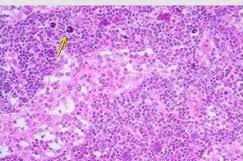
| A | Guarnieri bodies. | |
| B |
Cowdry bodies. |
|
| C |
Warthin Finkeldey cells. |
|
| D |
Councilman bodies. |
Ans:C.)Warthin Finkeldey cells.
Warthin–Finkeldey cell
- It is a type of giant multinucleate cell found in hyperplastic lymph nodes early in the course of measels and also in HIV-infected individuals,as well as in Kimura disease and more rarely in a number of neoplastic (e.g. lymphoma) and non-neoplastic lymph node disorders.
- Their origin is uncertain, but they have previously been shown to stain with markers similar to those of follicular dendritic cells , including CD21.
- Under the light microscope, these cells consist of a large, grape-like cluster of nuclei.
| A |
Diarrhea |
|
| B |
RTI |
|
| C |
SSPE |
|
| D |
Myocarditis |
Ans. is ‘b’ i.e., RTI
Respiratory tract infection (RTI) is the most common cause of death. “Pneumonia is the most common life-threatening complication”_ Park
