

SYMPATHETIC RECEPTORS
INTRODUCTION:
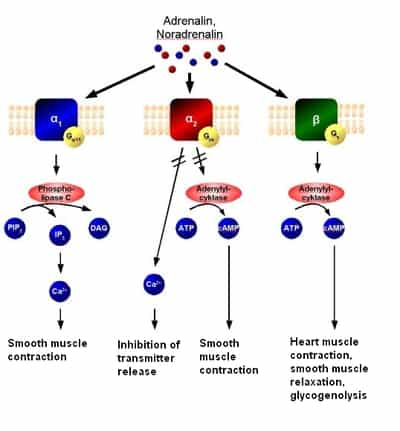
- Adrenergic receptors/adrenoceptors/Sympathetic receptors – Class of G protein-coupled receptors.
- Targets catecholamines, mainly norepinephrine (noradrenaline) & epinephrine (adrenaline).
- Cells binds to catecholamine receptors & stimulates sympathetic nervous system.
- Sympathetic nervous system –
- Responsible for fight-or-flight response, including pupil diltation, increasing heart rate, mobilizing energy, & blood-flow divertion from non-essential organs to skeletal muscle.
RECEPTOR TYPES:
- α receptors:
- Subtypes
- α1 (a Gq coupled receptor)
- α2 (a Gi coupled receptor)
- Phenylephrine – Selective α-receptor agonist.
- β receptors:
- Subtypes:
- β1, β2 and β3.
- All three linked to Gs proteins (although β2 also couples to Gi & to adenylate cyclase.
- Agonist binding causes raised intracellular second messenger cAMP concentration.
- Downstream effectors of cAMP include cAMP-dependent protein kinase (PKA), which mediates intracellular events following hormone binding.
- Isoprenaline – non-selective agonist.

| Receptor | Location | Selected action | Mechanism | Agonist | Antagonist |
| α1 |
Vascular , GU smooth muscle
Liver Intestinal Smooth muscle Heart |
|
Gq:
phospholipase C(PLC) activated, IP3,and DAG, ↑ calcium |
|
(TCAs)
Antihistamines (H1 antagonists)
|
| α2 |
β-cell of pancreas
Platelet Nerve Terminal Vascular smooth muscle |
|
Gi:
adenylate cyclase inactivated, cAMP↓ |
|
|
| β1 |
Juxtraglomular cell
Heart |
|
Gs:
adenylate cyclase activated, cAMP↑ |
|
|
| β2 |
Smooth muscle (GI,GU,Vascular,Braonchial)
Skeletal Muscle |
|
Gs:
adenylate cyclase activated, cAMP↑ |
|
|
| β3 | Adipose Tissue |
|
Gs:
adenylate cyclase activated, cAMP↑ |
|
|
Exam Important
- Adreneric β receptors having lipolysis property in fat cells is Beta -3.
- Alpha 2 agonist cause analgesia & not hyperalgesia.
- Salmeterol is long acting beta-2-agonist.
- Beta-2-agonist causes a brief spell of hyperkalemia followed by hypokalemia.
- Beta-2-agonist doesn’t cause hypoglycemia.
- Alpha-2-agonist causes Sedation, Glaucoma & Hypertension.
- Beta-1 receptors in heart stimulates its contractions.
- Beta-2 receptors are present in smooth muscles.
- Beta-1 receptors stimulation releases renin.
- Beta blockers are used to treat hyperthyroidism (Not hypothyroidism).
Don’t Forget to Solve all the previous Year Question asked on SYMPATHETIC RECEPTORS
Click Here to Start Quiz
Click Here to Start Quiz

