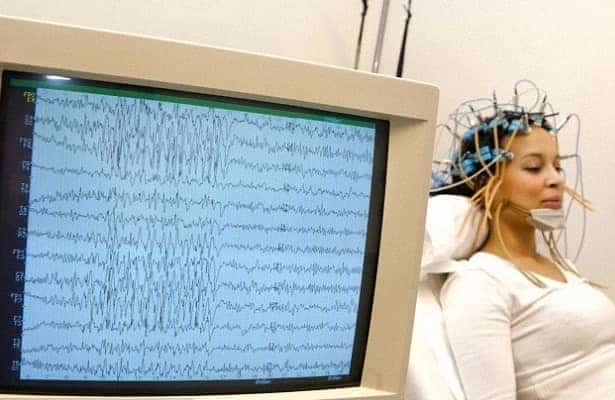
Question
What would be the most possible type of wave in the result in a relaxed female (with eyes closed) undergoing this test?
A. Alpha.
B. Beta.
C. Gamma.
D. Theta.
Show Answer
|
Correct Answer » A
Explanation
|
|
Ans: A. Alpha Waves.
The patient is undergoing EEG test.
Comparison of EEG bands
| Band |
Frequency (Hz) |
Location |
Normally |
Pathologically |
| Delta |
< 4 |
frontally in adults, posteriorly in children; high-amplitude waves |
- It is normal as the dominant rhythm in infants up to one year and in stages 3 and 4 of sleep.
|
- subcortical lesions
- diffuse lesions
- metabolic encephalopathy hydrocephalus
- deep midline lesions
|
| Theta |
4–7 |
|
- It is perfectly normal in children up to 13 years .
- sleep/drowsiness in adults and teens
|
- focal subcortical lesions
- metabolic encephalopathy
- deep midline disorders
- some instances of hydrocephalus
|
| Alpha |
8–15 |
posterior regions of head, both sides, higher in amplitude on dominant side. |
- relaxed
- closing the eyes
- It is present during most of life especially after the thirteenth year.
|
|
| Beta |
16–31 |
both sides, symmetrical distribution, most evident frontally; low-amplitude waves |
- It is the dominant rhythm in patients who are alert or anxious or have their eyes open.
|
|
| Gamma |
> 32 |
Somatosensory cortex |
- Displays during cross-modal sensory processing (perception that combines two different senses, such as sound and sight)
- Also is shown during short-term memory matching of recognized objects, sounds, or tactile sensations
|
- A decrease in gamma-band activity may be associated with cognitive decline.
|
| Mu |
8–12 |
Sensorimotor cortex |
- Shows rest-state motor neurons.
|
|