

Question
Diagnose the underlying condition due to electrolyte disturbance.

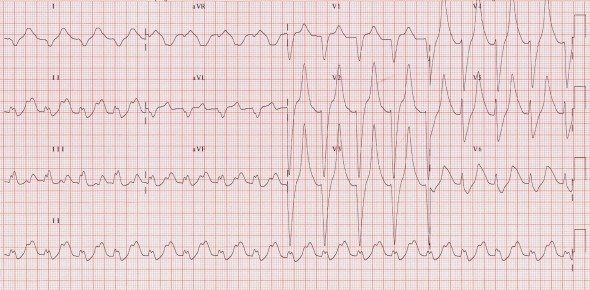
A. Hyperkalemia
B. Hypokalemia
C. Hypercalcemia
D. Hypocalcemia
Show Answer


|
Correct Answer » A Explanation |
 |

Ans: A. Hyperkalemia
This ECG image displays many of the features of hyperkalaemia:
- Prolonged PR interval.
- Broad, bizarre QRS complexes — these merge with both the preceding P wave and subsequent T wave.
- Peaked T waves.
Hyperkalemia
- Potassium is vital for regulating the normal electrical activity of the heart.
- Increased extracellular potassium reduces myocardial excitability, with depression of both pacemaking and conducting tissues.
- Progressively worsening hyperkalaemia leads to suppression of impulse generation by the SA node and reduced conduction by the AV node and His-Purkinje system, resulting in bradycardia and conduction blocks and ultimately cardiac arrest.
Classification
- Hyperkalaemia is defined as a potassium level > 5.5 mEq/L
- Moderate hyperkalaemia is a serum potassium > 6.0 mEq/L
- Severe hyperkalaemia is a serum potassium > 7.0 mE/L
Effects of Hyperkalemia on ECG
Serum potassium > 5.5 mEq/L is associated with repolarization abnormalities:
- Peaked T waves (usually the earliest sign of hyperkalaemia)
- Serum potassium > 6.5 mEq/L is associated with progressive paralysis of the atria:
- P wave widens and flattens
- PR segment lengthens
- P waves eventually disappear
Serum potassium > 7.0 mEq/L is associated with conduction abnormalities and bradycardia:
- Prolonged QRS interval with bizarre QRS morphology
- High-grade AV block with slow junctional and ventricular escape rhythms
- Any kind of conduction block (bundle branch blocks, fascicular blocks)
- Sinus bradycardia or slow AF
- Development of a sine wave appearance (a pre-terminal rhythm)
Serum potassium level of > 9.0 mEq/L causes cardiac arrest due to:
- Asystole
- Ventricular fibrillation