
Acute myeloid leukemia (AML)
ACUTE MYELOID LEUKEMIA (AML)
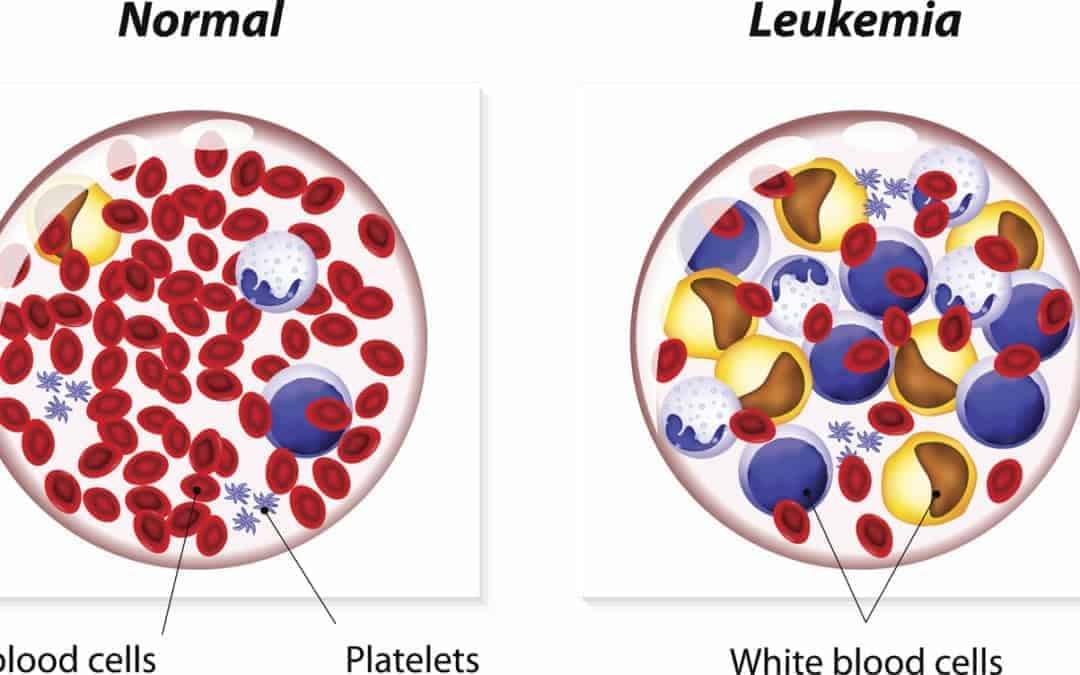
- AML is a heterogenous disease characterised by infiltration of malignant myeloid cells into blood, bone marrow.
- AML is due to inhibition of maturation of myeloid stem cells due to mutations.
- Seen in mainly in adults (50 years).
- Chromosomal mutations in AML are
- translocation t (8: 21) & t (15: 17)
- Inversion 16 or t (16: 16)
Etiology-
- Hereditary – Down syndrome, Klinefelter’s Syndrome, Patau Syndrome.
- Radiation
- Chemical- smoking
Pathogenesis-
- t (8: 21) disrupt the RUNXL gene & Inv (16) disrupts the CDF1β gene both have good prognosis.
- t (15: 17) (acute promyelocytic leukaemia-M3) have good prognosis.
- Gene mutation encoding components of cohesion complex.
- Most common congenital AML (in infants) are AML M5 (acute monocytic leukemia)
- Most common AML in children is AML M7 (acute megakaryoblastic anaemia)
- Most common translocation- MLL gene rearrangements on chromosome 11q.
- Monosomy is associated with a poor prognosis.
Clinical features-
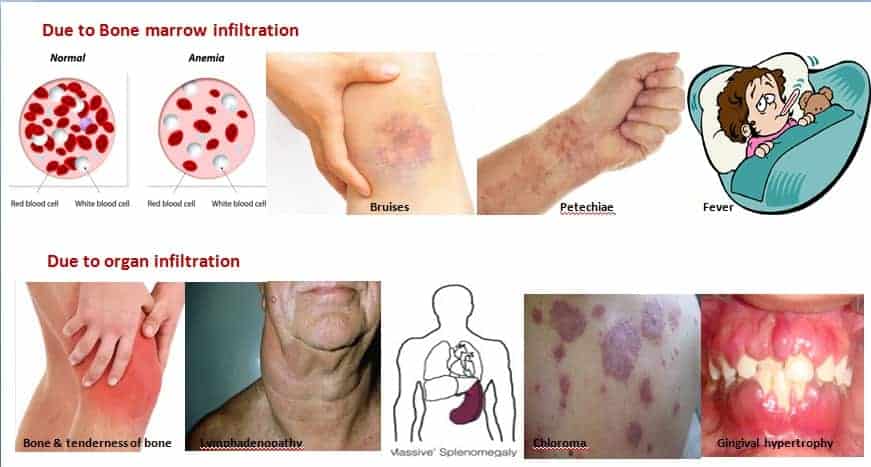
1. Due to bone marrow failure-
- Anaemia
- Bruises, petechiae, bleeding from gum
- Infection
- Fever
2. Due to organ infiltration-
- Pain & tenderness of bones
- Lymphadenopathy, enlargement of tonsils
- Splenomegaly
- Hepatomegaly
- Gum hypertrophy
- Chloroma
Investigations-
1. Blood picture-
- Anemia
- Thrombocytopenia
- WBC increased
2. Bone marrow examination
- Cellularity- marrow is hypercellular but blood tap or dry tap is seen.
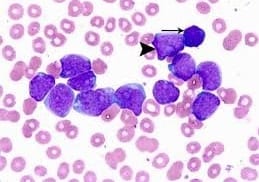
- Leukemic cells- Blast cell count >20% (WHO)
- Dyserythropoiesis, megaloblastic features & ring sideroblasts are common.
- Megakaryocytes.
3. Cytochemistry-
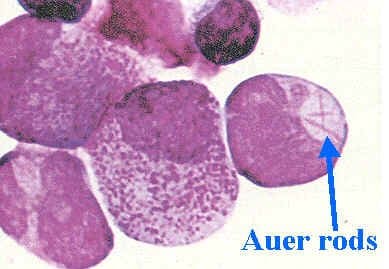
- Myeloperoxidase- Positive in immature myeloid cells containing granules & Auer rods (most definitive sign of myeloid differentiation)
- Cluster of Auer rods called as Faggot.
- Auer rods, distinctive needle like azurophilic granules,they are particularly numerous in AML with the t (15: 17) (acute promyelocytic leukaemia-M3).
- Non specific esterase (NSE)- positive in monocytic series (M3, M4 & M5)
- Investigation of choice is flow cytometry.
Treatment-
- Blood transfusion & platelet transfusion.
- Cytotoxic drug therapy- most effective treatment of AML is cytosine, arabinoside, anthracyclines.
- Promyelocytic leukemia (M3)- tretinoin orally
- Bone marrow transplantation.
Exam Important
- AML is due to inhibition of maturation of myeloid stem cells due to mutations.
- Seen in mainly in adults (50 years).
- Chromosomal mutations in AML are
- translocation t (8: 21) & t (15: 17)
- Inversion 16 or t (16: 16)
Pathogenesis-
- t (8: 21) disrupt the RUNXL gene
- Inv (16) disrupts the CDF1β gene.
- Gene mutation encoding components of cohesion complex.
- Most common congenital AML (in infants) are AML M5 (acute monocytic leukemia)
- Most common AML in children is AML M7 (acute megakaryoblastic anaemia)
- Most common translocation- MLL gene rearrangements on chromosome 11q.
Investigations-
- Leukemic cells- Blast cell count >20% (WHO)
- Dyserythropoiesis, megaloblastic features & ring sideroblasts are common
- Myeloperoxidase- Positive in immature myeloid cells containing granules & Auer rods (most definitive sign of myeloid differentiation)
- Cluster of Auer rods called as Faggot.
- Non specific esterase (NSE)- positive in monocytic series (M3, M4 & M5)
- Investigation of choice is flow cytometry
Treatment-
- Cytotoxic drug therapy- most effective treatment of AML is cytosine, arabinoside, anthracyclines.
Don’t Forget to Solve all the previous Year Question asked on Acute myeloid leukemia (AML)
Click Here to Start Quiz
Click Here to Start Quiz

