
Anal Fissure and Fistula
ANAL FISSURE (FISSURE-IN-ANO)
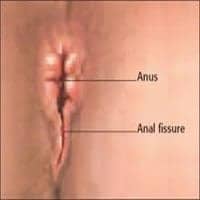
- A longitudinal split in the distal anal canal; extends from the anal verge proximally towards dentate line.
- Posterior fissures (most common) – passage of hard stool
- Anterior fissures – more common in women following vaginal delivery
- Fissure away from midline – Crohn’s disease, tuberculosis, STDs, HIV, Kaposi’s sarcoma, squamous cell carcinoma
- Severe anal pain associated with defaecation
- Stools are hard, pellet like and there is a drop or streaks of fresh (bright red) blood
- Mucus discharge
- Sentinel pile – tag of skin at the outer end of chronic fissures
Investigations
- Per-rectal examination with lignocaine jelly – can demonstrate sphincter spasm
- Proctoscopy is contraindicated
Treatment
- Conservative: stool softeners, high fibre diet, mild laxatives, sitz bath
Pharmacological
- Topical Lignocaine gel
- Topical 0.2% Glyceryl trinitrate – releases NO and relaxes internal sphincter (head ache is a complication)
- Oral Nifedipine
- Injection Botulinum A toxin
Surgery
- Lateral sphincterotomy – gold standard
- Fissurectomy and local advancement flap – for chronic, non-healing fissure
ANAL FISTULA (FISTULA-IN-ANO)
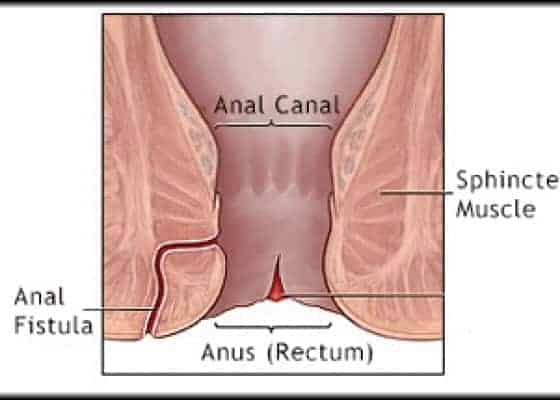
- An abnormal communication between anal canal and recto with exterior
- Even though multiple openings are seen in perianal skin – the internal opening is always single
- Causes: persistent anal gland infection, TB, Crohn’s disease, lymphogranuloma venereum, actinomycosis, rectal duplication, foreign body and malignancy
- More common in men
- Usual presentation – intermittent purulent discharge (may be bloody) and pain (which increases until temporary relief occurs when the pus discharges)
- A previous episode of acute anorectal sepsis that settled (incompletely) spontaneously or with antibiotics, or which was surgically drained
Parks classification
- Inter-sphincteric (45%) – do not cross external sphincter
- Trans-sphincteric (40%) – have a primary track that crosses both internal and external sphincters, which then passes through the ischiorectal fossa to reach the skin of the buttock
- Supra-sphincteric – rare; internal opening above anorectal bundle; usually result from pelvic disease or trauma
Goodsall’s rule (used to indicate the likely position of the internal opening according to the position of the external opening)
- Fistula with external opening in the anterior half of the anus within 3.75 cm – direct type
- Fistula with external opening in the posterior half of the anus– indirect, curved or horseshoe type
Investigations
- Endoanal ultrasound with hydrogen peroxide – to delineate fistulae
- MRI – Gold standard for fistula imaging
- Fistulography and CT – useful techniques if an extrasphincteric fistula is suspected
Treatment
- It is divided into 2 types – high & low, according to whether their internal openings is below or above the anorectal ring.
- The importance of deciding whether a fistula is a low or a high type is that a low level can be treated by fistulotomy (opening the tract) without causing damage to the sphincter.
Exam Important
- Intersphincteric fistula is the most common type of ‘fistula in ano’.
- Anal fissure is best diagnosed by characteristic history of bleeding PR and pain during defecation and clinical examination.
- Treatment of acute fissure in ano : Conservative , Dilatation under GA , Lateral sphincterotomy.
- Fistula in ano is not a cause of acute anal pain.
- Sentinel pile indicates Anal Fissure.
- Rectal examination should not be done in Anal Fissure.
- The treatment of choice in fistula in ano is Fistulotomy.
- Internal sphincterotomy is the treatment of choice for Fissure in Ano.
- High or low fistula in ano is termed according to its internal opening present with reference to Anorectal ring.
- Multiple fistula in ano commonly occurs in Tuberculosis and LGV.
- Lateral internal sphincterotomy is useful for Anal Fissure.
Don’t Forget to Solve all the previous Year Question asked on Anal Fissure and Fistula
Click Here to Start Quiz

