
AUTISM
| A | Isolated area of talent may be remarkable developed’ | |
| B |
Parental attitude and behavior do not attribute to it |
|
| C |
Emergence of speech and social smile is often delayed |
|
| D |
It represents a type of childhood neurotic disorder |
False regarding childhood autism is:
| A |
Isolated area of talent may be remarkable developed’ |
|
| B |
Parental attitude and behavior do not attribute to it |
|
| C |
Emergence of speech and social smile is often delayed |
|
| D |
It represents a type of childhood neurotic disorder |
Ans:D-It represents a type of childhood neurotic disorder
- AUTISM includes mental retardation, learning disability, communication disorder and attention deficit disorders.
- Autism is not a disease. It is one of the developmental disorders of the brain function
- Its cause is not known in majority of cases but unlike other developmental disabilities, prenatal and perinatal factors do not playa major role in its etiology.
- Clinical features are speech and language delay, impairment of comprehension of language, fluent but unintelligible jargon, impairment of social interaction, hyperactivity, unusual interest in TV commercials, repetitive compulsive play activity, etc.
- Seizures are more common in autistic children than in general population. Some autistic children have islands of brilliance
- Neurosis refers to a class of functional mental disorder involving distress but not delusions or hallucinations, where behavior is not outside socially acceptable norms.
- It is also known as psychoneurosis or neurotic disorder. This includes the following: Anxiety,OCD,Trichotillomania
| A | Attention deficit hyperactivity disorder (ADHD) | |
| B | Rett syndrome | |
| C | Conduct disorder | |
| D | Infantile autism |
features of infantile autism such as stereotypical movements, is seen only in girls.
| A |
Age between 18-24 months |
|
| B |
Child is able to interact |
|
| C |
Repetitive behavior is seen |
|
| D |
Language is not well developed |
Ans:B-Child is able to interact
|
Major Diagnostic Features of DSM-IV Pervasive Developmental Disorders |
|||||
| Feature | Autistic Disorder | Asperger’s Disorder | Childhood Disintegrative Disorder | Rett’s Disorder | Pervasive Developmental Disorder NOS |
| Social impairment | + | + | + | + | |
| Language or communication disorder | + | + | + | + | |
| Repetitive interests and activities | + | + | + | + | + |
| Onset prior to 36 months | + | + | |||
| A |
ADHD |
|
| B |
Autism |
|
| C |
Schizophrenia |
|
| D |
Depression |
Ans:B-Autism
Prevasive developmental disorder includes the following condition :
- Rett’s disorder
- Asperger’s disorder
- Childhood disintegrative disorder
- Pervasive disorders not otherwise specified
Autistic disorder
- It gives all the classical features of pervasive developmental disorder.
- The patient presents with problems in social interaction, communication and repetitive sterotype behaviour.
- In most of these patients there is subnormal intelligence.
Example
- A 3 year old boy shows no interest in or connection to his parents, other adults or children. He does not speak voluntarily and is fascinated with watching rotating objects. He screams fiercely when his environment is altered in any way such as when his mother tries to dress him.
Rett’s disorder
- It is seen exclusively in females.
- The characteristic feature of these patients is that they begin to lose their acquired skills.
Example
- After 4 months of normal development, an infant begins to lose her acquired skills. By 18 months of age, she shows little social interaction with her parents, other adults or children and she uses strange hand gestures.
Asperger’s disorder
- The important point in differential diagnosis of these patients is that they have normal intelligence. These are the only pervasive development disorders in which the intelligence is unimpaired.
- These patients often have some exceptional ability.
- They have little or no developmental language delay and relatively normal cognitive development.
In the question the lack of social interaction and communication along with stereotypic behaviour (watching her own hard) suggests Autistic disorder.
The patient does not give any symptoms of attention deficit disorder i.e. there are no symptoms indicating lack of concentration and hyperactivity.
A 3 year old boy with normal developmental milestones with delayed speech and difficulty in communication and concentration. He is not making friends. Most probable diagnosis is
| A |
Autism |
|
| B |
ADHD |
|
| C |
Mental retardation |
|
| D |
Specific learning disability |
Autism [Ref Ghai 6th/e p 65, C.P.D.T. 18thie p 186, 187]
“Difficulty in concentration and communication, delayed speech and problems in fonning social relationship in early childhood suggests the diagnosis of Autism”
Essentials of Diagnosis and Typical Features of Autism
- Onset in infancy or early childhood (before age of 3 years)
- Abnormal language and speech development (Abnormal communication)
– Inability to develop normal social skill (lack of eye contact gestures and facial expression)
– Understand little or no language (therefore fail to acquire speech)
– Deficient comprehension and communicative use of speech and gesture.
- Bahavioural peculiarities such as ritualized repetitive or stereotyped behaviour and rigidity.
- Difficulty in concentration
- Severe deficit in social responsiveness and interpersonal skills
– Intrusive sterotypes (Repetitive behaviour) together with inability to concentrate may prevent children from engaging in meaningful activity or social interaction (difficulty in making friends)
– Do not engage in pretended play (which starts before age of 2 in normal children)
Also know
- About 75% of children with autism are mentally retarded
- Epilepsy develops in one fifth to one third of autistic individuals.
- EEG abnormalities are noted in half of the patients.
| A | Onset after 6 years of age | |
| B |
Repetitive behavior |
|
| C |
Delayed language development |
|
| D |
Severe deficit in social interaction |
The onset of autistic disorder always occurs before age 3, at two peak periods.
Autistic disorders are characterized by the triad of impaired social interaction, communication and imagination. These are associated with rigid repetitive pattern of behaviour.
Ref: Essential Pediatrics By O P Ghai, 6th Edition, Page 65; Autism: A Very Short Introduction By Uta Frith, 2008, Preview.
A 3 year old child presents with developmental delayed in speech. He has difficulty in communication and social interactions. His teachers and parents are worried that he is not making any friends. He is observed to have unusual routines and repetitive activities. What is the likely diagnosis?
| A |
Autism |
|
| B |
ADHD |
|
| C |
Specific learning disability |
|
| D |
Mental retardation |
A four year old boy Tinu has normal developmental milestones except delayed speech. He is interested to watch spinning objects like fan and the washing machine. His parents struggle to get him interested in other children at home. People often comment that he is disinterested and self centred. What will be your thought regarding his diagnosis?
| A |
Autism Spectrum Disorder |
|
| B |
Sibling Rivalry |
|
| C |
Mental retardation |
|
| D |
Specific learning disability |
Tinu’s presentation is that of poor ‘theory of mind’ or lack of perspective taking, poor communication and social skills and obsessive interests in spinning objects, which is common in ASD (autism spectrum disorder).
Autism is characterized by triad of impaired social development, disturbed communication and language and presence of stereotypes.
Ref: The Biology of the Autistic Syndromes By Christopher Gillberg, Mary Coleman, 2000, Page 25
The parents of a 4-year-old girl Mili is worried that she is isolating herself from people. She seems to be deeply involved in her own games and keeping her toys in a particular order. She does not speak full sentences yet. All other developmental milestones were normal. She does not leave parents when she is taken out to a party or shopping. She finds it difficult to concentrate on reading and has not managed to write alphabets. Which of the following is the likely diagnosis?
| A |
Attention Deficit Disorder |
|
| B |
Childhood Depression |
|
| C |
Autism Spectrum Disorder |
|
| D |
Dyslexia and Dyspraxia |
In the above question, the child has persistent and pervasive symptoms of social withdrawal or poor social skills, obsessive nature and unusual routines, and poor communication skills e.g. late language development. Poor fine motor skills lead to difficulty in writing.
The condition cannot be considered as depression because the child is happy in her activities.
Due to the accompanying social and communication difficulties, it cannot be considered as dyslexia or dyspraxia.
Hence the diagnosis is Autism Spectrum Disorder which is a triad of social difficulties, communication difficulties, and obsessional symptoms.
A 3 year old girl with normal developmental milestones except that she started speaking by the age of four. She does not play with other children and wants to eat, play and sleep in her own way. She often has temper tantrums related to any new changes. What is the likely diagnosis?
| A |
ADHD |
|
| B |
Autism |
|
| C |
Specific learning disorder |
|
| D |
Mental retardation |
Autism is charecterised by a developmental delay in speech, communication difficulties, lack of social skills, difficulty in coping with change, rigid preferences and routines which is pervasive and persistent from childhood.
A 6-year-old boy is observed to be peculiar by his teacher. Children attempt to play with him but his response is to either ignore them or get angry at their advances. This response in someone with autism might best be described as which of the following?
| A |
Stereotyped behavior |
|
| B |
Lack of social reciprocity |
|
| C |
Poor language development |
|
| D |
Obsessional thinking |
- Qualitative impairments in communication
- Qualitative impairments in reciprocal social interaction
- Presence of stereotypic, restrictive, and repetitive patterns of behavior, interests, and activities.
True about Autism:
| A |
Persistent delusion |
|
| B |
Incordinate social interaction |
|
| C |
Defective reciprocal interaction |
|
| D |
B and C both |
B, C i.e. Incordinate social interaction, Defective reciprocal interaction
Infantile autism is characterizedby‑
| A |
Impaired vision |
|
| B |
Impaired neurobehavioral development |
|
| C |
A socioeconomic hazard |
|
| D |
B & C |
B, C i.e. Impaired neurobehavioral development, A socioeconomic hazard
Autism is :
| A |
Neurodevelopmental disorder |
|
| B |
Social and language communication problem |
|
| C |
Metabolic disease |
|
| D |
Mainly due to hypothalamus damage |
B i.e. Social &language communication problem
True about autism –
| A |
Occurs in high economic striata |
|
| B |
Normal communication |
|
| C |
Starts before 2-3 years of age |
|
| D |
More common in girls |
Ans. is ‘c’ i.e., Starts before 2-3 years of age
Autism
o Autism is a neurologic disroder characterized by ‑
Qualitative impairment in social interaction
- Qualitative impairment in communication.
- Restricted repetitive and streotyped patterns of behaviour, interests, and activities.
- Onset of symptoms is usually before 3 years of age.
- 3-5 times more common in boys, but more severe when occurs in girls.
o More common among low socio-economic groups.
Clinical features
- Impairment in communication
Impairment in social interaction
Inability to concentrate
Restricted repetitive and streotypes patterns of behaviour, interests and activities.
Failure to acquire speech.
Approximately 75% of children with autism are mentally retarded.
Epilepsy develops in approximately one-fifth to one-third individuals.
Half of autistic patients have abnormalties on EEG.
September 2009
| A |
A metabolic disorder |
|
| B |
Caused due to teratogenic drugs |
|
| C |
Impaired reciprocal social and interpersonal interaction |
|
| D |
Neurodevelopmental disorder |
Ans. C: Impaired reciprocal social and interpersonal interaction
Autism is characterized by impaired social interaction and communication, and by restricted and repetitive behavior. These signs all begin before a child is three years old.
Autism affects information processing in the brain by altering how nerve cells and their synapses connect and organize
It is one of three recognized disorders in the autism spectrum, the other two being Asperger syndrome, which lacks delays in cognitive development and language, and pervasive developmental Disorder-not otherwise specified (commonly abbreviated as PDD-NOS), which is diagnosed when the full set of criteria for autism or Asperger syndrome are not met.
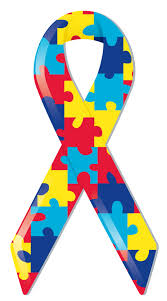
| A | Alcoholism | |
| B |
Depression |
|
| C |
Substance use disorders |
|
| D |
Autism |
Ans:D.-Autism.
- The puzzle ribbon was adopted in 1999 as the universal sign of autism awareness.
- Although this image is a trademark of the Autism Society, the organization has granted use to other non-profit organizations in order to demonstrate unity and advance a universal mission as opposed to any individually held interests or promotion of a single organization.
- The Autism Awareness Ribbon — The puzzle pattern reflects the complexity of the autism spectrum.
- The different colors and shapes represent the diversity of the people and families living with the condition.
- The brightness of the ribbon signals hope — hope that through increased awareness of autism, and through early intervention and access to appropriate services/supports, people with autism will lead full lives able to interact with the world on the own terms
| A |
2/3rd patients are mentally retarded |
|
| B |
Poor eye contact |
|
| C |
Language is impaired |
|
| D |
Abnormal dermatoglyphics |
Ans:A-2/3 patients are mentally retarded
Clinical criteria for the diagnosis of autism are based on the DSM-IV TR and ICD10 specifications.
A diagnosis of autism is based on symptoms in three areas: difficulties in reciprocal social interaction, difficulties in communication, and the presence of restricted and repetitive behaviors or interests.
Children with autism often appear relatively normal in their development until the age of 18-24 months, when parents may notice delays in language, play or social interaction.
Language develops slowly or not at all.
Social interaction is very poor.
There is no eye contact or smile.
