
BACTERIAL VAGINOSIS
| A | Fishy odour discharge | |
| B |
Grey discharge |
|
| C |
Clue cells found |
|
| D |
All of these |
True about Bacterial vaginosis :
| A |
Fishy odour discharge |
|
| B |
Grey discharge |
|
| C |
Clue cells found |
|
| D |
All of these |
Ans. is D. i.e. All of these
Grey discharge; Clue cells found; Fishy odor discharge; and Caused by Gardnerella vaginalis
- Overall M/c vaginitis.
- This is due to the alteration of vaginal flora.
- Gardnerella is the causative agent.
- Lactobacilli decrease whereas coccobacilli and Gardnerella increase
- It is not an STD.
- Vaginosis is associated with minimal inflammatory response, the vaginal fluid reveals few leucocytes.
- The concentration of bacteria is increased manifold (100–1000 fold) as compared to normal women.
- M/C complaint is Foul-smelling dirty white discharge.
- No inflammation-hence no itching.
- Dyspareunia.
- pH > 4.5
- Whiff test—The fishy odor is suggestive of the presence of bacterial vaginosis.
- Positive amine test.
| A |
pH < 4.5 |
|
| B |
Clue cell |
|
| C |
Amine test is positive |
|
| D |
B and C both |
Ans. is D. i.e. B and C both
Clue cells; Amine test is positive
Bacterial vaginosis
- It is characterized by Greyish white vaginal secretions thinly coating the vaginal walls.
- pH is >4.5.
- Whiff’s test / Amine test – Positive (i.e. addition of 10% KOH to vaginal secretions produces fishy odor).
- Microscopy in Bacterial vaginosis shows Clue cells.
- Increase in the number of Gardnerella vaginalis.
- Decreased number of lactobacilli.
- Leucocytes (conspicuously absent).
| A | Abundance of gram variable coccobacilli | |
| B |
Absence of Lactobacilli |
|
| C |
Abundance of polymorphs |
|
| D |
Present of clue cells |
Ans. is c i.e. Abundance of polymorphs
In Bacterial vaginosis, polymorphs are either absent or there is only a slight increase.
Consider the following characteristic of vaginal discharge in bacterial vaginosis :
| A |
Green and thick vaginal discharge |
|
| B |
pH < 4.5 |
|
| C |
Increase in number of lactobacilli |
|
| D |
Whiff test positive |
Ans. is D. i.e. Whiff test positive
Bacterial Vaginosis
- Overall M/c vaginitis
- This is due to the alteration of vaginal flora.
- Gardnerella is the causative agent.
- Lactobacilli decrease whereas coccobacilli and Gardnerella increase
- It is not an STD.
- Vaginosis is associated with minimal inflammatory response, the vaginal fluid reveals few leucocytes.
- M/C complaint is Foul-smelling dirty white discharge which is thin in consistency.
- pH > 4.5
- Whiff test—The fishy odor is suggestive of the presence of bacterial vaginosis.
- Positive amine test.
| A |
Metronidazole |
|
| B |
Doxycycline |
|
| C |
Clindamycin |
|
| D |
Ciprofloxacin |
Metronidazole
Bacterial vaginosis does not include?
| A | Profuse creamy discharge | |
| B |
Clue cells present |
|
| C | Positive whiff test | |
| D |
Absent leucocytes |
Profuse creamy discharge REF: 12th edition of Novak’s Gynecology p. 192, shaw 13th ed p 129, Repeat in December 2011
Bacterial vaginosis is diagnosed on the basis of the following findings:
- A fishy vaginal odour, which is particularly noticeable following coitus, and vaginal discharge are present.
- Vaginal secretions are gray and thinly coat the vaginal walls.
- The pH of these secretions is higher than 4.5 (usually 4.7 to 5.7).
- Microscopy of the vaginal secretions reveals an increased number of clue cells, and leukocytes are conspicuously absent. In advanced cases of BV, more than 20% of the epithelial cells are clue cells.
- The addition of KOH to the vaginal secretions (the “whiff” test) releases a fishy, amine-like odor.
- Culture of G. vaginalis is not recommended as a diagnostic tool because of its lack of specificity.
| A | Bacterial vaginosis | |
| B | Trichomonas | |
| C | Candida | |
| D | Gonorrhoea |
| A |
Bacterial vaginosis |
|
| B |
Chlamydia trachomatis |
|
| C |
Neisseria gonorrhoeae |
|
| D |
Trichomonas |
Clue cells are the most reliable indicators of bacterial vaginosis (BV).
These vaginal epithelial cells contain many attached bacteria, which create a poorly defined stippled cellular border.
The positive predictive value of this test for the presence of BV is 95 percent.
- Homogeneous white, noninflammatory discharge
- Microscopic presence of clue cells
- Vaginal discharge with pH >4.5
- Fishy odor with or without addition of 10% potassium hydroxide
| A |
Bacterial vaginosis |
|
| B |
Candidiasis |
|
| C |
Trichomoniasis |
|
| D |
Gonorrhoea |
Presence of clue cells (>20% of epithelial cells) on microscopy is one of the diagnostic criteria of bacterial vaginosis.
Clue cells are identified as numerous stippled or granulated epithelial cells. This appearance is caused by the adherence of G vaginalis organisms to the edges of the vaginal epithelial cells.
| A |
Plenty of lactobacilli |
|
| B |
pH > 4.5 |
|
| C |
Whiff’s test positive |
|
| D |
Clue cells |
Ans. is A. i.e. Plenty of lactobacilli
The diagnosis of bacterial vaginosis is made based on Amsel criteria.
- According to these criteria, bacterial vaginosis is present if 3 of the following findings are present:
- In bacterial vaginosis, lactobacilli producing strains are greatly diminished and are replaced with a large number of Gardnerella vaginalis.
- The decline in lactobacilli which normally produces lactic acid, resulting in increased vaginal pH.
- This increase in pH allows the overgrowth of anaerobic bacteria.
| A |
Bacterial vaginosis |
|
| B |
Herpes virus |
|
| C |
Syphilis |
|
| D |
Toxoplasmosis |
Ans. is A. i.e. Bacterial Vaginosis
Amsel criteria for bacterial vaginosis:
- Elevated vaginal pH (>4.5)
- Positive amine odor when vaginal fluid is mixed with 10% potassium hydroxide (KOH)—the so-called “whiff” test
- Presence of clue cells (squamous epithelial cells covered with adherent bacteria) in a saline (wet mount) preparation of the vaginal fluid
- Homogenous milky or creamy vaginal discharge
According to these criteria, bacterial vaginosis is present if three of the following findings are present.
| A |
Human papillomavirus |
|
| B |
Trichomonas vaginitis |
|
| C |
Monilial vaginitis |
|
| D |
Bacterial vaginosis |
Ans. is D. i.e. Bacterial vaginosis
Hazards of Bacterial Vaginosis
Women with BV are at increased risk for:
- PID
- Postabortal PID
- Postoperative cuff infections after hysterectomy
- Abnormal cervical cytology.
Pregnant women with BV are at risk for:
- PROM
- Preterm delivery
- Chorioamnionitis
- Post cesarean endometritis
| A |
Clue cells present |
|
| B |
Gardnerella is the causative agent |
|
| C |
Pruritis is seen |
|
| D |
Grey and foul-smelling discharge |
Ans. is C i.e. Pruritis seen
- Bacterial vaginosis causes minimal vulval irritation
Bacterial vaginosis
- Cause: Multibacterial (Hemophilus vaginalis, Gardnerella vaginalis, etc.)
- Clinical presentation:
- Milky, homogenous and adherent foul smelling discharge
- Vaginal pH: Alkaline (greater than 4.5)
- Histological feature: Clue cells
- DOC: Metronidazole
| A |
Abundant lactobacillus |
|
| B |
pH>4.5 |
|
| C |
Clue cells |
|
| D |
It is not sexually transmitted |
Ans. A: Abundant lactobacillus
To make a diagnosis of bacterial vaginosis, a speculum examination and subsequent swabs from high in the vagina should be obtained. These swabs should be tested for:
- A characteristic “fishy” odor on wet mount. This test, called the whiff test, is performed by adding a small amount of potassium hydroxide to a microscopic slide containing the vaginal discharge.
- A characteristic fishy odor is considered a positive whiff test and is suggestive of bacterial vaginosis.
- Loss of acidity.
- To control bacterial growth, the vagina is normally slightly acidic with a pH of 3.8-4.2.
- A swab of the discharge is put onto litmus paper to check its acidity. A pH greater than 4.5 is considered alkaline and is suggestive of bacterial vaginosis.
- The presence of clue cells on wet mount. Similar to the whiff test, the test for clue cells is performed by placing a drop of sodium chloride solution on a slide containing vaginal discharge.
- If present, clue cells can be visualized under a microscope. They are so-named because they give a clue to the reason behind the discharge. These are epithelial cells that are coated with bacteria.
- It is not an STD

| A | Bacterial vaginosis. | |
| B |
Herpes virus. |
|
| C |
Syphilis. |
|
| D |
Toxoplasmosis. |
Ans. is A. Bacterial Vaginosis
- cells marked in the picture are clue cells.
- Clue cells are seen in bacterial vaginosis.
Criteria for bacterial vaginosis:
- Elevated vaginal pH (>4.5)
- Positive amine odor when vaginal fluid is mixed with 10% potassium hydroxide (KOH)—the so-called“whiff” test
- Presence of clue cells (squamous epithelial cells covered with adherent bacteria) in a saline (wet mount) preparation of the vaginal fluid
- Homogenous milky or creamy vaginal discharge
According to these criteria, bacterial vaginosis is present if three of the following findings are present.
Cell type (Photograph) is seen in Vagina of a case of

| A |
HSV |
|
| B |
Candidiasis |
|
| C |
Bacterial vaginosis |
|
| D |
Trichomonas gaginitis |
These cells are clue cells
Bacterial vaginosis (BV) is a disease of the vagina caused by excessive growth of bacteria.Common symptoms include increased vaginal discharge that often smells like fish. The discharge is usually white or gray in color. Burning with urination may occur. Itching is uncommon.Occasionally, there may be no symptoms.Having BV approximately doubles the risk of infection by a number of other sexually transmitted infections, including HIV/AIDS. It also increases the risk of early delivery among pregnant women
Identify the infection in the vagina as shown in the photograph below?
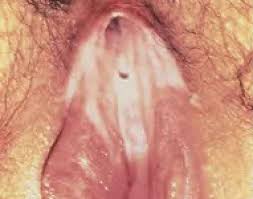
| A |
HIV. |
|
| B |
Syphilis. |
|
| C |
Bacterial vaginosis |
|
| D |
None of the above. |
Ans is C. i.e. Bacterial vaginosis
- It is a mild infection of the vagina caused by bacteria.
- Normally, there are a lot of “good” bacteria and some “bad” bacteria in the vagina. The good types help control the growth of the bad types.
- In women with bacterial vaginosis, the balance is upset.
- There are not enough good bacteria and too many bad bacteria.
- The most common symptom is a smelly vaginal discharge.
- It may look grayish-white or yellow.
- A sign of bacterial vaginosis can be a “fishy” smell, which may be worse after sex.
- About half of women who have bacterial vaginosis do not notice any symptoms.

| A |
Trichomoniasis |
|
| B |
Bacterial Vaginosis |
|
| C |
Candidiasis |
|
| D |
Actinomycosis |
Ans. is B. i.e. Bacterial Vaginosis.
- Indicator cells also known as “Clue Cells” form the characteristic picture of BV.
- Note the presence of multiple microorganisms, which are attached to a single squamous epithelial cell.
Investigations for bacterial vaginosis:
- IOC -Saline microscopy ‘Clue cells’, i.e. vaginal epithelial cells to which bacteria have adhered is seen.
- The gold standard investigation is a Gram stain.
- On gram staining -Nugent scoring is done.
- The Nugent score is calculated by assessing the Presence of lactobacillus (Gram +ve rods-scored as 0 to 4), Gardnerella vaginalis (scored as 0 to 4) and mobiluncus (Gram variable rods-scored as 0-2).
- A score of > 7 is consistent with bacterial vaginosis.
- Hanging drop examination—Reveals the presence of motile trichomonas organisms.
- KOH treated preparation of vaginal discharge—Reveals the presence of pseudomycelia and spores of candidal organisms.
- pH > 4.5
- Whiff test—The fishy odour is suggestive of the presence of bacterial vaginosis.
- Positive amine test.
