
CARPAL TUNNEL SYNDROME
A medical condition in which the median nerve is compressed at the wrist, leading to pain, paresthesias, and muscle weakness in the forearm and hand.
* Carpal tunnel syndrome is the most common & widely known entrapment neuropathy in which the body’s peripheral nerve is compressed or traumatized.
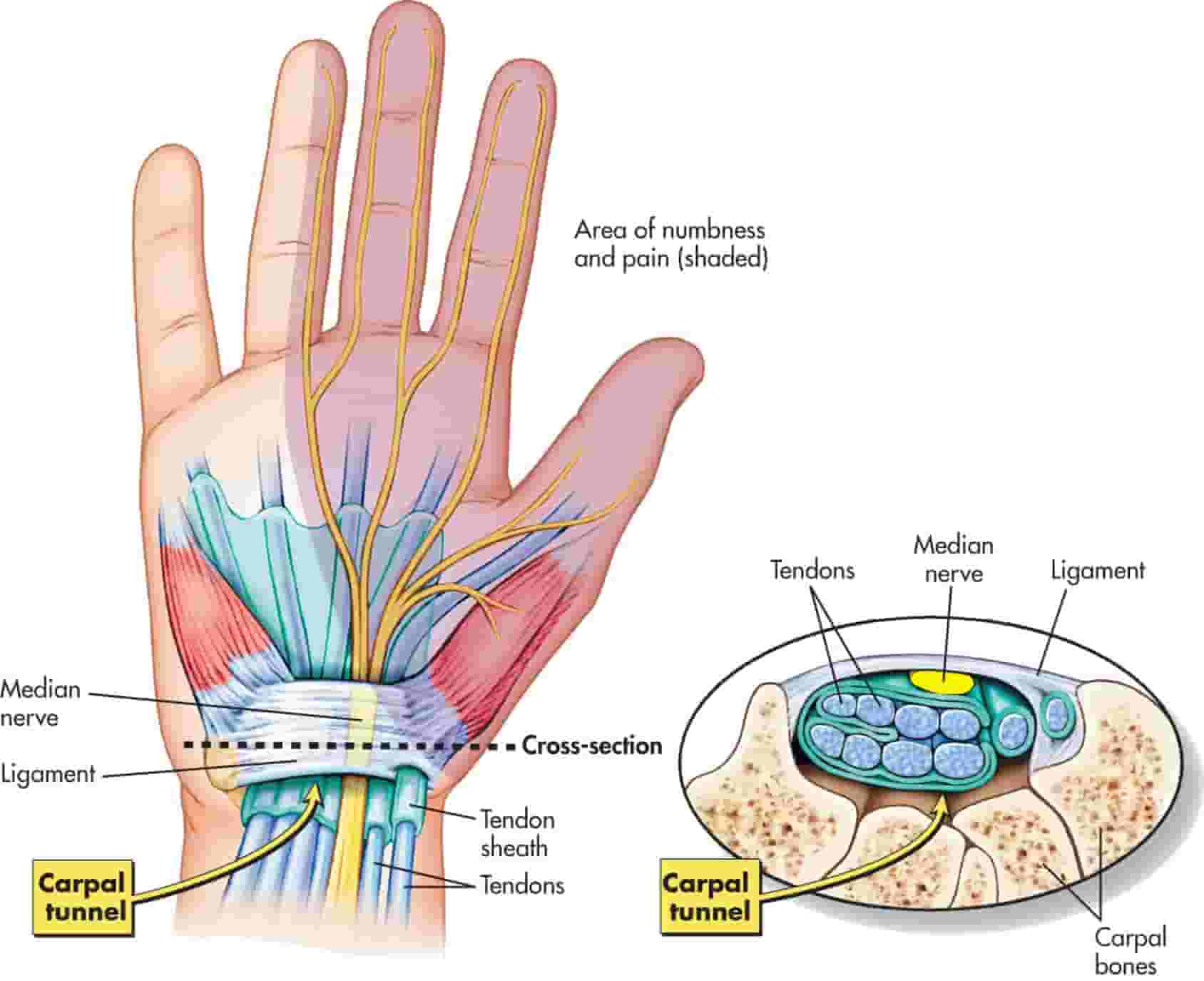
* Carpal tunnel syndrome occurs when the median nerve is compressed in the carpal tunnel below flexor retinaculum.
* The carpal tunnel is a narrow rigid passage way of ligament & bones at the base of hand, in front of distal part of wrist.
* Carpal tunnel houses the median nerve & 9 tendons (4 FDS, 4 FDP & FPL).
Associated conditions that can leads to carpal tunnel syndrome are:
1. Idiopathic (most common)
2. Pregnancy
3. Endocrine disorders
* Hypothyroidism
* Diabetes mellitus
* Myxedema
* Acromegaly
* Hyperparathyroidism
4. Deposition disorders
* Rheumatoid disorder
* Gout
* Rheumatic disorder
* Amyloidosis
* Sarcoidosis
* Leukemia
* Chronic renal failure
CLINICAL FEATURES:
* Symptoms usually start gradually, with frequent burning, tingling, paraesthesia and numbness in the distribution of median nerve, i.e. lateral three & half of fingers and lateral 2/3 rd of palm.
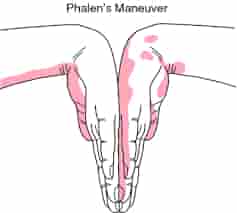
* Sensory symptoms can often be reproduced by percussing over median nerve (Tinel’s sign) or by holding the wrist fully flexed for a minute (Phalen’s test).
* As a disease progress, clumsiness of hand and impairement of digital function develop.
* Later in the disease, there is sensory loss in median nerve distribution and obvious wasting of thenar eminence.
CLINICAL TEST FOR CARPAL TUNNEL SYNDROME
* There are some provocative tests which act as important screening methods:
1. Wrist flexion (Phalen’s test):
* The patient is asked to actively place the wrist in complete flexion.
* If tingling & numbness develop in the distribution of median nerve, the test is positive.
* This is most sensitive provocative test.
2. Tourniquet test:
* A pneumatic BP cuff is applied proximal to the elbow & inflated higher than the patient’s systolic BP.
* The test is positive if there is paraesthesia or numbness in the region of median nerve distribution in hand.
3 .Median nerve percussion test (Tinel’s sign):
The median nerve is gently tapped at the wrist. The test is positive if there is tingling sensation.

4. Median nerve compression test:
* Direct pressure is exerted equally over both wrists by the examiner.
* If symptoms of carpal tunnel syndrome appear, the test is positive.
| NERVE | PLACE | USUALLY REFERRED TO AS |
| Median | Carpal tunnel | Carpal tunnel syndrome |
| Median (anterior interosseous) | Proximal forearm | Anterior interosseous syndrome |
| Median | Pronator teres | Pronator teres syndrome |
| Median | Ligament of Struthers | Ligament of Struthers syndrome |
| Ulnar | Cubital tunnel | Cubital tunnel syndrome |
| Ulnar | Guyon’s canal | Guyon’s canal syndrome |
| Radial | Axilla | Radial nerve compression |
| Radial | Spiral groove | Radial nerve compression |
| Radial (posterior interosseous) | Proximal forearm | Posterior interosseous nerve entrapment |
| Radial (superficial radial) | Distal forearm | Wartenberg’s Syndrome |
| Suprascapular | Suprascapular notch | Suprascapular nerve entrapment |
Exam Important
* Carpal tunnel syndrome is caused by Hypothyroidism, Pregnancy & Acromegaly.
* Median nerve involvement is present in Carpal tunnel syndrome.
* Carpal tunnel syndrome is associated with Acromegaly,Rheumatoid arthritis,Gout, Wrist osteoarthritis,Diabetes Mellitus,Hypothyroidism, Myxedema & Pregnancy
* The carpal tunnel involves Median Nerve, Flexor pollicis longus & Flexor digitorum superficialis.
* Compression of a nerve within the carpal tunnel products inability to Oppose the thumb.
* Most sensitive test for carpal tunnel syndrome is Phalen’s test.
Click Here to Start Quiz

