
Case Control Study
DEFINITION:
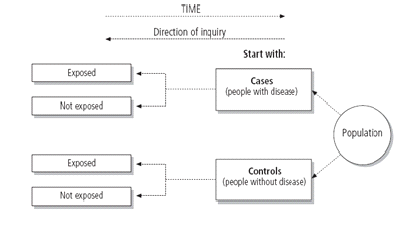

- A case control study involves two populations – cases and controls and has three distinct features :
- Both exposure and outcome have occurred before the start of the study.
- The study proceeds backwards from effect to cause(Retrospective)
- It uses a control or comparison group to support or refute an inference.
DESGIN:
- The investigator selects cases with the disease and appropriate controls without the disease and obtains data regarding past exposure to possible etiologic factors in both groups.
- The investigator then compares the frequency of exposure of the two groups.
- Hallmark of Case Control Study: Starts from cases and controls and searches for exposure.
|
CASES
(With disease) |
CONTROL
(Without disease) |
|
| Were Exposed | a | b |
| Were Not Exposed | c | d |
| Totals | a+c | b+d |
| Proportions Exposed | a/a+c | b/b+d |
SELECTION OF CASE & CONTROL:
Selection of CASES:
- Representativeness:
- Random sample of all cases of interest in the source population (e.g. from vital data, registry data).
- Selection of available cases from a medical care facility. (e.g. from hospitals, clinics)
- Information: Collected from cases themselves, or from a respondent by proxy (relative/ friend), from records or a combination of the above.
- Method of Selection:
- From incidence or prevalence case:
- Incident cases:Ongoing ascertainment of cases over time.
- Prevalent cases : Crosssectional survey.
- Selection of INCIDENT CASES is OPTIMAL.
- All newly diagnosed cases over a given period of time in a defined population.
- Excludes patients who died before diagnosis.
- Prevalent cases
- So patients who recovered early and those who died will not be included.
- Additional protection against bias by including deceased cases as well as those alive
- Diagnostic criteria for case studies
- Specificity
- Diagnostic bias
- Validation
Selection of CONTROLS:
- Comparability vs Representativeness:
- Similar to the cases in all respects other than having the disease i.e. COMPARABLE
- Representative of all non-diseased people in the population from which the cases are selected i.e. REPRESENTATIVE
- Representative of the general population in terms of probability of exposure to the risk factor
- They should also have had the same opportunity to be exposed as the cases have.
- Criteria:
- Comparability is more important than representativeness in the selection of controls
- The control should be at risk of the disease
- The control should resemble the case in all respects except for the presence of disease
- Sources:
- Hospital based
- Population based (registry cases)
- Neighbourhood controls/ Telephone exchange random dialing
- Best friend control/ Sibling control
- Number:
- Large study: Cases: Control :: 1:1
- Small study: Cases: Control :: 1:2, 1:3, 1:4.
- Use of multiple controls
- Types:
- Controls of same type:Cases: Control :: 1:1
- Multiple controls of different types: controls- 1 hospital, 1 neighborhood
- Objectives:
- Elimination of selection bias – Selection
- Minimization of information bias – Blinding
- Minimization of confounding – Matching
BIAS IN CASE CONTROL STUDY:
- Selection bias
- Information bias:
- Recall bias
- Interviewer bias
- Confounding bias
OUTCOMES OF CASE CONTROL STUDY:
- Exposure rates:
- The frequency of exposure to suspected risk factor in cases and in controls
- Exposure rates:
- Cases = a/ (a + c)
- Controls = b/ (b + d)
- Estimation of disease risk associated with exposure: (Odds ratio)
- Odds Ratio / Relative odds (estimate of relative risk)
- Odds ratio=Odds that case was exposed/Odds that control was exposed= (a/c)/ (b/d)
- Odds ratio ( = cross products ratio) can also be viewed =Product of the two cells that support the hypothesis of an association/product of the two cells which negate the hypothesis of an association= ad/bc
ADVANTAGES:
- Uncover etiology in rare diseases
- Understanding new diseases
- Commonly used in outbreaks investigation
- Useful if inducing period is long
- Relatively inexpensive
- Causal association factors can be revealed
DISADVANTAGES:
- Susceptible to bias
- Exposure misclassification
- Single outcome
- Incidence rates not usually calculate
- Cannot assess effects of matching variables
NESTED CASE CONTROL STUDY:
- Also k/as Prospective case-control study
- Cases and controls are drawn from the population in a fully enumerated cohort.
- Used when exposure of interest is difficult or expensive to obtain and when the outcome is rare.
- Cases and controls are developed during follow up.
- Exposure frequencies are compared by the data collected at the start of study.
- Advantages:
- Time and cost of beginning a new case–control study is avoided.
- Recall bias eliminated
- Exposure data are more likely to represent the preillness state
- Avoids problems (in study design) related to Temporal association
- By only measuring the covariate in as many participants as necessary, the cost and effort of exposure assessment is reduced.
Exam Important
- Recall bias is most commonly associated with Case control study
- Nested case control study is a type of Prospective study
- Odds ratio can be calculated in case control study
- Case control study are Relatively cheap
- Case control study Used for rare diseases
- Case control study proceeds from effect to cause
- Exposure already occur in case control study
- Risk factor can be identified using case control study
- There is no risk to subjects in case control study
- In a case control study, the most characteristic feature is Odds ratio estimation
- In case control study, the risk is calculated by Cross product ratio
- Possible to study many diseases in case control study
- Direction of study is reverse but time is forward in case control study
- As compared to a routine case control study, nested case control study avoids problems (in study design) related to Temporal association
- Causal association factors can be revealed by Case control study
- Matching is method to eliminate confounding bias used in Case control study
Don’t Forget to Solve all the previous Year Question asked on Case Control Study
Click Here to Start Quiz
Click Here to Start Quiz

