
Catabolism of carbon skeleton of amino acids
Introduction
The catabolism of amino acids has two parts
- Removal of amino group to form ammonia, which later is disposed after conversion into urea.
- Breakdown of the remaining carbon skeletal, which remains after removal of amino group.
The carbon skeletons of amino acids is degraded into seven products:
(i) Pyruvate, (ii) Acetyl-CoA, (iii) Acetoacetyl-CoA, (iv) α-ketoglutarate, (v) Succinyl-CoA, (vi) Fumarate and (vi) Oxaloacetate.
- All the products enter the citric acid cycle and are either involved in gluconeogenesis or in ketogenesis or either oxidized to CO2 and H2O with production of energy.
- Amino acids that are degraded only in acetyl-CoA or aceto-acetyl CoA give rise to ketone bodies,eg: Ieucine and lysine are ketogenic amino acids.
- Amino acids that are converted to pynrvate, α-ketoglutarate, succinyl-CoA, fumarate or oxaloacetate, are glucogenic amino acids,eg: alanine, glycine, serine
- Amino acid which involves both gluconeogenesis and ketogenesis are: isoleucine, phenylalanine tryptophan and tyrosine.
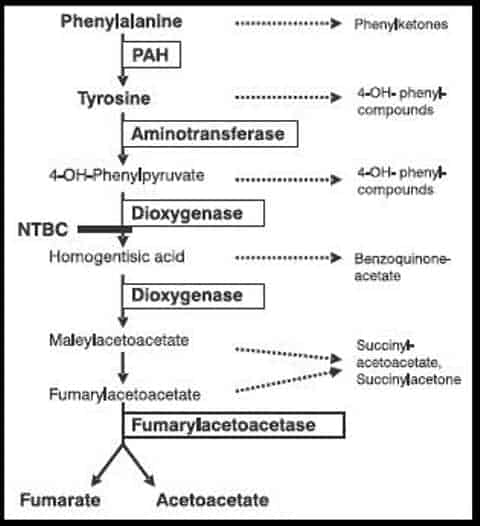
For example: Enzymes involved in catabolism of Tyrosine:
- Tyrosine Transaminase: PLP is the coenzyme for this reaction, Deficiency causes Tyrosinemia type – II (Richer-Hanhart syndrome)
- pHydroxyphenylpyruvate Hydroxylase: Dioxygenase, Cofactor is Copper, Ascorbic Acid is needed for reaction.
- Homogentisate Oxidase: Contains Iron at the active site.
- Maleyl acetoacetate Cis-trans lsomerase: Need Glutathione (GSH) as cofactor
- Fumaryl Acetoacetate Hydrolase: defeciency causes Tyrosinemia type-I (tyrosinosis/hepatorenal syndrome)
Products from Tyrosine: Melanin, Catecholamines, Thyroxine, Norepinephrine, Dopamine.
Exam Important
- Amino acids that are degraded only in acetyl-CoA or aceto-acetyl CoA give rise to ketone bodies,eg: Ieucine and lysine are ketogenic amino acids.
- Amino acids that are converted to pynrvate, α-ketoglutarate, succinyl-CoA, fumarate or oxaloacetate, are glucogenic amino acids,eg: alanine, glycine, serine
- Amino acid which involves both gluconeogenesis and ketogenesis are: isoleucine, phenylalanine tryptophan and tyrosine.
- Enzymes involved in catabolism of Tyrosine:
- Products from Tyrosine: Melanin, Catecholamines, Thyroxine, Norepinephrine, Dopamine.
Don’t Forget to Solve all the previous Year Question asked on Catabolism of carbon skeleton of amino acids
Click Here to Start Quiz
Click Here to Start Quiz

