
CATARACT- TYPES & CAUSES
| A | Sunflower cataract | |
| B |
Rosette-shaped cataract |
|
| C |
Snow-storm cataract |
|
| D |
Coronary cataract |
A true diabetic cataract is also known as:
| A |
Sunflower cataract |
|
| B |
Rosette-shaped cataract |
|
| C |
Snow-storm cataract |
|
| D |
Coronary cataract |
Ans. Snow-storm cataract
Cataract brunescens result due to deposition of:
| A |
Melanin |
|
| B |
Copper |
|
| C |
Iron |
|
| D |
Silver |
Ans. Melanin
Most common type of cataract following radiation is:
| A |
Posterior subcapsular |
|
| B |
Anterior subcapsular |
|
| C |
Tear-drop cataract |
|
| D |
Diffuse cataract |
Ans. Posterior subcapsular
Christmas tree cataract is seen in:
| A |
Down’s syndrome |
|
| B |
Rubella |
|
| C |
Myotonic dystrophy |
|
| D |
Diabetes |
Ans. Myotonic dystrophy
Congenital morgagnian cataract is a feature of:
| A |
Rubella cataract |
|
| B |
Lowe’s syndrome |
|
| C |
Hereditory cataract |
|
| D |
Galactosemic cataract |
Ans. Rubella cataract
The most common type of congenital cataract is:
| A |
Capsular |
|
| B |
Zonular |
|
| C |
Coralliform |
|
| D |
Blue dot |
- Punctate/Blue dot cataract is the most common type of congenital cataract.
- Appears as multiple tiny blue dots scattered all over the lens, especially in the cortex by oblique illumination with the slit lamp.
- The bluish colour is due to the effects of dispersion of light, in the same way that the sky appears blue.
- Visual acuity is not disturbed.

Which of the following is the only reversible cataract:
| A |
Senile cataract |
|
| B |
Cataract in galactosemia |
|
| C |
Congenital cataract |
|
| D |
None |
Ans. Cataract in galactosemia
Minimum vision loss with which cataract:
| A |
Blue dot cataract |
|
| B |
Zonular cataract |
|
| C |
Anterior polar cataract |
|
| D |
Posterior polar cataract |
Ans. Blue dot cataract
Traumatic cataract occurs as:
| A |
Rosette-shaped cataract |
|
| B |
Zonular cataract |
|
| C |
Total cataract |
|
| D |
All of the above |
Ans. All of the above
Sunflower cataract is due to deposition of:
| A |
Cu |
|
| B |
Zn |
|
| C |
Fe |
|
| D |
Ca |
Ans. A i.e. Cu
Cataract
- Snowflake cataract: DM
- Rossette cataract: Trauma
- Christmas tree pattern: Myotonic dystrophy
- Sunflower cataract: Wilsons disease
- Oil drop cataract: Galactosemia
| A | Uveitis | |
| B |
Retinitis pigmentosa |
|
| C |
Degenerative myopia |
|
| D |
All of the above |
Ans. D i.e. All of the above
Cataract
- Systemic causes of cataract:
– HTN,
– Smoking,
– DM
MC cataract in adults: Cortical cataract
- Complicated cataract: Characteristic sign is polychromatic lusture
- Lamellar cataract: Associated with
– Malnutrition &
– Hypoparathyroidism
- After cataract: Nd: YAG LASER capsulotomy is done
March 2007
| A | Trauma | |
| B |
DM |
|
| C |
Age related |
|
| D |
Hereditary |
Ans. C: Age related
Age-related/senile cataract is the most common cause of catarcat.
It may be of significance that as age progresses the semipermeability of the capsule is impaired, the inactive insoluble proteins increase, and the antioxidative mechanisms becomes less effective.
The normal lens contains sulphydryl-containing reduced glutathione and ascorbic acid, both of which decrease with age and in cataract.
| A | Wilson’s disease | |
| B |
Diabetes mellitus |
|
| C |
Galactosemia |
|
| D |
None of the above |
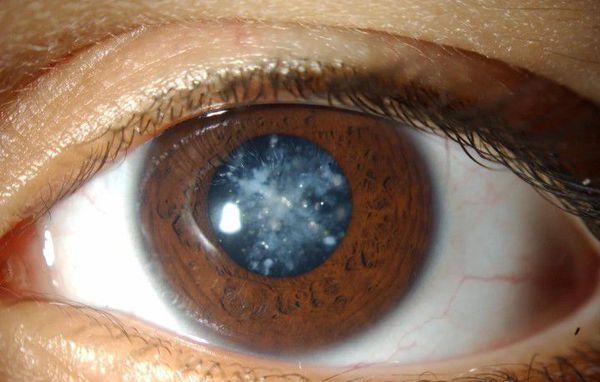
Snowflake cataract is seen in diabetes mellitus.
Snowflake cataract:
- cataract-bilateral, acute
- cortical (anterior and posterior cortex) opacities seen in young patients with uncontrolled diabetes mellitus.
- More common in patients with type 1 DM.
Causes:
- Osmotic overhydration
- Excess glucose is converted to sorbitol by the enzyme aldose reductase.
Associated feature:
Fluctuation in refractive error is a sign of changing lens hydration.
Snowflake cataract in diabetes mellitus:
Intumescent cataract is associated with which type of glaucoma:
September 2009
| A |
Phacolytic glaucoma |
|
| B |
Phacomorphinc glaucoma |
|
| C |
Phacotopic glaucoma |
|
| D |
Pseudophakic glaucoma |
Ans. B: Phacomorphinc glaucoma
Increase in the water content and alteration in the protein structure causes lens opacification.
People with cortical cataracts experience glare from oncoming car headlights which can incapacitate them leading on to what is known as “nonocular diplopia” – seeing a single object double with the affected eye, the other eye being closed.
As the lens continues to take up water it may swell and become an intumescent cataract, still later it forms a total white opacity called mature cataract and finally become Hypermature cataract.
The proteins leak out leaving behind a shrunken -Posterior subcapsular cataract – Patients develop a greater decrease in near vision than distant vision.
- Phacolytic glaucoma is associated with a damaged lens/if lens protein from a hypermature cataract escape into the aqueous.
- Phacomorphinc glaucoma occurs when the swollen lens (intumescent stage) obliterates the drainage angle by forcing the root of the iris against the cornea.
- Phacotopic glaucoma is seen when a partial subluxation/ complete dislocation of lens blocks the angle of drainage.
March 2009
| A | Fructose | |
| B |
Galactose |
|
| C |
Glucose |
|
| D |
Sorbitol |
Ans. D) Sorbitol
- Cataract is considered as a major cause of visual impairment in diabetic patients.
- Senile cataract tends to develop at an earlier age and more rapidly than usual in diabetic patients.
- The enzyme aldolase reductase catalyzes the reduction of glucose to sorbitol through the polyol pathway, a process linked to the development of diabetic cataract.
- NADPIP dependent aldolase reductase reduces excessive glucose to sorbitol and intracellular accumulation of sorbitol leads to osmotic changes resulting in hydropic lens fibers that degenerate and form sugar cataract.
- The typical diabetic cataract is snowflake cataract, i.e., dense white subcapsular opacities in the anterior and posterior cortex resembling a snowstorm.
| A |
Cortical |
|
| B |
Nuclear |
|
| C |
Posterior subcapsular |
|
| D |
Zonular |
Ans. C: Posterior subcapsular
Posterior subcapsular cataract results in loss of ability to see objects in bright sunlight and blinded by the light of oncoming headlights when driving at night as constriction of pupil cut off peripheral vision from non-cataractous area
Posterior subcapsular cataract
- An opacity in the lens positioned just anterior to the posterior lens capsule and characterized by the posterior migration of lens epithelial cells from the lens bow.
Etiology
- The lens is composed largely of crystallins which aggregate in cataract formation.
- There are many associations with posterior subcapsular cataracts including chronic vitreal inflammation, ionizing radiation, trauma and prolonged use of corticosteroids.
Clinical Findings
- Younger individuals may be affected and the symptoms include complaints of glare at night with bright headlights or poor vision with accommodation.
- Near vision may often be more affected than distance vision.
- Usually, the earliest sign is a focal dot-like area on the posterior capsule or a reflective sheen.
- With progression, translucent opacities appear (the swollen Wedl cells) on the posterior capsule that have been likened to a “cloth of gold” or “fish eggs”.
- A posterior capsular cataract is associated with cortical degeneration and nuclear sclerosis.
Gross
- An opacity that is central and irregular is the most frequent finding
Treatment
Surgical removal of the cataract generally restores vision.
| A | Chalcosis | |
| B |
Juvenile diabetes mellitus |
|
| C |
Down syndrome |
|
| D |
Trauma |
Ans. A: Chalcosis
Sunflower cataract is associated with deposition of copper.
Chalcosis lentis/ Copper cataract/ Sunflower catarac
Ans. A: Chalcosis
Sunflower cataract is associated with deposition of copper.
Chalcosis lentis/ Copper cataract/ Sunflower cataract
- A cataract caused by excessive intraocular copper.
- May be due to intraocular, copper-containing foreign bodies.
- Copper deposits in Descemet membrane, vitreous, the internal limiting membrane of the retina, and fibrous capsule around the foreign bodies could be demonstrated by rhodanine, rubeanic acid, and alizarin blue stains.
- Eyes with foreign bodies containing more than 85% copper tended to show more disseminated copper deposits.
- Eyes with an alloy containing less than 85% copper showed more localized deposits of copper.
- A cataract caused by excessive intraocular copper.
- May be due to intraocular, copper containing foreign bodies.
- Copper deposits in Descemet membrane, vitreous, internal limiting membrane of the retina, and fibrous capsule around the foreign bodies could be demonstrated by rhodanine, rubeanic acid, and alizarin blue stains.
- Eyes with foreign bodies containing more than 85% copper tended to show more disseminated copper deposits.
- Eyes with alloy containing less than 85% copper showed more localized deposits of copper.
| A | Congenital rubella | |
| B |
Blunt trauma to eye |
|
| C |
Wilson’s disease |
|
| D |
Diabetes mellitus |
Ans. is ‘b’ i.e., Blunt trauma to eye
Vossius ring on anterior surface of lens, Rosette shaped cataract.
Sunflower cataract is seen in ‑
| A |
Wilson’s disease |
|
| B |
Congenital rubella |
|
| C |
Blunt trauma to eye |
|
| D |
Myotonicdystrophica |
Ans. is ‘a’ i.e., Wilson’s disease
Polyopia/diplopia is seen in which type of cataract‑
| A |
Nuclear |
|
| B |
Cortical |
|
| C |
Posterior subcapsular |
|
| D |
Anterior polar |
Ans. is ‘b’ i.e., Cortical
Oil drop cataract is characteristic of ‑
| A |
Diabetes |
|
| B |
Chalcosis |
|
| C |
Galactosemia |
|
| D |
Wilson’s disease |
Ans. C) Galactosemia
Oil drop cataract
- Commonly seen in patients with galactosemia (a recessively inherited inborn error of carbohydrate metabolism).
- Accumulation of dulcitol (galactose reduction product) within the lens cells leads to increased intracellular osmotic pressure and fluid influx into the lens. [img id=9230]
Clinical features:
- Symptoms: decreased vision depends on the severity of the cataract
- Signs:
- Bilateral lens changes
- Zonular or nuclear opacity with increased refractive power of the nuclear portion causes an “oil droplet” appearance on retroillumination
- Lenticular myopia
- May progress to total opacification of the lens if the systemic condition is left untreated
Management:
- Remove galactose from the diet
- Avoid all milk products to prevent the progression of cataract and mental retardation.
Cataract is caused by ‑
| A | Hypoparathyroidism | |
| B |
Cigrate smoking |
|
| C |
Non-ionizing radiation |
|
| D |
All of the above |
Ans. is ‘d’ i.e., All of the above
