
Cell derived inflammatory mediators
INFLAMMATORY MEDIATORS
- Inflammatory mediators are of 2 types-
- Cell derived mediators (present in cells)
- Plasma derived mediators (synthesized in liver)
Cell Derived inflammatory mediators

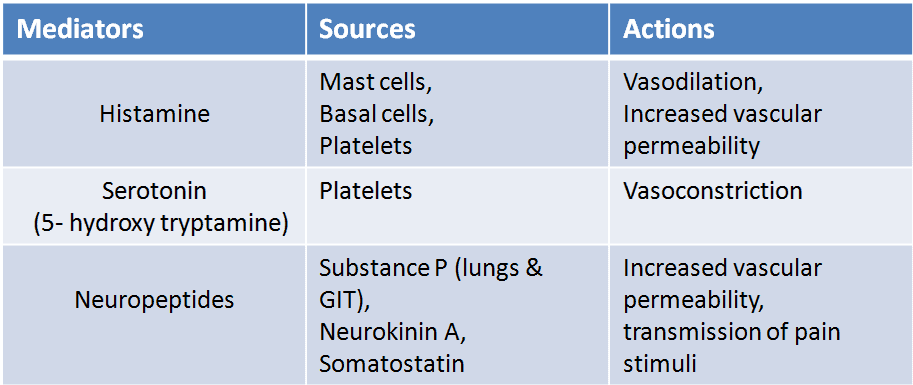
I) Vasoactive amines-
II) Arachidonic acid metabolites (Eicosanoids)
- Most potent mediators of inflammation.
- They are formed by 2 pathways-
A) Via cyclo- oxygenase pathway- includes

B) Via- lipooxygenase pathway-

III) Lysosomal components- 2 types
A) Granules of neutrophils- 3 types
1. Primary granules (azurophil granules)
- Develop at promyelocytic stage.
- More destructive
- These are-
- Myeloperoxidase (MPO)
- Cathepsin
- Non- specific collagenase
2. Secondary granules (specific granules)
- Develop at myelocytic stage.
- These are-
- Lactoferrin
- Lysozyme
- Type IV collagenase
- Vitamin B12 binding proteins
3. Tertiary granules (C- particles)
- Involved in chemotaxis
- Contains gelatinase
IV) Platelet activating factor (PAF)

V) Cytokines
- They are soluble polypeptide.
- Source- lymphocytes & monocytes.
- They are highly specific.
- Important cytokines are-
a) Interleukines
- IL1- fever
- IL4- anti-inflammatory
- IL6- synthesis of acute phase proteins
b) Tumour necrosis factor (TNF)
- TNF- α- acute inflammatory, septic & shock, systemic inflammatory response syndrome & cachexia.
c) INF- γ- granuloma formation
VI) Chemokines
- Action- leukocyte movement, chemotaxis
- Alpha chemokines (C-X-C)- IL-8
- Beta- chemokines- Ecotaxin, RANTES, MIP1- alpha
- Gamma- chemokines- lymphotactin
VII) Nitric oxide-
- Derived- endothelial cells
- Now synthsized from arginine amino acid
- Action- Vasodilation, anti platelet aggregation, microbicidal action
Exam Important
II) Arachidonic acid metabolites (Eicosanoids)
A) Via cyclo- oxygenase pathway- includes
III) Lysosomal components
1. Primary granules (azurophil granules)
- Develop at promyelocytic stage.
- More destructive
- These are-
- Myeloperoxidase (MPO)
- Cathepsin
- Non- specific collagenase
2. Secondary granules (specific granules)
- Lactoferrin
- Lysozyme
- Type IV collagenase
- Vitamin B12 binding proteins
3. Tertiary granules (C- particles)
- Involved in chemotaxis
- Contains gelatinase
V) Cytokines
- They are soluble polypeptide.
- Source- lymphocytes & monocytes.
- They are highly specific.
- Important cytokines are-
a) Interleukines
- IL1- fever
- IL4- anti-inflammatory
- IL6- synthesis of acute phase proteins
b) Tumour necrosis factor (TNF)
- TNF- α- acute inflammatory, septic & shock, systemic inflammatory response syndrome & cachexia.
c) INF- γ- granuloma formation
VI) Chemokines
- Action- leukocyte movement, chemotaxis
- Alpha chemokines (C-X-C)- IL-8
- Beta- chemokines- Ecotaxin, RANTES, MIP1- alpha
- Gamma- chemokines- lymphotactin
VII) Nitric oxide-
- Now synthsized from arginine amino acid
- Action- Vasodilation, anti platelet aggregation, microbicidal action
Click Here to Start Quiz

