
CONGENITAL DISLOCATION OF THE HIP (CDH)
| A | Ortolani test | |
| B |
Cozen’s test |
|
| C |
McMurray’s test |
|
| D |
None of the above |
Which of the following test is used to diagnose congenital dislocation of hip?
| A |
Ortolani test |
|
| B |
Cozen’s test |
|
| C |
McMurray’s test |
|
| D |
None of the above |
Ortolani and Barlows test are used to diagnose congenital dislocation of hip. Cozen’s test is positive in tennis elbow. McMurray’s test is used to detect meniscus injury.
Reference:
Essential Orthopaedics By J Maheswari, 3rd edition page 201.
Waddling gait due to:
March 2009
| A |
Bilateral congenital dysplasia of hip |
|
| B |
Coxa valga |
|
| C |
CTEV |
|
| D |
Bilateral coxa valgum |
Ans. A: Bilateral congenital dysplasia of hip
A waddling gait is the style of walking that is seen in a patient with proximal myopathy. It is characterised by:
- A broad-based gait with a duck-like waddle to the swing phase
- The pelvis drops to the side of the leg being raised
- Forward curvature of the lumbar spine
- Marked body swing
- This gait may be seen in patients with bilateral congenital hip dislocation and pregnancy.
| A | Barlow test | |
| B |
Ortolani test |
|
| C |
Painful ROM |
|
| D |
Limited abduction of Lower Limb |
Ans. is ‘d’ i.e., Limited abduction of Lower Limb
Clinical features of congenital dislocation of hip lDevelopmental dysplasia of hip
- Girls are affected six times as often as boys. In one third of cases, bilateral affection occurs. Unless it is specially looked for in infancy – as it always should be – abnormality may not be noticed until the child begins to walk.
- The clinical findings in older child are :-
- Limitation of abductionand external rotation.
- Limb is in adduction, internal rotation & flexion.
- Asymmetrical thigh fold
- Higher buttock fold on the affected side.
- Galeazzi’s sign : The level of the knees are compared in a child lying with hip flexed to 70° and knees flexed. There is a lowering of the knee on the affected side
- Ortolani’s test may be positive.
- Trendelenbug’s test is positive : This test is performed in an older child. The child is asked to stand on the affected side. The opposite ASIS (that of the normal side) dips down .
- The limb is short and slightly externally rotated. There is lordosis of the lumbar spine.
- Telescopypositive : In a case of a dislocated hip, it will be possible to produce an up and down piston- like movement at the hip. This can be appreciated by feeling the movement of the greater trochanter under the fingers.
- A child with unilateral dislocation exhibits a typical gait in which the body lurches to the affected side as the child bears weight on it (Trendelenburg’s gait). In a child with bilateral dislocation, there is alternate lurching on both side (waddling gait).
- There is compensatory genu valgum as patient tries to keep the foot out (to compensate adduction at hip).

| A | Congenital dislocation of hip. | |
| B |
Testicular descent. |
|
| C |
Down’s syndrome. |
|
| D |
Hip fracture. |
The technique shown in the photograph above is used for testing of congenital dislocation of hip.
Congenital hip dislocation is when the formation of the hip joint is abnormal. The ball at the top of the thighbone which is known as the femoral head is not stable within the socket (which is also known as the acetabulum). This abnormality may cause the ligaments of the hip to be loose or stretched.
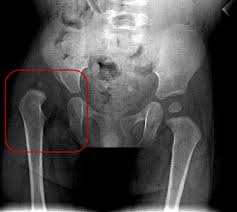
Diagnose the condition as “marked by a red box” in the X-ray below?
| A |
Congenital dislocation of hip. |
|
| B |
Testicular descent. |
|
| C |
Hip fracture. |
|
| D |
None of the above. |
Ans :A-Congenital dislocation of hip
The condition shown in the x-ray above represents the congenital dislocation of the hip.
Congenital hip dislocation is when the formation of the hip joint is abnormal. The ball at the top of the thigh bone which is known as the femoral head is not stable within the socket (which is also known as the acetabulum). This abnormality may cause the ligaments of the hip to be loose or stretched.
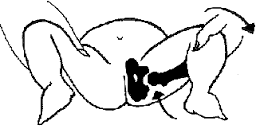
A newborn girl presented with a click sound when the legs moved apart.Clinical examination of the hip was done as shown in the image.Identify this test.
| A |
Barlow’s test |
|
| B |
Ortolani’s test |
|
| C |
Galeazzi test |
|
| D |
Allen’s test |
Ans:B.)Ortolani’s test.
The patient is suffering from Developmental Dysplasia of Hip
Congenital dislocation of hip /Developmental dysplasia of hip
- The femoral head is not stable within the socket (which is also known as the acetabulum).
- Girls are affected six times as often as boys. In one third of cases, bilateral affection occurs.
- The early sign of congenital hip dislocation is when a person is able to hear “clicking” sounds when the legs are moved apart from one another.
Screening:
- Ortolani maneuver :the examiner put the newborn baby in a position in which the contralateral hip is held still while the thigh of the hip being tested is abducted and gently pulled anteriorly. If a “clunk” is heard (the sound of the femoral head moving over the acetabulum), the joint is normal, but absence of the “clunk” sound indicates that the acetabulum is not fully developed.
- Barlow maneuver. It is done by adducting the hip while pushing the thigh posteriorly. If the hip goes out of the socket it means it is dislocated, and the newborn has a congenital hip dislocation.
The clinical findings in older child are :-
- Limitation of abduction and external rotation.
- Limb is in adduction, internal rotation & flexion.
- Asymmetrical thigh fold
- Higher buttock fold on the affected side.
- Galeazzi’s sign : The level of the knees are compared in a child lying with hip flexed to 70° and knees flexed. There is a lowering of the knee on the affected side
- Ortolani’s test may be positive.
- Trendelenbug’s test is positive : This test is performed in an older child. The child is asked to stand on the affected side. The opposite ASIS (that of the normal side) dips down .
- The limb is short and slightly externally rotated. There is lordosis of the lumbar spine.
- Telescopy positive : In a case of a dislocated hip, it will be possible to produce an up and down piston- like movement at the hip. This can be appreciated by feeling the movement of the greater trochanter under the fingers.
- A child with unilateral dislocation exhibits a typical gait in which the body lurches to the affected side as the child bears weight on it (Trendelenburg’s gait).
- In a child with bilateral dislocation, there is alternate lurching on both side (waddling gait).
- There is compensatory genu valgum as patient tries to keep the foot out (to compensate adduction at hip).
| A |
Barlow’s test |
|
| B |
Trendenlenburg test |
|
| C |
Galeazzi test |
|
| D |
Ortolani’s test |
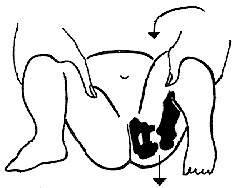
Ans:A.)Barlow’s test
The patient is suffering from Developmental Dysplasia of Hip
Congenital dislocation of hip /Developmental dysplasia of hip
- The femoral head is not stable within the socket (which is also known as the acetabulum).
- Girls are affected six times as often as boys. In one third of cases, bilateral affection occurs.
- The early sign of congenital hip dislocation is when a person is able to hear “clicking” sounds when the legs are moved apart from one another.
Screening:
- Ortolani maneuver :the examiner put the newborn baby in a position in which the contralateral hip is held still while the thigh of the hip being tested is abducted and gently pulled anteriorly. If a “clunk” is heard (the sound of the femoral head moving over the acetabulum), the joint is normal, but absence of the “clunk” sound indicates that the acetabulum is not fully developed.
- Barlow maneuver. It is done by adducting the hip while pushing the thigh posteriorly. If the hip goes out of the socket it means it is dislocated, and the newborn has a congenital hip dislocation.
The clinical findings in older child are :-
- Limitation of abduction and external rotation.
- Limb is in adduction, internal rotation & flexion.
- Asymmetrical thigh fold
- Higher buttock fold on the affected side.
- Galeazzi’s sign : The level of the knees are compared in a child lying with hip flexed to 70° and knees flexed. There is a lowering of the knee on the affected side
- Ortolani’s test may be positive.
- Trendelenbug’s test is positive : This test is performed in an older child. The child is asked to stand on the affected side. The opposite ASIS (that of the normal side) dips down .
- The limb is short and slightly externally rotated. There is lordosis of the lumbar spine.
- Telescopy positive : In a case of a dislocated hip, it will be possible to produce an up and down piston- like movement at the hip. This can be appreciated by feeling the movement of the greater trochanter under the fingers.
- A child with unilateral dislocation exhibits a typical gait in which the body lurches to the affected side as the child bears weight on it (Trendelenburg’s gait).
- In a child with bilateral dislocation, there is alternate lurching on both side (waddling gait).
- There is compensatory genu valgum as patient tries to keep the foot out (to compensate adduction at hip).

| A |
Pelvis fracture |
|
| B |
Bilateral acetabular fracture |
|
| C |
Genu varum |
|
| D |
Developmental Dysplasia of Hip |
Ans:D.)Developmental Dysplasia of Hip
Brace shown in the image is Pavlik harness
Congenital dislocation of the hip ( hip dysplasia or developmental dysplasia of the hip).
- The femoral head is not stable within the socket (which is also known as the acetabulum).
- Girls are affected six times as often as boys. In one third of cases, bilateral affection occurs.
- The early sign of congenital hip dislocation is when a person is able to hear “clicking” sounds when the legs are moved apart from one another.
Screening:
- Ortolani maneuver :the examiner put the newborn baby in a position in which the contralateral hip is held still while the thigh of the hip being tested is abducted and gently pulled anteriorly. If a “clunk” is heard (the sound of the femoral head moving over the acetabulum), the joint is normal, but absence of the “clunk” sound indicates that the acetabulum is not fully developed.
- Barlow maneuver. It is done by adducting the hip while pushing the thigh posteriorly. If the hip goes out of the socket it means it is dislocated, and the newborn has a congenital hip dislocation.
Management
• 0-6 months
– Pavlik harness.
It is a soft harness-like device that has straps that hold the legs apart and bent at the knee, in an attempt to keep the femur (ball) in the acetabulum (socket) in the correct position.
• 6 Months – 2 years, failed Pavlik
– Closed reduction ± tenotomies, hip spica cast 3 months
• 2-3 years, failed closed reduction
– Open reduction
• 3+ years
– Open reduction ± femoral osteotomy ± pelvic
osteotomy.
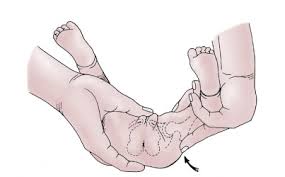
Maneuver shown in Photograph is done to evaluate ……. in Newborn
| A |
Femur fracture |
|
| B |
Congenital dislocation of hip |
|
| C |
CTEV |
|
| D |
Imperforate anus |
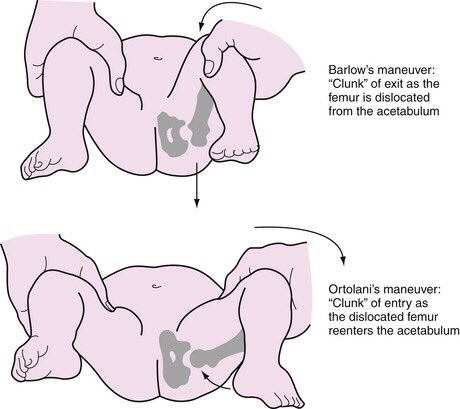
* Congenital dislocation of hip (Maneuver shown: Ortolani’s maneuverer)
* The Ortolani test or Ortolani maneuver is part of the physical examination for developmental dysplasia of the hip, along with the Barlow maneuver.
* Screening for CHD occurs at birth and throughout the first year of your child’s life.
* Your child’s doctor will gently maneuver your child’s hip and legs while listening for clicking or clunking sounds that may indicate a dislocation.
This exam consists of two tests:
* During the Ortolani test, your child’s doctor will apply upward force while they move your child’s hip away from the body. Movement away from the body is called abduction.
* During the Barlow test, your child’s doctor will apply downward force while they move your child’s hip across the body. Movement toward the body is called adduction.
6 months old female baby with apparent shortening of the right lower limb..Xray shows the following features.Identify this condition:

| A |
Scoliosis |
|
| B |
Developmental Dysplasia of Hip |
|
| C |
Coxa Vara |
|
| D |
Acetabular immaturity |
Ans:B.)Developmental Dysplasia of Hip.
Typical radiographic evaluation of developmental dysplasia of hip (DDH).
- From anteroposterior radiograph of hips, horizontal line (Hilgenreiner line) is drawn between each triradiate cartilage.
- Next, lines are drawn perpendicular to Hilgenreiner line through superolateral edge of acetabulum (Perkin line), dividing hip into 4 quadrants.
- Proximal medial femur should be in lower medial quadrant, or ossific nucleus of femoral head, if present (usually observed in patients aged 4-7 months), should be in lower medial quadrant. Acetabular index is angle between Hilgenreiner line and line drawn from triradiate cartilage to lateral edge of acetabulum.
- Typically, this angle decreases with age and should measure less than 20° by 2 years of age.
- Shenton line is drawn from medial aspect of femoral neck to inferior border of pubic rami. It should create smooth arc that is not disrupted. Disruption of Shenton line indicates presence of some degree of hip subluxation.
Putti’s triad for developmental dysplasia of the hip include :
- Superolateral displacement of proximal femur .
- Increase in acetabular angle.
- Small capital femoral epiphysis.
