
Disease associated with collagen
Defect in collagen formation is seen in:
| A | Scurvy | |
| B | Hunter’s syndrome | |
| C |
Marfan’s syndrome |
|
| D |
All |
Defect in collagen formation is seen in:
| A |
Scurvy |
|
| B |
Hunter’s syndrome |
|
| C |
Marfan’s syndrome |
|
| D |
All |
A i.e. Scurvy
Collagen show triple helixQ and is never present free inside the cytoplasmQ. Scurvy, osteogenesis imperfectaQ, Ehler – Danlos syndrome & Alport syndrome occurs d/t its deficient synthesis.
| A |
Alport’s syndrome |
|
| B |
Thin membrane disease |
|
| C |
Nodular glomerulosclerosis |
|
| D |
Good pasture syndrome |
Answer is A (Alport’s syndrome):
Most cases of Alport’s syndrome arise from a mutation or deletion of the COL4/A5 gene located on the X chromosome which codes for alpha 5 chain of type IV collagen – Davidson
Alport’s syndrome
Alport’s syndrome is an inherited disorder charachterized by hereditary nephritis, senserineural deafness and ocular abnormalities.
Alport’s syndrome is the most common hereditary nephritisQ
Genetic defect, Pathology
- Primary pathology in Alport’s syndrome is an abnormality in type IV collagen (Type IV collagen is the predominant collagen in basement membrane)
- The most common form of Alport’s syndrome is due to mutation of the COLA4A5 (a 5 Chain) gene located on the X chromosomeQ.
- The most common inheritance pattern for Alport’s syndrome is X Linked – Classic Alport’s syndrome


| A | Deficient Hydroxylation secondary to Ascorbate deficiency | |
| B |
Mutations in Collagen genes |
|
| C |
Mutations in collagen genes and Lysyl hydroxylase gene |
|
| D |
Deficient cross linking secondary to functional copper deficiency |
Ans:C.)Mutations in collagen genes and Lysyl hydroxylase gene.
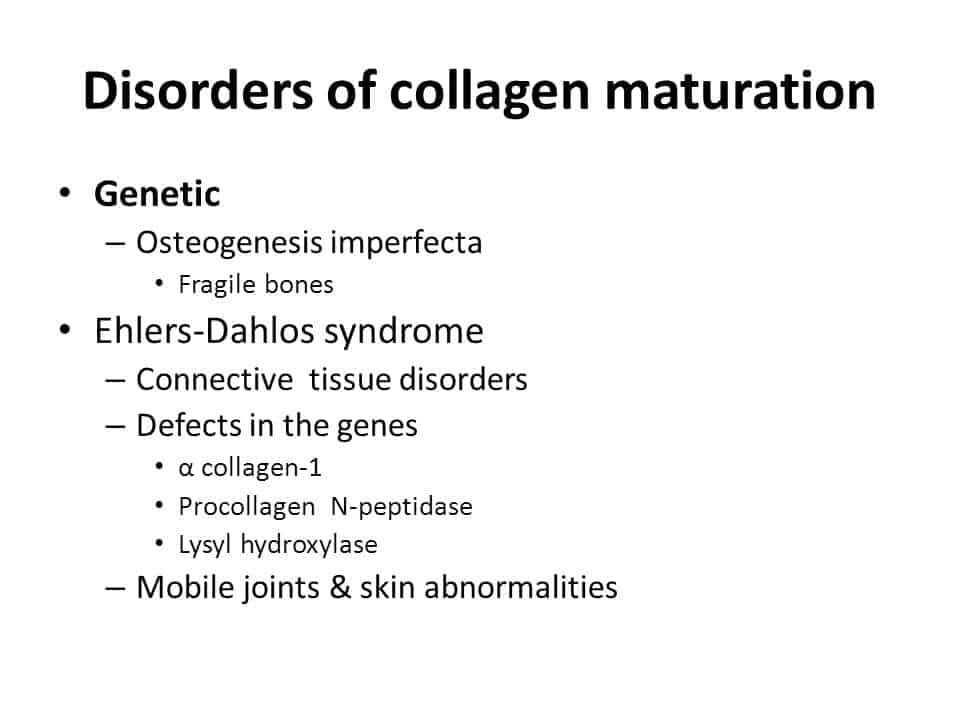
The image of the disorder shown in the image is of Ehlers -Danlos Syndrome.
Disorders of Collagen Biosynthesis
Mutation in which collagen is present in epidermolysis bullosa ‑
| A |
II |
|
| B |
IV |
|
| C |
V |
|
| D |
VII |
Ans. is ‘d’ i.e., VII
Molecular pathology of EB
- Normal basement membrane is between epidermal basal layer and dermis. This basement membrane (basal lamina) is attached to basal cells hemidesmosomes with the help of keratin containing intermediate filaments and is attached to dermis (dermal papillary layer) with the help of type VII collegen containing fibrils. Any defect in this anchoring complex leads to separation of skin; the site of separation depends on the type of defect
- EB simplex → Mutation in gene coding for keratin 5 & 14 (major keratin of BMZ) and separation will be epidermal.
- EB junctional → Mutation in Lantinin a-3 (LAM a-3), LAM [I-3, LAM 7-2 genes. As laminin is part of basement membrane the separation will be at dermo-epidermal junction (DEJ).
- EB dystrophicans → Mutation in collagen VII-Al gene. As collagen VII containing fibrils join BM to dermal papilla, separation will be in the dermis.
- Any of the above defect results in defective cohesiveness which leads to vulnerability to trauma and blisters formation. As the disease is inherited, Family history may be positive.
