
Endocrinology in Relation to Reproduction
HORMONES OF PLACENTA:
- Syncytiotrophoblasts are the principal site of protein and steroid hormones
- Placenta produces a variety of hormones of which protein and steroid hormones
PROTEIN HORMONES:
HUMAN CHORIONIC GONADOTROPIN (hCG):
- Glycoprotein.
- LH-like activity
- Hormone nonspecific α (identical to LH, TSH , FSH) and hormone specific β subunit
Functions:
- Rescue and maintenance of corpus luteum till 6 weeks of pregnancy
- Stimulates Leydig cells of the male fetus at 8 week to produce testosterone
- Immunosuppressive activity
- Diagnosis of hydatidiform mole
- Stimulates both adrenal and placental steroidogenesis
- Thyrotropic activity.
- Promotes secretion of relaxin from the corpus luteum.
Abnormal rise in HCG:
- Testicular embryonal tumors(Beta hCG)
- Germ cell tumors
- Extragonadal germinomas
- Lung cancer
- Yolk sac tumor
- Hepatoma
- Choriocarcinoma
- Pancreatic islet tumors.
- Down’s syndrome(Increased free beta HCG)
- Minimum hCG level that a urine pregnancy test can detect is 5 m IU/ ml
- Plasma levels of hCG during pregnancy doubles every 2 days
| 60 – 70 days of pregnancy | 100-200 IU/mL |
| 100 -130 days | 10–20 IU/mL |
| 32 weeks | 100-200 IU/mL |
HUMAN PLACENTAL LACTOGEN (hPL):
- Human chorionic somatomammotropin
- 5 μg/mL to 25 μg/mL From 3rd week to 36 weeks of gestation
- The plasma concentration of hPL is proportional to placental mass
Functions:
- Antagonizes insulin
- Maternal lipolysis
- Promotes transfer of glucose and amino acids to the fetus
- Angiogenic hormone
- Growth and differentiation of breasts
PREGNANCY-SPECIFIC β-1 GLYCOPROTEIN (PS β-1G):
- Detected in the maternal serum 18–20 days after ovulation
- Immunosuppressor of lymphocyte proliferation and prevents rejection of the conceptus
Early pregnancy factor (EPF):
- Immunosuppressant
- Prevents rejection of the conceptus
- Detectable in the circulation 6 – 24 hours after conception
Growth factors:
- Inhibin
- Activin
- IGF-1 and 2
- TGF-β
- EGF
- Functions
- Immunosuppressive, paracrine and steroidogenic
Pregnancy-associated plasma protein—A (PAPP-A):
- Immunosuppressant in pregnancy
STEROIDAL HORMONES:
ESTROGEN:
- Site of its production :syncytiotrophoblast
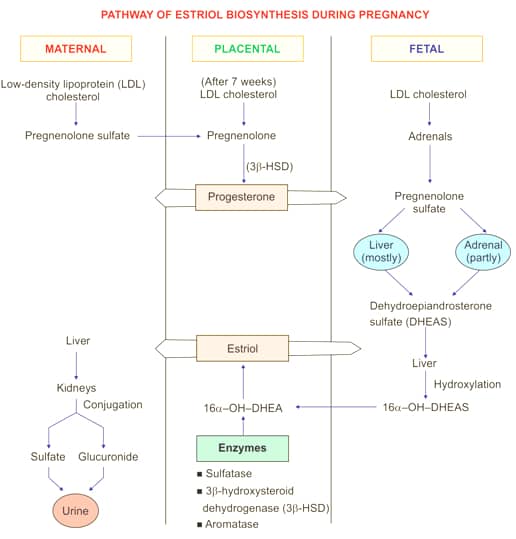
Fetoplacental unit and biosynthesis of estriol:
- Fetal adrenal gland and the placenta contain the complementary enzyme system
- Estriol is first detectable at 9 weeks (0.05 ng/mL) and increases gradually to about 30 ng/mL at term.
Low estriol:
- Fetal death
- Fetal anomalies (adrenal atrophy, anencephaly, Down’s syndrome)
- Hydatidiform moles
- Placental sulfatase or aromatase deficiency
PROGESTERONE:
- Before 6 weeks of pregnancy corpus luteum secretes 17-hydroxyprogesterone later by placenta.
- 250 mg/day
Low progesterone levels:
- Ectopic pregnancy
- Abortion
High values:
- hydatidiform mole
- Rh-isoimmunization.
Functions of the steroid hormones:
Estrogen:
- Hypertrophy and hyperplasia of uterine myometrium
- Hypertrophy and proliferation of ducts of breast
- Sensitizes the myometrium to oxytocin and prostaglandin
- Ripen the cervix.
Estrogen+Progesterone:
- Growth of the uterus & decidual changes of the endometrium
- Lobuloalveolar system
- Adaptation of the maternal organs
- Antagonistic in the process of labor
- Preserve gonadal function.
Progesterone:
- Maintains uterine quiescence
- Immunomodulatory role
DIAGNOSTIC VALUE OF PLACENTAL HORMONES:
Diagnosis of pregnancy:
Presence of hCG:
- Detected in the urine prior to the first missed period
- RIA(most sensitive)
- Biological
Follow-up cases who had trophoblastic tumors:
- RIA for detection of hCG β subunit in hydatidiform mole or choriocarcinoma
Detection of function of fetoplacental unit:
- Placental insufficiency and status of the fetus-in-utero are hPL and estriol
RELAXIN:
- Produced from corpus luteum of the ovary, placenta and decidua
- Relaxes myometrium, the symphysis and sacroiliac joints during pregnancy
- Cervical ripening
CHANGES OF ENDOCRINE GLANDS DURING PREGNANCY:
| GLAND | MORPHOLOGICAL | PHYSIOLOGICAL |
| PITUITARY GLAND | ↑weight & size |
↓FSH, LH
↑Growth hormone ↑Serum prolactin ↑ACTH and CRH |
| THYROID GLAND | Hyperplasia |
↓Serum iodine
↑BMR Hyperthyroidism ↑Thyroxin-binding globulin ↑ Maternal total T4 and T3 Free T4 and T3 unchanged |
| ADRENAL CORTEX | Slight enlargement |
↑aldosterone
↑DOC ↑CBG ↑ACTH ↑Cortisol ↑ CRH ↓ DHEAS ↑Testosterone ↑Androstenedione |
| PARATHYROID GLAND | Hyperplasia |
↑1, 25 dihydroxy vitamin D levels
↑calcitriol |
| PANCREAS | Hypertrophy and hyperplasia | Hyperinsulinemia |
HORMONAL INFLUENCES NECESSARY FOR MAINTENANCE OF LACTATION:
The endocrine control of lactation can be divided into following stages

- Preparation of breast (mammogenesis
- Synthesis and secretion of milk by breast alveoli(lactogenesis)
- Ejection of milk (galactokinesis)
- Maintenance of lactation (galactopoiesis)
Exam Important
- Minimum level of HCG detected by radio immunoassay is 0.001 IU/ml
- Abnormal rise of HCG in a female of reproductive age group may indicate Choriocarcinoma
- Increased free beta HCG levels are features of down’s syndrome
- Human chorionic gonadotropin produced by the human placenta has LH-like activity
- Human chorionic somatotropin participates in stimulation of ductal growth in the mammary gland during pregnancy
- HCG is glycoprotein
- hCG can be detected in the urine prior to the first missed period
- HCG titer, USG & Chest x ray are used for a diagnosis of hydatidiform mole
- Radioimmune assay is the most sensitive or gold standard test for assessing HCG in maternal serum
- Minimum hCG level that a urine pregnancy test can detect is 5 m IU/ ml
- The corpus luteum of the ovary is maintained by the secretion of human chorionic gonadotropin from The trophoblast cells
- HCG is secreted by Embryonal cell cancer,Yolk sac tumor, Choriocarcinoma & Polyembryoma
- Placental HCG stimulates the gonads in male at 8 week to secret testosterone
- Marker for testicular tumor is Beta hCG
- During pregnancy, maximum urinary HCG level is reached in 70 days
- Plasma levels of hCG during pregnancy doubles every 2 days
- Alpha chain of HCG is identical to
Don’t Forget to Solve all the previous Year Question asked on Endocrinology in Relation to Reproduction
Click Here to Start Quiz
Click Here to Start Quiz

