
EXOCRINE GLANDS
EXOCRINE GLANDS
- The glands are specialised epithelial cells which produce secretion.
- Exocrine glands characteristics:
|
Cellular composition |
|
|
Unicellular (single cell) |
Goblet cell |
|
Multicellular (more than 1 cell) |
Submandibular gland |
|
Duct form |
|
|
Simple (unbranched) |
Sweat gland |
|
Compound (branched) |
Mammary gland |
|
Type of secretion |
|
|
Serous (watery) |
Parotid gland |
|
Mucous (viscous) |
Palatal glands |
|
Mixed (serous & mucus) |
Sublingual gland |
|
Mode of secretion |
|
|
Merocrine (only secretory product released) |
Parotid gland |
|
Apocrine (secretory product along with a portion of cell cytoplasm) |
Lactating mammary gland |
|
Holocrine (cell dies & becomes the secretion) |
Sebaceous gland |

Based on types of secretory process, exocrine glands divided into:
I. Merocrine glands
- Release their secretion by exocytosis without any loss of cellular components.
- E.g Sweat glands, secretion of protein casein by mammary gland, Pancreas.
-
The sweat glands are not obstructed in CF patients.
-
Because in serous glands such as sweat glands there are abnormal concentrations of inorganic ions, rather than glandular obstruction with thick mucus.
II. Apocrine glands
- Discharge apical part of cells as secretory product.
- E.g. Secretion of milk fat by mammary gland, specialized sweat glands in axilla & perineal area.
III. Holocrine glands
- Cells themselves become the secretory product.
- E.g. Sebaceous glands

Based upon the type of seretion:
1. Serous glands
- Contain serous acini (cuboidal cells)
- Secreting fluid which is thin, watery in nature.
- E.g. Parotid gland, lacrimal gland
2. Mucous glands
- Contain mucous acini (columnar cells), secreting fluid, which is thick & viscous.
- E.g Palatal gland
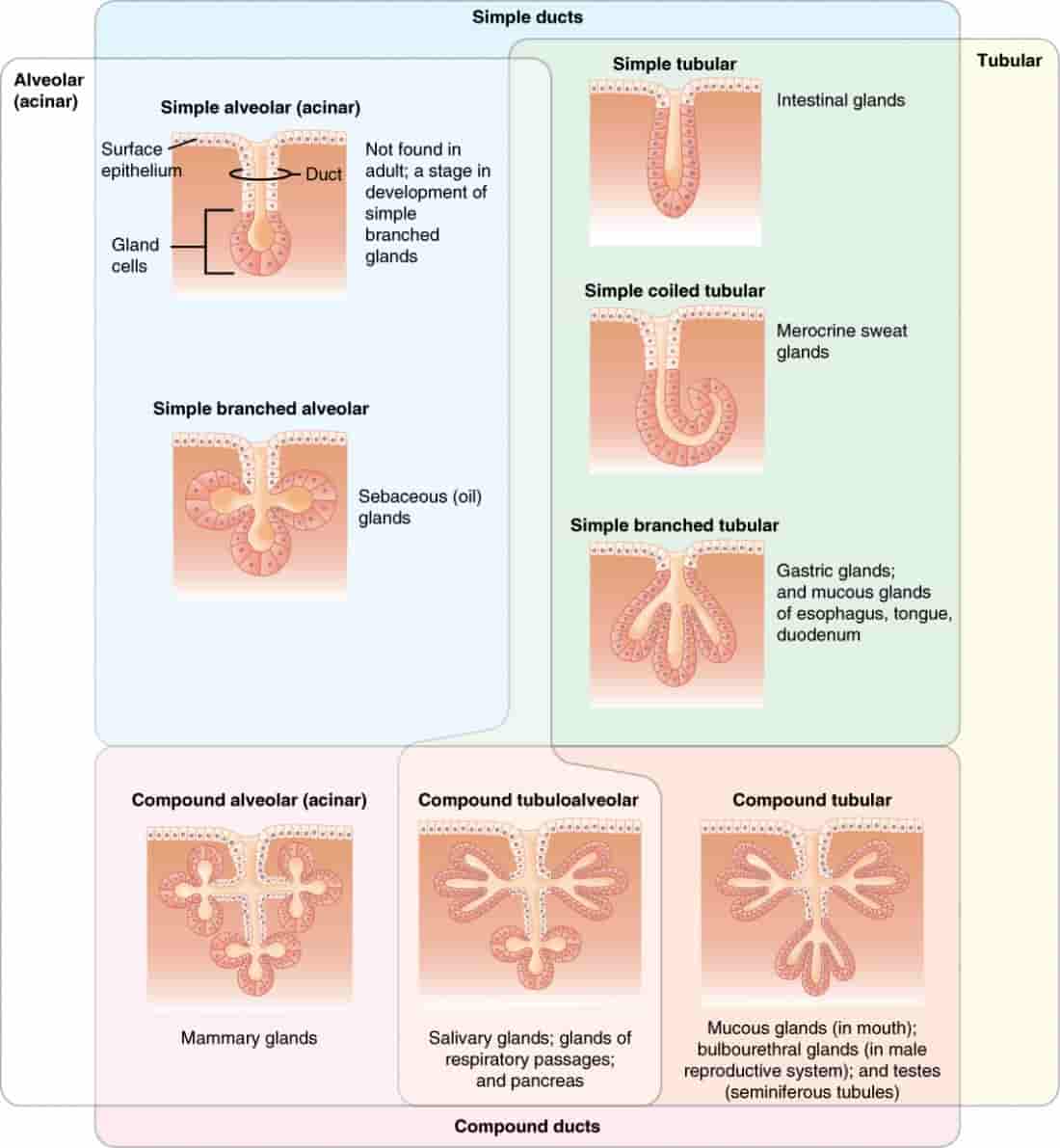
|
Type of gland |
Secretory gland |
Duct |
Examples |
|
Simple tubular |
Tubular & straight |
Unbranched |
Intestinal glands |
|
Simple coiled tubular |
Tubular & coiled |
Unbranched |
Sweat glands |
|
Simple branched tubular |
Tubular & branched |
Unbranched |
Gastric glands |
|
Simple branched acinar |
Acinar & branched |
Unbranched |
Sebaceous glands |
|
Compound tubular gland |
Tubular |
Branched |
Brunner’s gland of duodenum |
|
Compound acinar |
Acinar |
Branched |
Exocrine part of pancreas |
|
Compound tubuloacinar |
Tubuloacinar |
Branched |
Submandibular gland |
Exam Important
- Halocrine secretion is seen in Sebaceous gland.
- Mammary gland is a modified sweat gland of apocrine variety.
- Sweat glands are lined by the simple coiled tubular epithelium.
- The sweat glands are not obstructed in Cystic fibrosis patients.
Click Here to Start Quiz

