
Explosion injury
Explosion injury
- An explosion is a phenomenon resulting from sudden release of energy which is then dissipated by a blast wave, by translocation of objects, or by the generation of heat. Injuries in explosion occur due to four factors
1) Blast or shock wave
- When an explosion occurs, the explosive material produces a large volume of gas and releases a large amount of energy.
- It produces a ‘shock wave’ which spread concentrically from the site of explosion.
- The injuries depend on the enviornment in which blast occurs :-
Air blast (most common) :
Explosion occurs in air.
There is barotrauma to air filled hollow organs.
- Tympanic membrane (ear drum) is most sensitive and most commonly injured.
- Lung is the second organ to be injured and is the most commonly injured hollow organ and most common cause of life threatening injury.
- Other parts injured are middle ear, cochlea, eyes, bowels, mesentery, omentum and brain. Homogenous solid organs like liver and muscles are usually not affected.
- Under water blast (explosion under water):
- Gastrointestinal tract is injured most commonly.
- Lungs are also injured.
Solid blast :
- Explosive is detonated near a rigid/solid structure and wave of energy spreads through it.
- If people are in contact with that rigid structure, injuries take place.
- The injuries are mostly skeletal; fracture of legs and vertebral column are more common.
- GIT damage is more common than lung.
2) Flame or hot gases
- Burns or burning of body may occur.
3) Flying missiles (debris)
- Flying pieces of explosive debris may be driven through air against the skin causing bruises, abrasions, lacerations, and ragged perforations.
4) Anoxia
- Various gases liberated during explosion may cause anoxia, e.g. carbon monoxide, nitrous oxide, nitric oxide, HCN and SO,
CLASSIFICATION OF BLAST INJURIES
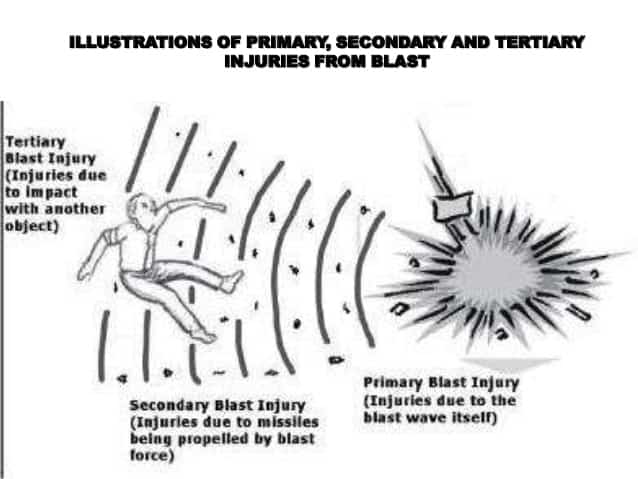
Primary injuries
- Caused by blast overpressure waves, or shock waves
- Person is close to exploding ammunition, such as a land mine.
- Gas filled structures are most susceptible as air is easily compressible than water
- Blast lung (pulmonary barotrauma)
- Abdominal haemorrhage and perforation
- TM rupture and middle ear damage
- Globe (eye) rupture
- Concussion
- Gastrointestinal injuries may present after a delay of hours or even days.
- Absence ofexternal injuries; thus internal injuries are frequently unrecognized andtheir severity underestimated.
Secondary injuries
- Caused by fragmentation and other objects propelled by the explosion.
- Results from flying debris, broken glass, loose pieces and bomb fragmentsany body part can be affected.
- Penetratingtrauma with visible bleeding.
Tertiary injuries
- Displacement of air by the explosion creates a blast wind that can throw victims against solid objects.
- Injuries resulting from this typeof traumatic impact are referred to as tertiary blastinjuries.
- May present as some combination of blunt and penetrating trauma, including bone fractures and coup contre-coup injuries.
- Young children, because they weigh less thanadults, are at particular risk of tertiary injury.
Quaternary injuries or other miscellaneous named injuries,
- All explosion-related injuries, illnesses or diseases not due to primary, secondary, ortertiary mechanisms.
- Burns (flash, partial, and full thickness)
- Crush injuries
- Closed and open brain injury
- Asthma, COPD, or other breathing problems from dust, smoke, or toxic fumes
- Angina Hyperglycemia
- Hypertension Traumatic amputations quickly result in death, and are thus rare in survivors,and are often accompanied by significant other injuries.
- Psychiatric injury
Exam Important
- In blast injury, tympanic membrane is the first organ to be damaged.
- The structures injured by the primary blast wave, in order of prevalence, are the middle ear, the lungs and the bowel
- Organ is least vulnerable to the blast wave is liver
- Most common organ affected in underwater blast is intestine
- Primary Injury : It is due to shock wave which causes injury to hollow organs. e.g. ears, lungs, eyes, GIT
- Secondary Injury: These are due to flying debris (missiles).
- Tertiary injuries: Displacement of air by the explosion creates a blast wind that can throw victims against solid objects.
Don’t Forget to Solve all the previous Year Question asked on Explosion injury
Click Here to Start Quiz
Click Here to Start Quiz

