
FRACTURE CLAVICLE
SIGN & SYMPTOMS:
- Pain, particularly with upper extremity movement or on front part of upper chest
- Swelling
- Often, after the swelling has subsided, the fracture can be felt through the skin.
- Sharp pain when any movement is made
- Referred pain: dull to extreme ache in and around clavicle area, including surrounding muscles
- Possible nausea, dizziness, and/or spotty vision due to extreme pain
- Fracture of clavicle is commonest at Junction of medial 2/3rdand lateral 1/3rd
MECHANISM OF INJURY:

The location of the clavicle
- The most common type of fracture occurs when a person falls horizontally on the shoulder or with an outstretched hand.
- A direct hit to the collarbone can also cause a break.
- In most cases, the direct hit occurs from the lateral side towards the medial side of the bone.
- The muscles involved in clavicle fractures include the deltoid, trapezius, subclavius, sternocleidomastoid, sternohyoid, and pectoralis major muscles.
- The ligaments involved include the conoid ligament and trapezoid ligament.
- Incidents that may lead to a clavicle fracture include automobile accidents, biking accidents (especially common in mountain biking), horizontal falls on the shoulder joint, or contact sports such as football, rugby, hurling, or wrestling.
TREATMENT:
- Medication can be prescribed to ease the pain and tetanus vaccination for any skin breaks.
- Antibiotics may be used if the bone breaks through the skin.
- Often, they are treated without surgery. In severe cases, surgery may be done.
NONOPERATIVE:
- The arm must be supported by use of a splint or sling to keep the joint stable and decrease the risk of further damage.
- Usually, a figure-of-eight splint that wraps the shoulders to keep them forced back is used and the arm is placed in a clavicle strap for comfort.
- Current practice is generally to provide a sling, and pain relief, and to allow the bone to heal itself, monitoring progress with X-rays every week or few weeks.
- Surgery is employed in 5–10% of cases. However, a recent study supports primary plate fixation of completely displaced midshaft clavicular fractures in active adult patients.
- If the fracture is at the lateral end, the risk of nonunion is greater than if the fracture is of the shaft.
SURGICAL:
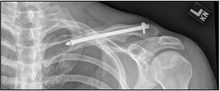
- X-ray of the above comminuted fracture treated with an intramedullary fixation device
- Surgery is considered when one or more of the following conditions presents.A discontinuity in the bone shape often results from a clavicular fracture, visible through the skin, if not treated with surgery.
- Comminution with separation (multiple piece)
- Significant foreshortening of the clavicle (indicated by shoulder forward)
- Skin penetration (open fracture)
- Clearly associated nervous and vascular trauma (brachial plexus or supraclavicular nerves)
- Nonunion after several months (3–6 months, typically)
- Distal third fractures (high risk of nonunion)
- Surgical procedures often call for open reduction internal plate fixation where an anatomically shaped titanium or steel plate is affixed along the superior aspect of the bone by several screws.
- In some cases, the plate may be removed after healing, but this is very rarely required (based on nerve interaction or tissue aggravation), and typically considered an elective procedure.
- In a surgically indicated patients now surgery of choice is elastic TEN intramedullary Nailing.
- These devices are implanted within the clavicle’s canal to support the bone from the inside.
- Typical surgical complications are infection, neurological symptoms distal the incision (sometimes to the extremity), and nonunion.
Exam Important
- Most common Complication is Malunion of Fracture of clavicle
- In treating a fractured clavicle in a 14 month old child, the best procedure is Figure – of – eight bandage
- Fracture of clavicle is commonest at Junction of medial 2/3rdand lateral 1/3rd
- Clavicle fracture result from a violent force
Don’t Forget to Solve all the previous Year Question asked on FRACTURE CLAVICLE
Click Here to Start Quiz
Click Here to Start Quiz

