
FRACTURES OF THE PATELLA
FRACTURES OF THE PATELLA
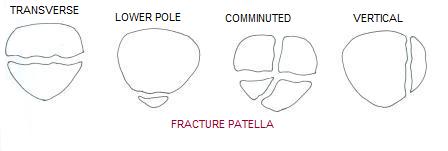
- Common fracture, result from a direct or an indirect force.
- In a direct injury, blow on the anterior aspect of the flexed knee, results in comminuted fracture.
- The comminution limited to a part or whole of the patella.
- The latter is also called a stellate fracture.
- Sudden violent contraction of the quadriceps, gives rise to a fracture with the fracture line.
- Running transversely across the patella, dividing it into two; the so-called two-part fracture.
CLINICAL FEATURES
Presenting complaints:
- Pain and swelling over the knee.
- In an undisplaced fracture the swelling and tenderness may be localised over the patella.
- A crepitus is felt in a comminuted fracture.
- In displaced fractures, one may feel a gap between the fracture fragments.
- The patient will not be able to lift his leg with the knee in full extension (extensor lag).
- Bruises over the front of the knee – a tell tale sign of direct trauma.
- The knee may be swollen because of haemarthrosis.
Radiological examination:
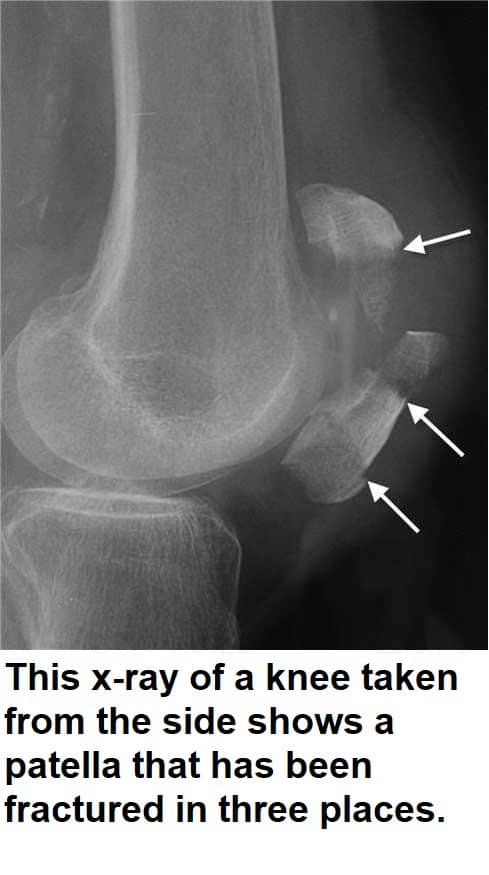
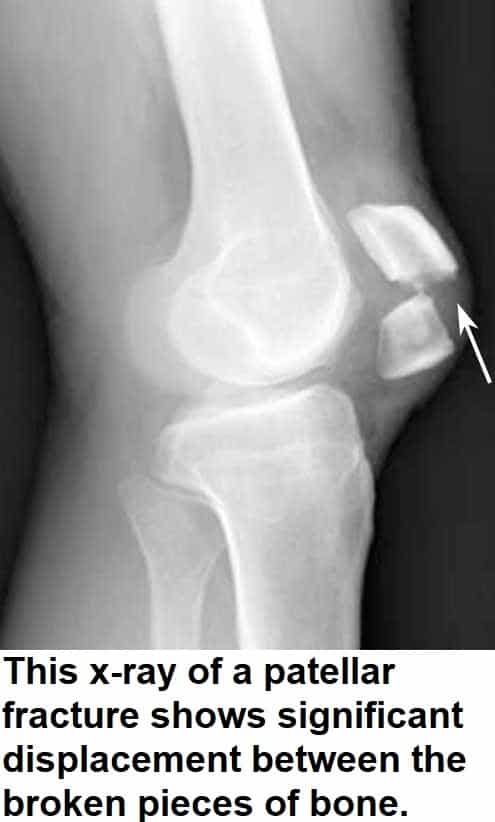
- Antero-posterior and lateral X-rays sufficient in most cases.
- In undisplaced fractures, a ‘skyline view’ of the patella.
- A fracture with wide separation of the fragments is easy to diagnose on a lateral X-ray.

COMPLICATIONS
- Knee stiffness
- Extensor weakness
- Osteoarthritis
Exam Important
- Patella commonly dislocates Laterally.
- Lateral dislocation of patella is prevented by Vastus medialis.
- A comminuted fracture of the Patella should be treated by Removal of all the patella.
- In transverse fracture of the patella, the treatment is Wire fixation.
- Transverse fracture of the patella with separation of fragments is best treated by Open reduction with Kirschner wire fixation of the fragment an tension band wiring.
Don’t Forget to Solve all the previous Year Question asked on FRACTURES OF THE PATELLA
Click Here to Start Quiz
Click Here to Start Quiz

