
FUNCTIONAL AREAS OF CEREBRAL CORTEX
- Cerebral cortex presents functionally specialized areas.
Three general kinds of functional area:
1. Sensory areas
2. Association areas
3. Motor areas
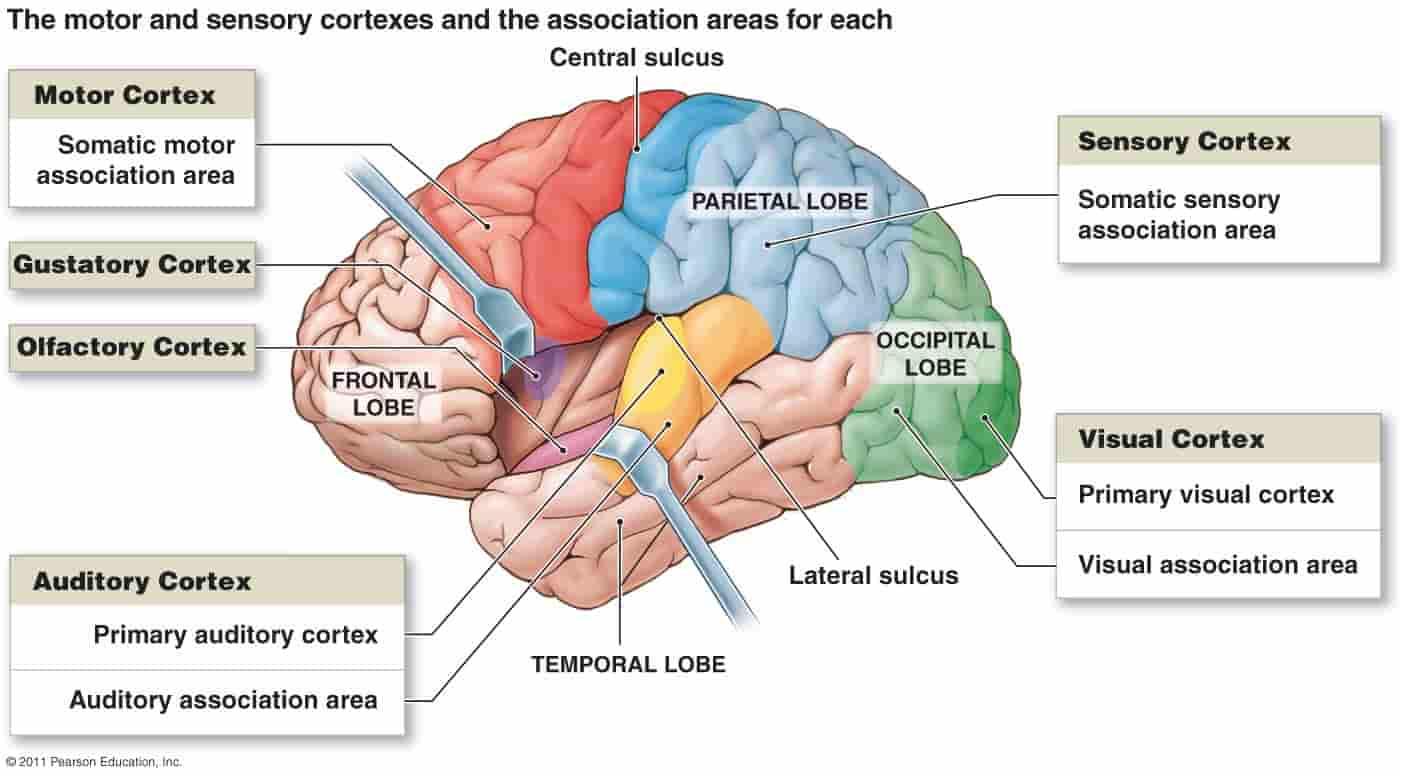
- Sensory areas receive sensory input, motor areas control movement of muscles.
- Association areas are involved with more complex functions such as learning, decision making and complex movements such as writing.
- Each of the major senses has a specific brain region called a primary sensory cortex.
- There are also multimodal association areas to process information.
- These areas can be located on different lobes of cerebral hemisphere as given below:
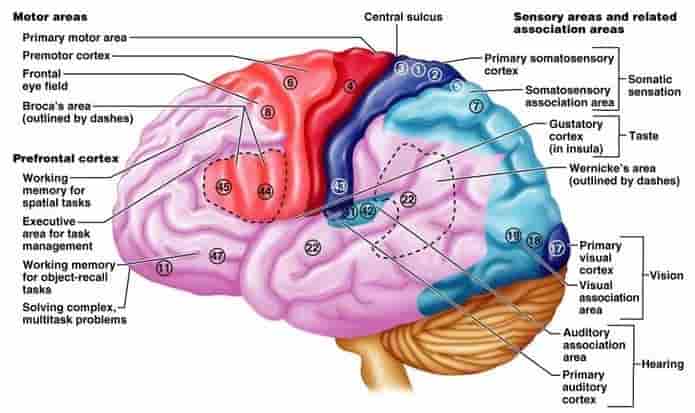
|
FRONTAL LOBE |
1. Primary motor cortex
2. Premotor cortex
3. Supplementary motor area
4. Frontal eye field
5. Broca’s motor speech area
6. Prefrontal area |
Brodmann’s area 4
Areas 6,8
Areas 6,8
Area 6,8,9
Area 44, 45
Area 9,10,11,12 |
|
|
PARIETAL LOBE |
i) Superior parietal lobule ii) Supramarginal gyrus iii) Angular gyrus |
Areas 3,1,2
Areas 5,7 Area 40 Area 39 |
|
|
TEMPORAL LOBE |
1.Primary auditory area
2. Auditory association cortex |
Areas 41, 42
Secondary auditory area OR area 22 |
|
|
OCCIPITAL LOBE |
1. Primary visual cortex
2. Visual association area |
Strike area, area 17
Secondary visual area OR area 18,19 |
|
Exam Important
- Locus coeruleus is the most important source of noradrenergic innervation to the cerebral cortex.
- Broca’s area is formed of two minor gyri, called pars opercularis and pars triangularis, that lie in the posterior end of the inferior frontal gyrus. This area subserves expressive language function.
- Area 8 (the frontal eye field) is concerned with eye movements.
- Spongiform degeneration of cerebral cortex occurs in Creutzfeldt-Jakob disease
- Trunk has small representation in somatosensory area of cerebral cortex
Click Here to Start Quiz

