
GUSTATION
GUSTATION/TASTE
- Main function of taste bud.
- Taste buds contain clusters of “Taste receptor cells”, supporting cells & basal cells.
- Found in tongue, epiglottis, palate & pharynx.
- In tongue, taste buds are grouped into structures called “Papillae”.
– Taste buds are located in papillary walls.
Types of papillae:
1. Fungiform papillae –

- Are especially numerous near tip & margins of tongue.
2. Circumvallate (Vallate) papillae –
- Largest papillae distributed in V-shaped region near base of tongue.
3. Foliate papillae –
- Confined to tongue’s back edge.
4. Filiform papillae –
- Have no taste buds.
PRIMARY TASTE SENSATIONS:
- All taste sensations result from various combinations of Sour, Salty, Sweet & Bitter.
SAPID SUBSTANCES:
- Are “Taste-producing substances”.
- Must dissolve in saliva to stimulate taste receptors.
1. SOUR TASTE:


- Caused by acids (H+ ions).
– More acidic food, sourer is taste.
- Edges of tongue are more sensitive.
- Sour substances depolarize taste cells by raising intracellular H+ion conc. —-> K+ channel closure.
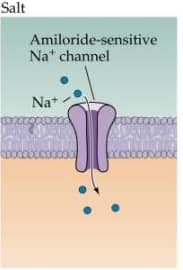
2. SALTY TASTE:
- Is elicited by ionized salts mainly by (cations) Na2+ concentration.
- Anterior half of tongue is more sensitive.
- Depolarize taste cells by activating amiloride-sensitive Na2+ channels.
3. SWEET TASTE:
- Produced by various classes of organic molecules.
- Tip of tongue is most sensitive.
- Mechanism of sensory transduction –
– G protein-coupled receptor.
– Leads to cAMP increase in sensory cells → K+ channels closure & depolarization.
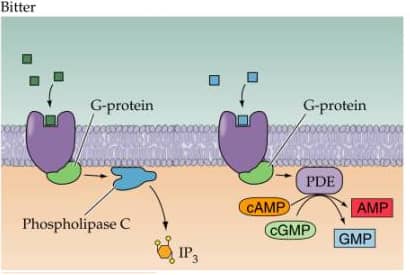
4. BITTER TASTE:
- Produced by long-chain organic substances containing nitrogen & by alkaloids (quinine & caffeine).
- Back of tongue is sensitive.
- Mechanism of sensory transduction –
– G protein-coupled receptors.
– Causes ↑ed intracellular Ca2+ by IP3-DAG system → Triggers neurotransmitter release.
5. UMAMI TASTE:
- Unique fifth taste.
- Acts through glutamate taste receptors with release of neuronal glutamic acid.
INNERVATION:
Taste buds:
- Innervated by branches of Facial, Glossopharyngeal & Vagus N.
Taste buds in Anterior 2/3rd of tongue:
- Innervated by“Branches of Facial N” (via Chorda tympani).
- Note: General sensation is by “Lingual nerve”.
Taste buds in Posterior 1/3rd of tongue:
- Innervated by “Glossopharyngeal nerve”.
Taste receptors in pharyngeal part of tongue, hard & soft palate & epiglottis:
- Innervated by “Vagus N”.
TASTE PATHWAY:

TASTE AREAS IN CEREBRAL CORTEX:
- Taste area I – Located in postcentral gyrus.
– Close to “Somesthetic representation of tongue”.
– Ie., Where “General sensations” of touch, pain & pressure/temperature project.
- Taste area II – In “Insular cortex”.
Exam Important
GUSTATION
- Fungiform papillae – Numerous near tip & margins of tongue.
- Circumvallate (Vallate) papillae – V-shaped region near base of tongue.
- Foliate papillae – Confined to tongue’s back edge.
- Filiform papillae – No taste buds.
- Edges of tongue are more sensitive to sour taste.
- Anterior half of the tongue is more sensitive to salty taste.
- Tip of tongue – Most sensitive to sweet.
- Back of tongue – Sensitive to bitter.
- Bitter taste receptors areG protein-coupled receptors.
- Salty-tasting substances depolarize taste cells by activating amiloride-sensitive Na2+ channels.
- Umami taste acts through glutamate taste receptors with release of neuronal glutamic acid.
- Taste fibers from anterior two third of tongue are carried by Facial nerve via Chorda tympani.
- Taste sensations from posterior 1/3rd of tongue are carried by Glossopharyngeal Nerve.
Don’t Forget to Solve all the previous Year Question asked on GUSTATION
Click Here to Start Quiz
Click Here to Start Quiz

