
Haemophilus influenzae
Which of the following is not permeable through the Blood Brain Barrier?
| A |
Water |
|
| B |
Lipophilic drugs |
|
| C |
Gas |
|
| D |
Proteins |
Which of the following is not permeable through the Blood Brain Barrier?
| A |
Water |
|
| B |
Lipophilic drugs |
|
| C |
Gas |
|
| D |
Proteins |
Ans. is. D. Proteins [Ref. Guyton 11/e p766; Ganong 23/e p572.1
Blood brain barrier:
- is highly permeable to
– water
– carbon dioxide
– oxygen
– most lipid-soluble substances such as alcohol and anaesthetics
- is slightly permeable to
– electrolytes such as sodium, chloride and potassium
- is totally impermeable to
– plasma proteins
– non-lipid soluble large organic molecules
Cause of blood brain barrier: The reason for the low permeability of the blood-brain barriers is the presence of tight junctions in between the endothelial cells of the brain capillaries. That is, the membranes of the adjacent endothelial cells are tightly fused rather than having large slit-pores between them, as is the case for most other capillaries of the body.
Also Know:
- Circumventricular organs
- They are named so as they are positioned around the margins of the ventricular system of the brain.
- Circumventricular organs are a group of areas of the brain which lie outside the blood brain barrier.
- Importance of being outside the blood brain barrier is that they have sensory receptors that respond to specific changes in the body fluids, such as changes in osmolality and in glucose concentration, as well as receptors for peptide hormones that regulate thirst, such as angiotensin II.
Circumventricular organs include the following:
- Subfornicial organ
- Organurn vasculosum of the lamina terminalis
- Median eminence
- Posterior pituitary(neurohypophysis)
- Subcommissural organ
- Pineal gland
- Area postrema
| A | Requires Factors X and V for growth | |
| B |
In CNS, mostly causes meningitis |
|
| C |
Outer membrane protein plays important role in pathogenesis in type ‘b’ H. influenzae |
|
| D |
Not a common cause for meningitis in less than 2 months of life |
- The polyribose phosphate capsule of type b H influenzae is the major virulence factor.
- H influenzae was the most common cause of bacterial meningitis in children age 5 months to 5 years.
- H influenzae is differentiated from related gram-negative bacilli by its requirements for X and V factors and by its lack of hemolysis on blood agar.
Also know:
- H influenzae does not grow on sheep blood agar except around colonies of staphylococci (“satellite phenomenon”).
- H influenzae does not produce exotoxin.
Ref: Brooks G.F., Carroll K.C., Butel J.S., Morse S.A., Mietzneron T.A. (2010). Chapter 18. Haemophilus, Bordetella, Brucella, & Francisella. In G.F. Brooks, K.C. Carroll, J.S. Butel, S.A. Morse, T.A. Mietzneron (Eds), Jawetz, Melnick, & Adelberg’s Medical Microbiology, 25e.
Which among the following is NOT TRUE about H. influenzae?
| A |
Requires factor X and V for growth |
|
| B |
Rarely presents as meningitis in children less than 2 months of age |
|
| C |
Capsular polypeptide protein is responsible for virulence |
|
| D |
M.C invasive disease of H influenza is meningitis |
H.influenzae is a small gram negative, non motile, non sporing bacilli. The accessory growth factors named X & Y present in blood are essential for growth.
Factor X(hemin) —> It is required for synthesis of cytochrome. Factor V (NAD) – It is essential for oxidation de adenine dinucleotide reduction.
There are 3 main antigens:capsular polysaccharide, outer membrane protein, lipooligosaccharide.
Influenzae does not secrete any exotoxins, the polysaccharide capsule is considered to be the major factor in virulence.
There are “6” types of capsule designated a, b, c, d, e and f of these type “b” is commonly associated with invasive Haemophilus influenzae disease in children. The capsular PRP antigen of Hib induces IgA, IgM, IgA antibodies which are bactericidal, opsonic & protective.
| A |
‘IVY protein |
|
| B |
Capsular polysaccharide |
|
| C |
Catalase |
|
| D |
Coagulase |
Ans. is `b’ i.e., Capsular polysaccharide
All of the following are true regarding Haemophilus influenzae except –
| A |
It can be a part of the normal flora in some persons |
|
| B |
The serotyping is based on the bacterial outer membrane porteins |
|
| C |
It requires Haemin and NAD for growth in culture medium |
|
| D |
Type b is responsible for invasive disease |
Ans. is ‘b’ i.e., The serotyping is based on the bacterial outer membrane protein
. The major antigenic determinant of capsulated strains is the capsular polysaccharide based on which H. influenzae strains have been classified into six capsular types – types a to f.
. H. influenzae strains lacking a capsule can not be typed and are called non typable strains.
About other options
Option ‘a’
“Non typable strains colonize the upper respiratory tract of up to three-fourth of healthy adults”
Option `b’
. The accessory growth factors, named X and V present in blood are essential for growth.
. The X-factor is hem in or other porphyrins required for the synthesis of cytochrome and other heme enzyme such as catalase and peroxidase involved in aerobic respiration.
. The V factor is a coenzyme, nicotinamide adenine dinucleotide (NAD) or (NADP) which acts as a hydrogen acceptor in the metabolism of the cell.
Option
. Diseases due to H. influenzae may be considered under two groups invasive and noninvasive diseases.
. Group ‘b’ (Hib) accounts for 95% cases of invasive disease.
| A | Haemophilus influenza | |
| B |
Streptococcus haemolyticus |
|
| C |
Pasturellamultocida |
|
| D |
Cornybacterium diphtheria |
Ans. is ‘a’ i.e., Haemophilus influenza
Acute bacterial rhinitis is most commonly seen among children, but adult may develop the condition after nasal trauma, viral upper respiratory tract infection, or surgery.
- The clinical presentation of acute bacterial rhinitis may be identical to that of common cold.
- Most common causative organisms include S. pneumoniae, H. influenzae and Moraxella Catarrhalis.
Note: Overall, most common cause of infective rhinitis is viral infection (viral rhinitis).
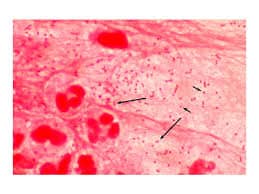
| A |
Requires factor X and V for growth. |
|
| B |
Rarely presents as meningitis in children less than 2 months of age. |
|
| C |
Capsular polypeptide protein is responsible for virulence. |
|
| D |
M.C invasive disease of H influenza is meningitis. |
The organism shown in the photomicrograph above represents H. influenzae.
H.influenzae is a small gram negative, non motile, non sporing bacilli. The accessory growth factors named X & Y present in blood are essential for growth.
Factor X(hemin) —> It is required for synthesis of cytochrome. Factor V (NAD) – It is essential for oxidation de adenine dinucleotide reduction.
There are 3 main antigens:capsular polysaccharide, outer membrane protein, lipooligosaccharide.
Influenzae does not secrete any exotoxins, the polysaccharide capsule is considered to be the major factor in virulence.
There are “6” types of capsule designated a, b, c, d, e and f of these type “b” is commonly associated with invasive Haemophilus influenzae disease in children. The capsular PRP antigen of Hib induces IgA, IgM, IgA antibodies which are bactericidal, opsonic & protective.
A 5 year old boy presented with sudden onset of fever, dysphagia, drooling, muffled voice, inspiratory retractions, cyanosis and soft stridor.On X ray of neck,the following is seen.Which is the most common causative organism of this condition?

| A |
Staphylococcus aureus. |
|
| B |
H influenza. |
|
| C |
Streptococcus. |
|
| D |
Pseudomonas. |
Ans;B.)H.influenza.
The condition shown in the X-ray above represents Acute Epiglottitis.
Enlarged epiglottis in epiglottitis is stubby like thumb instead of its usual thin finger projection.(Thumb Sign)
ACUTE EPIGLOTTITS
- It is an acute inflammation of epiglottis with inflammatory edema of hypopharynx.
- H.influenzae Influenza Type B is the most common causative organism.
- Other organisms are – Pneumococci, Streptococcus pyogenes, N.meningitidis, Staphylococcus.
CLINICAL FEATURES OF EPIGLOTTITIS
- Onset is sudden.
- Most common in 2 to 7 years of age.
- Symptoms are fever, dysphagia, drooling, muffled voice, inspiratory retractions, cyanosis and soft stridor.
- Patients often sit in sniffing dog position.
- Complications:
- The main complication is death from respiratory arrest due to acute airway obstruction.
- Other complications are rare but include epiglottic abscess, pulmonary edema secondary to relieving airway obstruction and thrombosis of internal jugular vein (Lemierre’s syndrome)
DIAGNOSIS AND TREATMENT OF EPIGLOTTITIS
- Laryngoscopy-“Cherry red” swollen epiglottis is seen.
- Acute Laryngeal Spasm may occur during Indirect Laryngoscopy.
- Radiograph – Culture of blood and secretions covering Epiglottis
- A plain lateral soft tissue radiograph of neck shows the following specific features
- Thickening of the epiglottis—the thumb sign
- Absence of a deep well-defined vallecula—the vallecula sign
- A plain lateral soft tissue radiograph of neck shows the following specific features
- Treatment
- Immediate endotracheal intubation.
- IV antibiotics to cover H.influenzae.
- The antibiotic of choice in acute epiglottitis pending culture sensitivity report is Ampicillin or 3rd generation Cephalosporin like Ceftriaxone.

| A | Staphylococcus aureus | |
| B |
E. coli |
|
| C |
Hemophilus influenzae |
|
| D |
Klebsiella pneumoniae |
Ans:C.) Hemophilus influenzae
Spleen is shown in the image marked by ‘A’
- An overwhelming post-splenectomy infection (OPSI) is a rare but rapidly fatal infection occurring in individuals following removal of the spleen.
- The infections are typically characterized by either meningitis or sepsis, and are caused by encapsulated organisms: Streptococcus pneumoniae, Salmonella typhi, Neisseria meningitidis, E. coli, Hemophilus influenzae, Streptococcus agalactiae, Klebsiella pneumoniae).
- Vaccination for pneumococcus, H. influenza and meningococcus should be given pre-operatively if possible to minimize the chance of overwhelming post-splenectomy infection
